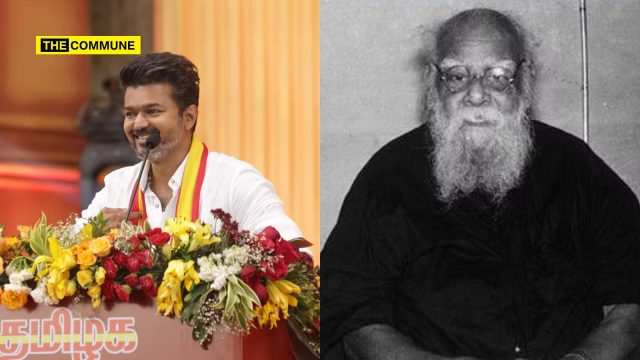
TVK chief Vijay’s speech at a public meeting in Erode on December 18, praising EV Ramasamy Naicker (hailed as Periyar by his followers) as a central force behind constitutional changes on reservation and as a foundational policy influence, has drawn sharp criticism from sections of Dalit activists, historians, and political commentators.
In his address, Vijay described EVR as a reformer who led agitations that resulted in amendments to constitutional provisions on reservation and said his movement sought class-based proportional representation. He said, “Let us talk about a hero from the 19/20th century. If there is a hero who is known for being an Iron Man – yes, it is our Erode crowbar (kadapparai) – A reform lever who has turned the entire state of Tamil Nadu upside down. Born in Erode district, he was the one who led the protest across India to amend the constitutional provisions related to reservation for the oppressed. Who is that? Our Thanthai Periyar. 100 years ago, he asked for class-based proportional representation. Whether it is then or now, he is one whom we look at with astonishment. Our policy leader. We took all the policies that we want from Periyar. We have also taken the policies followed by Anna and MGR who followed him.”
However, critics argue that Vijay’s remarks compress a long and complex history into a singular narrative and overlook a body of statements and positions attributed to EVR that they say were hostile to Dalit political and social aspirations.
Why Is Vijay Wrong?
Vijay’s claim that EVR singularly led the push for constitutional change compresses a complex history. The First Constitutional Amendment (1951), which introduced Article 15(4) to protect reservations after the Champakam Dorairajan verdict, was indeed influenced by EVR’s agitations. However, historians stress it was the result of pressure from multiple movements, regional governments, and leaders, not a one-man campaign.
The Omitted History: EVR Vs Dalit Leaders
The more significant omission in Vijay’s speech is the historical record of EVR’s frequent opposition to independent Dalit mobilization. Scholars and Dalit intellectuals highlight a pattern:
Ridicule Of Dalit Demands: EVR openly mocked early 20th-century Dalit leaders like MC Rajah and Ayothidasa Pandithar for focusing on education and government jobs, once stating that asking for jobs and education from the government was “a shame.”
The Keezhvenmani Silence: After 44 Dalit landless labourers were burnt alive by landlords in Keezhvenmani in 1968 for demanding higher wages, EVR famously refused to condemn the caste atrocity. Instead, he admonished labourers to accept the wages offered, dismissing the caste-violence angle.
Contempt For Dalit Progress: In writings for Kudiarasu, he complained that the rising price of clothing was due to Dalit women starting to wear blouses, a symbol of their social mobility.
Antagonism Towards Ambedkar: EVR viewed Dr BR Ambedkar, the architect of the Indian Constitution and Dalit emancipation, with suspicion, once labelling him an “agent of the North Indian Brahminical Congress Party.”
A Selective Hero For Political Legitimacy
Vijay’s speech, by presenting EVR as an unblemished hero of social justice, appears to be an attempt to claim the potent legacy of Dravidian social justice politics for his nascent party. However, it does so by offering a sanitized version of history.
Vijay seems to engage in a classic political maneuver: appropriating a symbolic figure while erasing the uncomfortable parts of his legacy. To claim Periyar’s mantle without addressing his documented conflicts with Dalit assertion creates a paradox. It appeals to a section of OBCs while hoping Dalits overlook both history and present alliances.
The speech, therefore, serves less as a history lesson and more as a strategic political pitch, one that seeks to anchor the TVK in Tamil Nadu’s dominant political narrative but may struggle to reconcile with the full, and often difficult, historical record of the figure it seeks to celebrate. By ignoring EVR’s fraught relationship with Dalits – the oppressed, the narrative risks perpetuating the very social fissures the Dravidian movement claims to have resolved.
Subscribe to our channels on WhatsApp, Telegram, Instagram and YouTube to get the best stories of the day delivered to you personally.