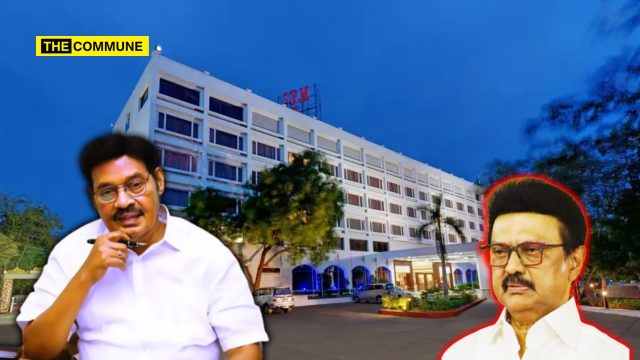
With the Madras High Court’s August order clearing the decks for repossession, holding that SRM had no automatic right to lease renewal and had run up nearly ₹40 crore in arrears, Tamil Nadu Tourism Development Corporation, on Wednesday, 22 October 2025, took physical possession of Trichy’s SRM Hotel.
The move follows last year’s failed first attempt (stayed briefly by the Madurai Bench) and will inevitably be read through a political lens in the central region, since SRM chief TR Paarivendhar fought the 2024 Lok Sabha election from Perambalur on the BJP side against KN Arun Nehru, son of DMK heavyweight KN Nehru.
Legally, the State stands on firm ground after the division bench
ruling; politically, the optics invite “vendetta-by-procedure” allegations unless TTDC now publishes comparable action across all delinquent leases to show parity.
The Political Shadow Everyone Sees
In 2024, T.R. Paarivendhar, founder of SRM and of Indhiya Jananayaga Katchi (IJK), pitched his tent with the BJP-led alliance and contested Perambalur. His opponent? KN Arun Nehru, a sitting DMK MP and son of powerful minister KN Nehru, went on to win and now holds that seat. Those are not conspiracy dots; they’re electoral facts that frame public perception.
So, when TTDC, a State PSU under a DMK government, pushes hard on a high-visibility SRM asset in Trichy, right after a bruising Lok Sabha face-off in the same belt, citizens don’t need wild imagination to suspect vendetta-by-procedure, even if the file has a legal backbone.
What Did The State Get Right?
In fairness to the State, three facts strengthen its legal hand: the SRM–TTDC lease never guaranteed renewal, and the Madras High Court’s division bench has now affirmed that any extension was purely at the government’s discretion; the record also shows substantial unpaid lease dues, reported at about ₹38–39 crore, so pressing for repossession protects public revenue; and the appellate ruling did more than green-light possession, it expressly overturned the earlier single-judge relief and even deleted adverse observations against the administration, signalling that TTDC’s course of action complied with law.
What Is The State Getting Wrong?
Optics matter in a democracy. When a government that loudly touts TTDC’s “revivals” and revenue wins statewide suddenly stages its most telegenic force-eviction around a politically inconvenient landlord in KN Nehru’s backyard, the rule-of-law narrative starts to sound like score-settling.
If arrears are the driver, the administration should publish asset-wise arrear data for all TTDC leases over the last decade – dues assessed, payments made, notices issued, litigation status, and repossessions, to show SRM wasn’t singled out.
Until the State releases comparable numbers on how many other expired, non-paying leases saw equally swift, police-backed takeovers, the charge of selective zeal will linger despite the legal footing, especially given how frequently TTDC has publicized revenue gains and new initiatives in recent months.
Shailendar Karthikeyan is the Editor of Nyayavimarsha.
Subscribe to our channels on Telegram, Instagram and YouTube to get the best stories of the day delivered to you personally.