


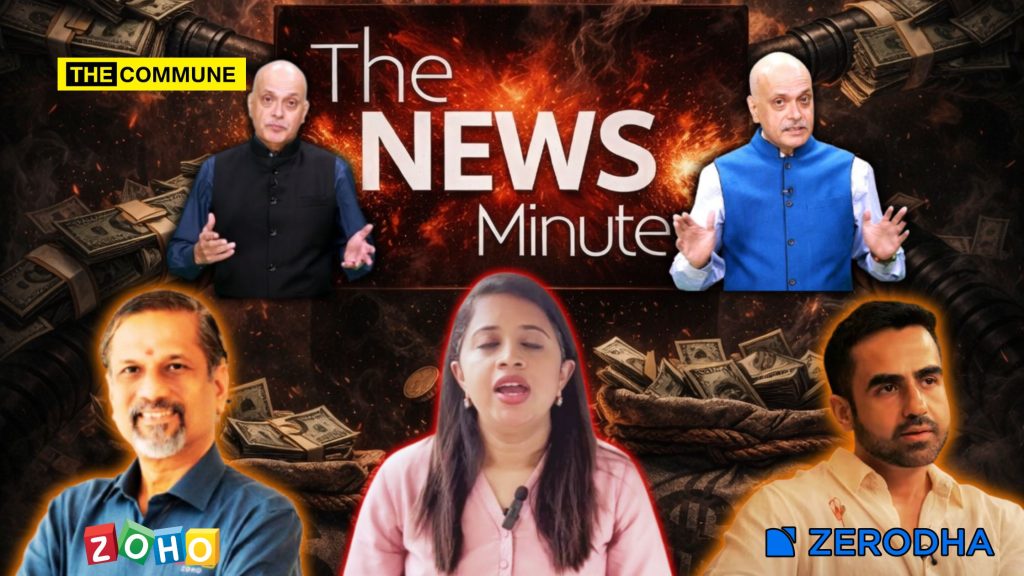
The News Minute published a hit job article of Zoho founder Sridhar Vembu. based on US court proceedings that came out a year ago in January 2025.
A few months ago, in October 2025, TNM went after Nikhil Kamath – co-founder of Zerodha.
With the hitjob on Vembu, one can safely say that The News Minute is going after entrepreneurs, people who are generating employment and wealth and taking the country forward.
The News Minute writes these pieces as if it is an ‘independent’ media doing truthful ‘journalism’.
But did you know that The News Minute received an ‘undisclosed’ amount as funding from its investor Quintillion Media whose founders Raghav Bahl and Ritu Kapoor have been accused of corruption and money laundering?
Who Is Raghav Bahl?
Bahl co-founded Quintillion Media Pvt Ltd and currently promotes Quint Digital Media Limited, controlling thequint.com.
In October 2018, the Income Tax Department of India raided The Quint’s offices and Raghav Bahl’s residence as part of an investigation into an alleged case of tax evasion. The raid was officially referred to as a survey by the Income Tax officers.
Not just that. According to PMC Fincorp MD Raj Kumar Modi’s statement to tax officials, Raghav Bahl and Ritu Kapur allegedly invested about ₹3.03 crore in PMC Fincorp at around ₹5.50 a share, saw the price shoot up to roughly ₹848 despite no real business activity, and then sold the shares to seven Kolkata-based shell companies, booking over ₹100 crore in bogus long-term capital gains and turning unaccounted cash into “white” money; Modi further claims Bahl’s chartered accountant handed him ₹100 crore in cash for this purpose and that he took about a 1.5% commission on the amount converted.
In 2019, media owner Raghav Bahl faced money laundering accusations by the Enforcement Directorate for allegedly understating a London property’s investment value by GBP 2.73 lakh (around ₹2.45 crore) and failing to explain the source of funds. Bahl’s properties were raided previously, prompting him to release details. His assets, including a London flat, were declared in income tax filings under the Liberalised Remittance Scheme.
In August 2023, the Delhi High Court temporarily lifted a lookout circular (LOC) against Raghav Bahl and his wife Ritu Kapur, allowing them to travel abroad for business meetings amidst the Enforcement Directorate’s (ED) money laundering probe. The High Court had earlier dismissed Bahl’s plea to quash the ED’s complaint, deeming it premature, and rejected his request to annul the LOC, granting only conditional travel permissions. Kapur’s plea against the ED probe is pending, asserting her non-involvement under the Black Money Act. The Income Tax Department initiated proceedings against Bahl under the Black Money Act, followed by the ED’s complaint under the Prevention of Money Laundering Act.
Yes, it is true that some start-ups do not disclose the amount raised as capital. However, since The News Minute portrays itself to be a transparency champion and claims itself to be doing journalism for public good asking readers to pay for ‘good journalism’, shouldn’t the ‘undisclosed amount’ of funding it received be disclosed?
Are they being funded by laundered money?, is a question to be asked to The News Minute that lectures on accountability, justice and what not!
Now let us take a quick look at both the ‘exclusive’ pieces – both paywalled to fleece money.
Sridhar Vembu – Character Assassination, Ambiguity & Half-Truths
In Sridhar Vembu’s case, TNM builds its entire narrative on a pre-trial California order issued nearly a year ago, in January 2025, on an emergency application in an acrimonious divorce, treating it like a final judgment on character. Vembu’s counsel has since stated that the order was passed under severe time constraints, based on outrageously false allegations, and that subsequent proceedings, including appellate review, have already stayed the receivership and questioned the absurdity of the USD 1.7-billion bond figure, as mentioned by his counsel.
According to Vembu’s counsel, the bond order, now under appeal has no legal basis, is impossible to comply with, and was acknowledged by a subsequent judge as appearing excessive, with the receivership itself stayed pending appellate review.
TNM’s piece quotes every damaging adjective in that order – “without regard for the law”, “duplicitously”, “moving assets out of the US” while downplaying three basic facts that the case is ongoing, discovery and valuation are still being contested, and such aggressive interim measures are common in high‑net‑worth divorces involving offshore structures.
It never asks what any decent lawyer would: how often do US courts use huge bonds and receiverships as leverage in complex divorces, and how frequently are those orders modified or narrowed later. The ambiguity is inconvenient, so it is erased.
The piece uses the USD 1.7‑billion figure as the headline hook. TNM presents it as proof of extraordinary guilt while refusing to explain what a bond is. Bonds secure potential claims: they are not fines, settlements, or alimony awards. Non‑payment does not automatically prove hidden billions or fraudulent intent – it can simply mean the court has pegged security to notional global enterprise value rather than liquid assets actually within reach.
This distinction is central to the story. TNM avoids it because nuance blunts outrage.
In the same piece on Vembu, several crucial points are still disputed. It is not clear whether Zoho’s IP was really sold for USD 50 million, whether that amount was actually paid, whether Vembu’s true economic interest is 5% or higher and whether early‑2010s restructurings were legitimate corporate housekeeping or deceptive.
The court has doubts. Doubt is not adjudication. Yet the piece stitches together allegations, judicial scepticism and interim language into a single, seamless narrative of wrongdoing. The reader is never clearly told which parts are proven, which are inferred, and which are simply what one angry spouse alleges. TNM’s piece uses ambuiguity as its fuel.
Moreover, it is someone’s personal life – would they be fine if media goes after their founders’ personal lives and wealth?
Nikhil Kamath – Use Random Minor Incidents To Accuse
The Nikhil Kamath profile published (incidentally by the same author – Indulekha Aravind, follows the same playbook, with a different surface. Here the target isn’t a divorce order (sadly for them) but a curated “simple billionaire” persona. The article creates a persona about his middle-class upbringing, his brother, his podcast soundbites, his references to Carl Jung, Rene Girard, “mimetic theory”, reading habits and then tries to puncture them with a handful of quotes about poverty and caste, some sloppy analogies, and the 2021 chess‑cheating scandal.
The cheating against Viswanathan Anand on Chess.com was real and indefensible. Kamath admitted to using computer assistance and was banned. That should be a tight, contained story about personal ethics. TNM treats it as proof that everything about him is suspect.
What’s missing is revealing:
No evidence that Kamath or Zerodha fabricated titles or falsified formal achievements; even the article concedes that there is a FIDE record and that a grandmaster recalls playing “Nikhil Kamat” in an Asian Junior event.
No serious attempt to show that his supposed superficiality on social questions has translated into regulatory violations, client harm, or SEBI action.
No concrete case where Kamath lied to regulators, investors, or customers in the way he lied on a charity chessboard.
Instead, like with Vembu, TNM works backwards from conclusion to evidence: the man is suspect, therefore his success must be recast as performance.
Data When Convenient, Silence When Inconvenient
With Vembu, TNM scrutinizes every sentence of a family‑court order but never interrogates how asset‑holding structures are standard in founder‑led global firms. It never confirms facts with independent corporate lawyers to ask whether routing IP through relatives or long‑time co‑founders is inherently unlawful or simply common tax and control planning that can become contested during divorce.
With Kamath, it spends paragraphs on vibe – podcast tone, book references, “carefully crafted persona” but never digs into Zerodha’s actual market conduct, risk disclosures, or complaint record. If TNM is claiming that Indian founders are gaming the system, the first place to examine is the system itself. TNM keeps the spotlight on optics instead.
The Same Pattern: Pick The Man, Then Build The Case
The pattern for every such hitjob is the same – hard to miss.
Start with a business owner whose politics, public piety or rural‑India rhetoric do not fit into TNM’s narrative. If they have been seen with PM Modi, they rank higher on the list. If they have praised PM Modi, yeah, they get to be at the top of the list.
Then they go digging through court orders, online platforms, and old interviews, pulling out whatever sounds most damaging on its own be it a judge’s passing remark, a cheating ban on a chess site, or an offhand comment about slums or caste.
These bits are then stitched together into a long story that leans heavily in one direction. Every unclear point is read against the person being written about, and facts that don’t fit the narrative are quietly ignored. The final product is placed behind a paywall and sold as an “investigation” or an “extensive profile”.
This does not mean that Sridhar Vembu is necessarily right in his divorce case, or that Nikhil Kamath’s cheating incident was insignificant – Vembu’s marital dispute is a private matter still under adjudication, and Kamath was banned and penalised for his actions. That is where those stories should reasonably end.
What TNM does is turn personal disputes and individual lapses into sweeping judgments about legitimacy and character. They are narratives built to suggest that a flaw in one sphere disqualifies a person in all others.
When so-called ‘investigative journalists’, have to rely on private matters (gossip) and minor errors into material for larger political or ideological fights, it stops doing its job. It is obvious they are taking sides. The real issue here is not that Indian founders have flaws, that is hardly surprising, everyone is flawed. But the real issue is that a platform claiming moral authority has built a habit of turning those flaws into sellable outrage, while staying safely within the limits of what the evidence can actually prove.
Subscribe to our channels on Telegram, WhatsApp, and Instagram and get the best stories of the day delivered to you personally.