


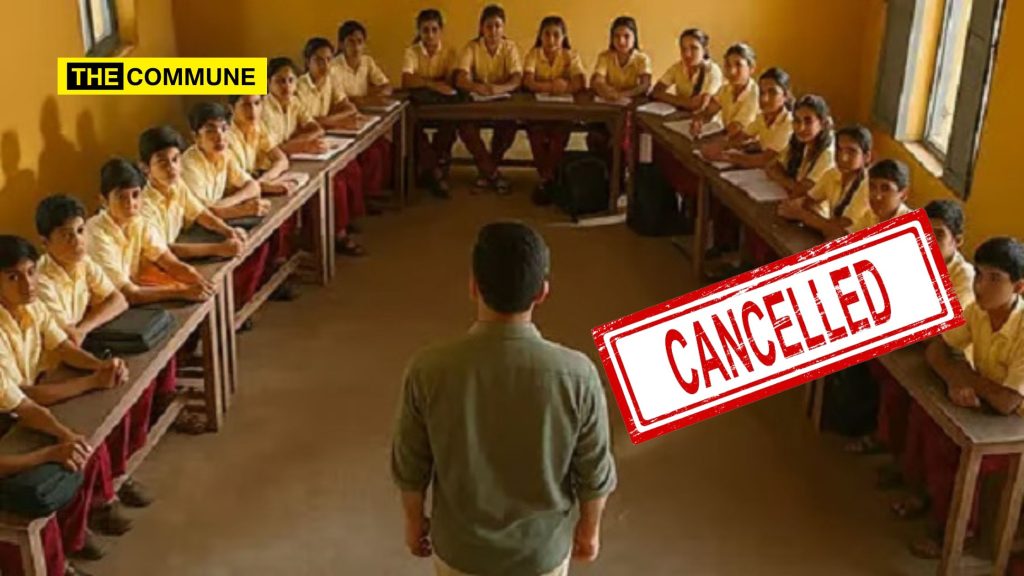
The Tamil Nadu School Education Department has suspended its newly introduced directive to reorganize classroom seating in a ‘ப’ (Pa)-shaped format, following concerns raised by medical experts, educators, and the general public.
ப வடிவில் இருக்கை வசதி
நிறுத்தி வைத்தது தமிழக அரசு #schools | #Government | #Ushapedseating | #Keralaschoolshttps://t.co/y4W3uzOWeZ pic.twitter.com/5QpQtslopA— Dinamalar (@dinamalarweb) July 13, 2025
The Tamil Nadu School Education Department’s recently announced “no backbencher” seating model has sparked debate among health experts and educators, with calls for caution over its long-term physical and psychological impact on students. The semi-circular “ப” (Pa)-shaped seating arrangement, introduced to promote inclusivity and engagement, is now under scrutiny for potential ergonomic and logistical issues.
The experimental seating design, inspired by the Malayalam film Sthanarthi Sreekuttan, was intended to eliminate the perceived hierarchy of frontbenchers and backbenchers in classrooms. First implemented at Ramavilasom Vocational Higher Secondary School in Valakom, Kerala, the model had students seated along the walls of the classroom or in a semi-circle, ensuring equal visibility and proximity to the teacher. The concept gained traction after the film portrayed a student’s frustration at being sidelined on the backbench, eventually leading to a classroom design where all students felt equally seen and heard.
Kerala’s innovation quickly caught the attention of neighbouring Tamil Nadu, where the School Education Department issued a circular (Rc.No. 0043/ M/S 1/2025), directing headmasters of government middle schools to arrange classroom seating in a “ப”-shaped format. Officials said the model would be piloted in classes with fewer than 35 students across approximately 8,000 government middle schools.
The directive described the new layout as a tool to promote engagement, visual equality, and interactive teaching. According to the circular, the U-shaped model (similar to the Tamil letter “ப”) would encourage eye contact, class participation, and peer learning. “When every voice can be seen and heard, learning becomes a conversation, not a lecture,” it stated, urging classrooms to become “circles of trust, engagement, and shared learning.”
No more backbenchers in Tamil Nadu too? pic.twitter.com/iUv7jXCnBL
— Thinakaran Rajamani (@thinak_) July 12, 2025
However, within days of the announcement, the move drew concern from educationists and health professionals. The Indian Association of Physiotherapists (Tamil Nadu Branch) issued a public statement warning of the physical health risks posed by such a layout, particularly for young students.
In the statement, Dr. V. Krishnakumar, State President of the association, noted that students seated along the curved arms of the “ப” configuration would be required to repeatedly twist their necks and spines to face the teacher or blackboard. This, he said, could lead to cervical strain, muscular imbalance, lower back discomfort, and hip rotation stress—especially in children during their developmental years.
“Twisted trunk postures and asymmetrical viewing angles can cause early postural fatigue,” the statement read, also warning of increased risks of torticollis (neck muscle tightness) and cervicogenic headaches. The association cited global ergonomic guidelines, including those by the WHO and International Ergonomics Association, which recommend symmetrical body alignment and frontal viewing angles for classroom seating.
In addition to physiological concerns, experts flagged psychosocial issues. Constant visibility in a semi-circular setup, they argued, may cause anxiety in introverted or neurodivergent children who may prefer a degree of visual privacy.
Mixed reactions to the 'No more backbenchers' instructions.
Press Release from The Indian Association of Physiotherapists, Tamil Nadu Branch
Tamil Nadu’s Education Department recently announced the elimination of traditional “Back Benches” in government schools by introducing… https://t.co/cBn71M5bSL
— Thinakaran Rajamani (@thinak_) July 12, 2025
The seating arrangement also raised logistical challenges in overcrowded classrooms. The new design, critics said, restricted movement, limited space for students with disabilities, and potentially reduced the teacher’s ability to monitor and interact with all students evenly.
The Federation of Private School Associations echoed these concerns, urging the government to reconsider the plan before wide-scale implementation. “This arrangement can accommodate only a few students and may cause eye-related issues due to frequent head turning,” said Federation President M. Arumugam, as told to Times Of India.
Following these expert assessments and the mixed reactions from educators, the Tamil Nadu School Education Department has now quietly withdrawn the seating directive. Sources within the department confirmed that further implementation has been paused and that no new instructions will be issued until a comprehensive review, including consultations with health and education professionals, is conducted.
Subscribe to our channels on Telegram, WhatsApp, and Instagram and get the best stories of the day delivered to you personally.