


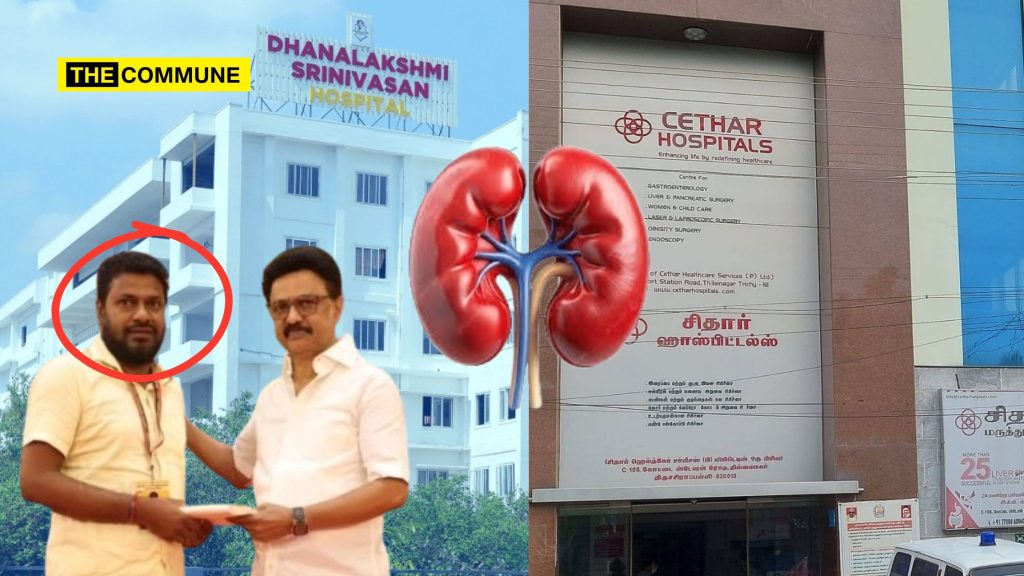
An official investigation into the TN kidney trafficking scandal mainly centered in Pallipalayam, Namakkal district has exposed major irregularities in organ transplant procedures carried out at two private hospitals Dhanalakshmi Srinivasan Hospital in Perambalur and Cethar Hospital in Trichy. The detailed report, recently submitted by a government-appointed committee, confirms that kidney transplants were performed using fraudulent methods and recommends strong action against the institutions involved.
Key Findings and Recommendations
Following alarming reports of poor laborers being exploited for their organs, particularly power loom workers from Namakkal, the Tamil Nadu government initiated a probe on 22 July. The committee, headed by Health Project Director Vineeth and including senior health officials like Dr. Marimuthu and Dr. Meenakshi Sundari, investigated the suspected illegal kidney transplant operations.
Their findings revealed blatant violations of the Human Organ Transplantation Act, 1994. It was discovered that documents for kidney donation and transplant surgeries were improperly prepared. Private hospitals collaborated with brokers to illegally obtain organs from impoverished donors in exchange for money. Transplant coordinators within the hospitals manipulated paperwork to legitimize the procedures. As a result, the committee has recommended revoking the transplant authorization granted to both hospitals and urged a full-scale investigation by the Directorate of Medical and Rural Health Services.
Involvement of Middlemen
The probe also identified two individuals Dravida Anandan and Stanley Mohan as brokers facilitating these unlawful transplants. The committee has advised filing FIRs and legal action under relevant sections of the BNS 2023 Act against them.
Structural Reforms Proposed
To prevent such exploitation in the future, the report proposes major structural reforms:
- Restructure the current District Accreditation Committees involved in organ transplant approvals.
- Establish one State-level Committee and four District-level Committees to oversee and regulate transplant procedures more effectively.
- The Directorate of Medical Education should develop and implement Standard Operating Procedures (SOPs) to ensure consistent and lawful operations across all approval committees.
- Make video-recorded interviews mandatory for all transplant approval applicants to enhance transparency.
- Enforce disciplinary measures against staff who approved surgeries without due diligence.
Additional Measures for Transparency and Accountability
- Hospitals must retain all medico-legal documents for 10 years, with a circular issued to the Revenue, Police, and Health Departments.
- Transplant forms should be made available in both Tamil and English to ensure better understanding among the public.
- All hospitals authorized to conduct transplants should display clear banners stating that organ donations must not be made in exchange for money or under coercion. These banners must also include contact details of the official to whom complaints can be reported.
Monitoring and Awareness Initiatives
- The Human Organ Transplant Approval Committee will be required to audit rejected cases biannually, under the supervision of the Director of Medical and Rural Welfare Services, and submit a consolidated report to the government annually.
- If a recipient cannot appear before the approval committee due to medical reasons, a video consultation must be arranged.
- District Collectors across Tamil Nadu have been asked to initiate awareness campaigns about the legal aspects of organ donation.
- Awareness workshops on the Human Organ Transplantation Act are to be organized across the four approved zones in the state.
(With Inputs from ETVBharat)
Subscribe to our channels on Telegram, WhatsApp, and Instagram and get the best stories of the day delivered to you personally.