


On 22 December 2025, ThePrint published a ‘ground report’ from the Tata Institute of Social Sciences after the ‘government takeover’ and they headlined it “‘Spies’ on campus, police, protests—the uneasy evolution of TISS after govt takeover”.
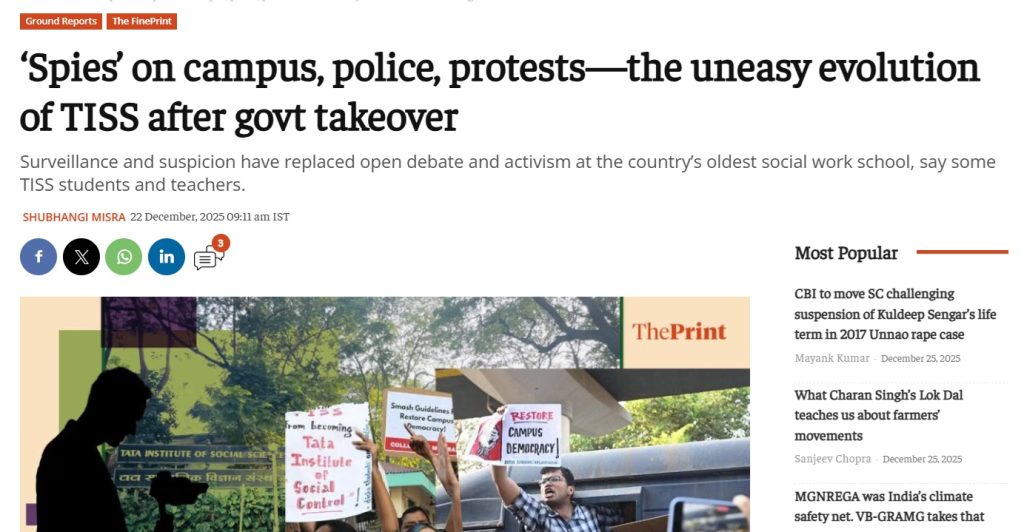

There are so many things wrong in the so-called report and it reeks of entitlement in so many ways. It is an open secret that TISS has been an ultra-leftist den for a very long time and only recently, the government took over the administration – not because of leftist reasons, but because in 2023 there were new UGC regulations that targeted deemed universities receiving over 50% funding from the Centre, and TISS was one of them.
Coming back to the ‘ground report’ – it presents itself as a neutral examination of institutional change at TISS. But when one reads the article closely, a deeply one-sided narrative conflating loss of ideological dominance with loss of academic freedom is revealed. This framing relies heavily on anecdote over evidence and normalises entitlement to subjective gatekeeping while portraying transparency reforms as repression.
Fear as a Premise, Not a Fact
The article opens like this – “A professor at TISS Guwahati has started to think twice before speaking in class. He’s wary of students making videos and then misrepresenting what was said.”
The reason offered is the possibility that students might record lectures and post clips online “out of context.” The article treats this fear as self-evident proof of repression, without asking a basic question: why would responsible classroom speech suddenly become risky only after accountability increased?
In any professional academic environment, measured language is expected. The article frames this newfound caution as a chilling of freedom, when it could just as plausibly reflect long-overdue professional restraint. ThePrint never interrogates this contradiction.
Screening Students or Screening Ideology?
One of the most revealing quotes comes from a TISS Mumbai teacher lamenting the removal of interviews and group discussions: “We knew exactly what kind of students were coming to our institute earlier; now we have lost that ability to screen students, maza nahi aa raha (the spark is gone).”
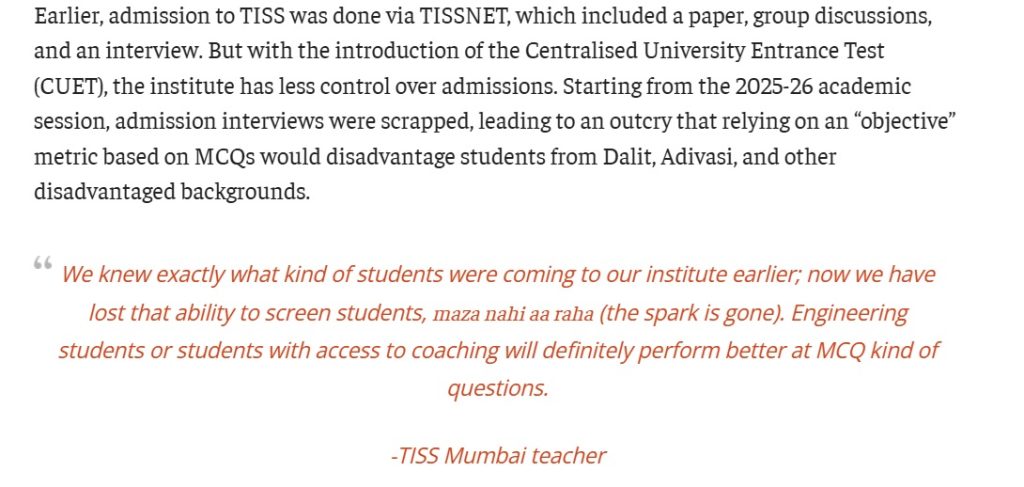

This statement is reported sympathetically, without scrutiny. ThePrint does not ask the obvious follow-up: screen students on what basis – academic preparedness or ideological alignment? In effect, the article normalises the idea that faculty should have discretionary power to filter entrants, even as it criticises standardised testing as exclusionary.
MCQs as “Casteist”? No Evidence Provided
ThePrint repeatedly amplifies the claim that CUET’s MCQ-based admissions are discriminatory to Dalit, Adivasi, and marginalised students.
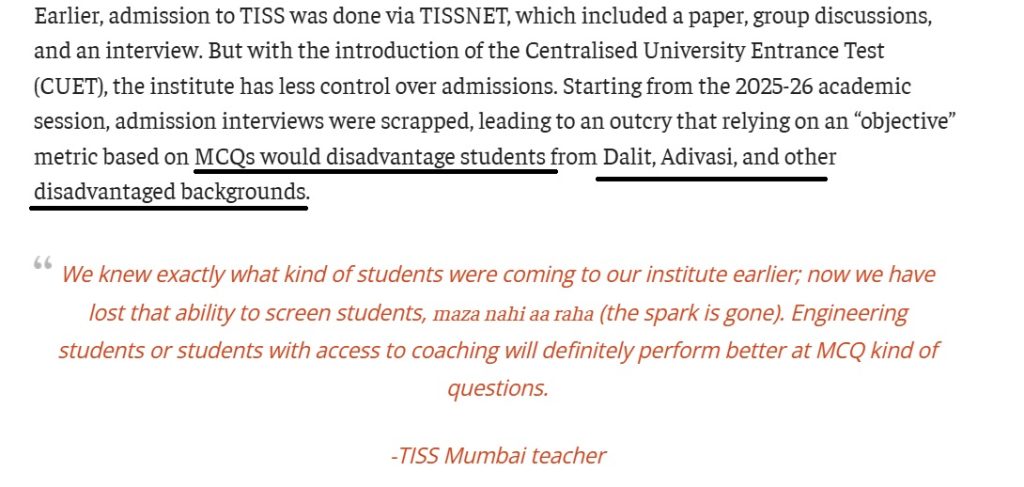
Yet the report provides no data, no study, no comparative evidence to support this assertion.
Instead, it quotes statements such as, “Engineering students or students with access to coaching will definitely perform better at MCQ kind of questions.”


This is presented as fact, not opinion. The article entirely ignores counter-arguments – that MCQs reduce interviewer bias, curb ideological filtering, and often benefit rural and first-generation learners by creating a level playing field.
“Saffronisation” as a Catch-All Accusation
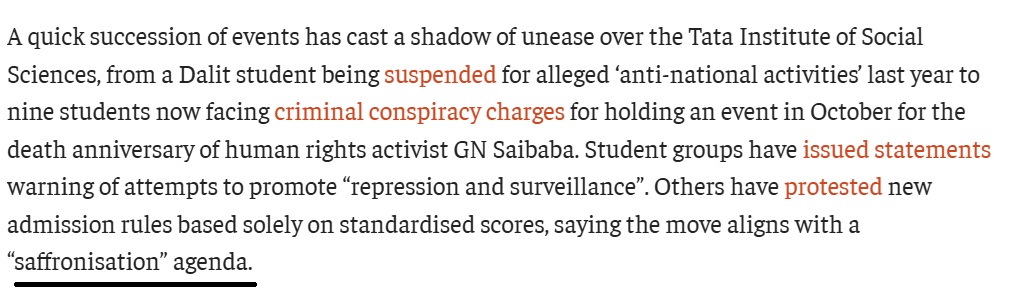
ThePrint allows the charge of “saffronisation” to be repeated across the article without substantiation. No policy document, directive, or institutional order is cited. The term functions as a political slogan, not an analytical category, yet is woven into the narrative as an established diagnosis.

Asymmetry in Political Activity
The report applies different moral standards to political expression on campus. Left-leaning activities such as BBC documentary screenings, memorials for GN Saibaba, protests against CAA and NEP are framed as “dissent” and “free speech.” Meanwhile, Right-leaning student activities are described as “aggressive,” “polarising,” or evidence of infiltration.
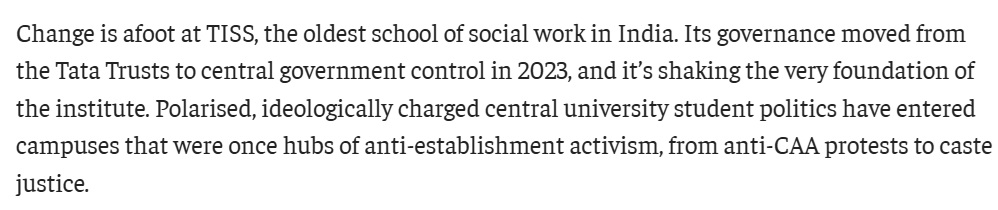

For instance, the article notes that screenings of films like The Kerala Files drew no action, but does not ask whether administrative neutrality should apply uniformly or only when Left-aligned activities are restricted.

The ‘Spy’ Narrative: Serious Claims, No Proof
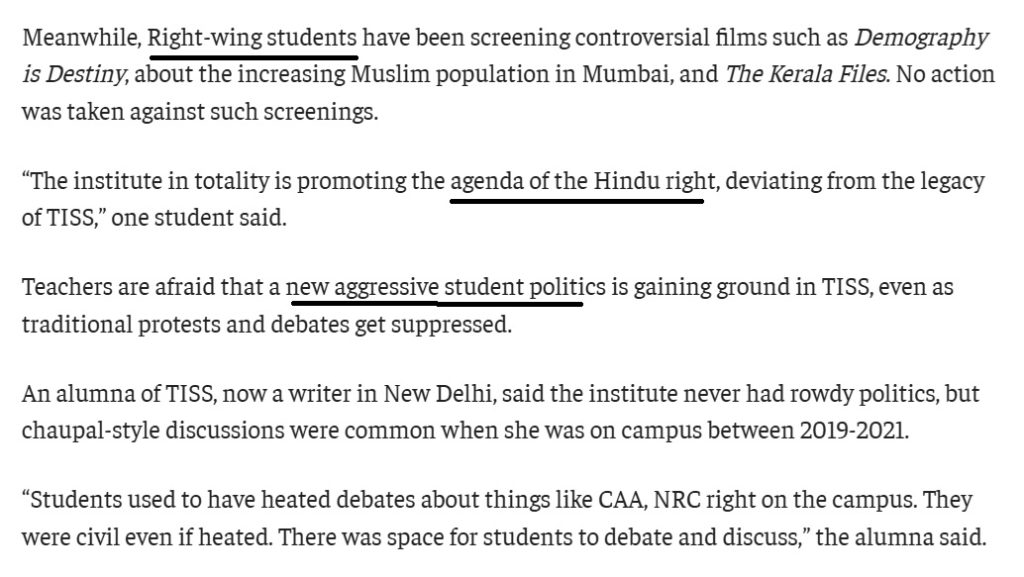
One of the article’s most sensational framings is the idea of “spies” on campus. Students and faculty allege that peers are reporting to BJP offices or RSS shakhas. These are grave accusations, yet ThePrint provides no names, documents, police records, or corroboration.
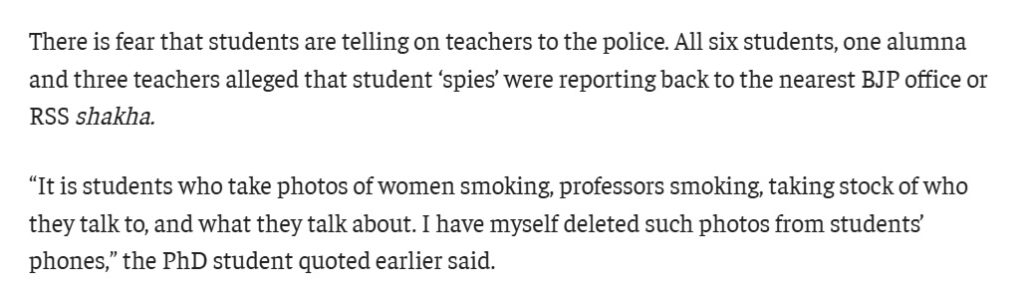

The administration’s denial is included but immediately undercut, with allegations allowed to stand as atmosphere-setting truths rather than claims requiring verification.
Romanticising the Past, Sanitising Conflict
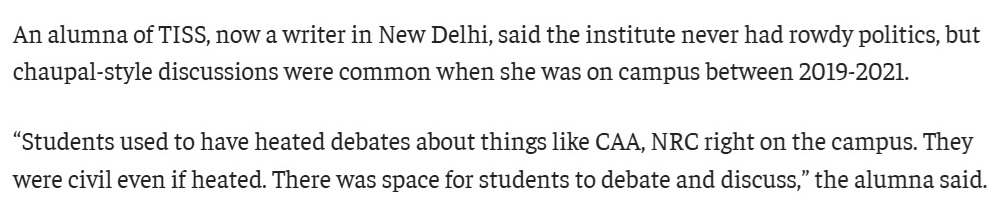
The article nostalgically portrays earlier campus politics as civil and healthy: “Students used to have heated debates… They were civil even if heated.”

Silence on Due Process
Nine students face criminal conspiracy charges related to a memorial event. ThePrint frames this almost entirely as victimisation, without examining the legal basis of the complaint, the sections invoked, or whether due process was followed.


The assumption of bad faith by authorities is implicit, not argued.
CUET’s Rationale Ignored
Notably absent is a serious engagement with why CUET was introduced at all: to reduce arbitrariness, end institution-specific gatekeeping, and widen access nationally. Instead, the reform is framed almost exclusively as an attack on TISS’s “ethos,” defined narrowly through the lens of those who previously controlled admissions.
A Narrative of Loss, Not Change
Throughout, the article treats the dilution of a particular ideological ecosystem as institutional decay. Anonymous critics dominate the narrative; administrative voices are brief and defensive. The result is a story less about TISS adapting to a new regulatory framework and more about who has lost cultural and political control of the campus.
Far from being a neutral ground report, ThePrint’s article reads as advocacy journalism, one that conflates transparency with repression, accountability with fear, and diversity of opinion with ideological threat. By privileging anecdote over evidence and framing reform as conspiracy, it projects institutional change as a moral collapse rather than a contested transition.
In doing so, it tells readers less about what TISS is becoming, and more about what a particular political-academic ecosystem fears it is losing.
Subscribe to our channels on Telegram, WhatsApp, and Instagram and get the best stories of the day delivered to you personally.