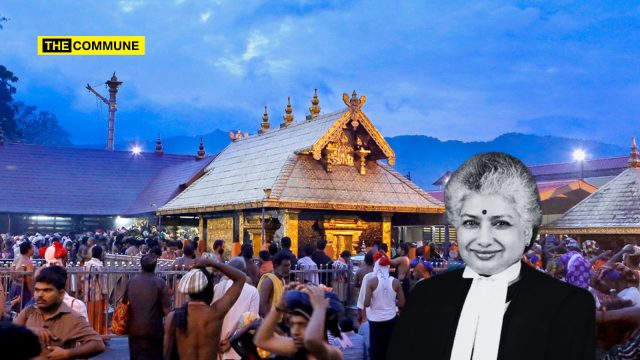
The recent observation by Justice BV Nagarathna during hearings related to the Sabarimala case, that a woman cannot be treated as “untouchable” for three days a month, raises a fundamental question: is the Court interpreting a religious practice, or redefining it through a modern constitutional lens without fully engaging with its theological context?
At the heart of the issue lies a critical distinction that the observation appears to blur: the difference between constitutional untouchability under Article 17 and ritual restrictions rooted in specific religious traditions.
Article 17 was designed to abolish caste-based discrimination – an oppressive, birth-based system that denied dignity and access to entire communities. To extend that definition to the Sabarimala practice risks conflating two entirely different frameworks: one of social exclusion, and the other of denominational religious observance.
The Sabarimala tradition, as defended by multiple stakeholders, is not a blanket prohibition on women. It is a specific, context-bound restriction tied to the nature of the deity, Lord Ayyappa, who is believed to be a naishtika brahmachari (eternal celibate). This is not a universal rule across Hinduism. In fact, there are hundreds of Ayyappa temples where women of all ages are allowed entry, a point repeatedly raised in legal and public discourse.
By framing the restriction as “untouchability,” the observation implicitly attributes social stigma to what adherents argue is a theological discipline. That leap, from ritual limitation to constitutional discrimination, is precisely where the critique emerges.
The Untouchability Argument Does Not Apply Here
Article 17 of the Constitution, which prohibits untouchability, was designed to dismantle caste-based social discrimination that denied people dignity, livelihood, and basic rights in public life. Applying it to a single temple’s deity-specific restriction is a significant legal stretch. As Solicitor General Tushar Mehta argued before the very bench that Justice Nagarathna sits on: “Sabarimala concerns only a particular age group… it is a sui generis case.” By equating the deity’s traditional practice with the centuries-old social evil of untouchability, Justice Nagarathna’s analogy, however emotionally resonant, conflates two fundamentally different legal and social phenomena.
Selective Constitutionalism?
Another layer of criticism stems from the inconsistency. If courts intervene in Hindu practices on grounds of equality and dignity, the question arises: should the same standard apply uniformly across all religions?
There are also several Hindu temples where men are not permitted entry, or where entry is restricted based on gender. For instance, the Brahma Temple places restrictions tied to specific rituals, while the Kumari Amman Temple has traditions linked to the deity’s celibate form. Similarly, festivals like the Attukal Pongala are conducted exclusively by women, with men not participating in core rituals.
These examples demonstrate that gender-specific access in Hindu worship is not inherently viewed as discrimination, but as part of diverse ritual traditions tied to the nature of the deity.
Islamic religious practice explicitly prohibits menstruating women from entering a mosque, touching the Quran, performing salat, or observing fast. Catholic canon law bars women from priesthood ordination entirely. Yet the Supreme Court has not subjected these practices to the same Article 17 scrutiny it directed at Sabarimala.
The Shah Bano judgment, which upheld maintenance rights for a Muslim divorced woman, was overturned by Parliament under political pressure, and the Supreme Court did not intervene despite the discrimination.
If the same standard of “untouchability” reasoning were applied uniformly across religions, courts would need to examine far more than one Hindu temple’s practice. This raises a difficult but unavoidable question: Is constitutional morality being applied universally, or selectively?
The Article 21 vs Article 25 Conflict
This controversy also exposes a deeper constitutional tension between Article 21 and Article 25. If every religious practice is tested solely on the touchstone of individual dignity as interpreted by the Court, then a vast number of religious doctrines across faiths would come under challenge. Religious traditions, by their very nature, impose conditions, restrictions, and boundaries. If Article 21 is allowed to override Article 25 in every such instance, the guarantee of religious freedom risks becoming conditional rather than fundamental.
The Hindu Deity Has Legal Personhood and That Changes the Argument
Indian law recognises Hindu deities as juristic persons with property and legal standing. A temple’s religious practice tied to the nature of the deity is therefore not merely a human preference – it is an expression of the deity’s own juristic character as recognised in law. Saying that the deity’s tradition of celibacy makes women “untouchable” is an “outrageous conclusion” because it misattributes a spiritual vow as a social stigma.
Indu Malhotra’s Dissent Deserves More Weight
Justice Indu Malhotra’s dissenting opinion in the original 2018 judgment remains the most constitutionally careful position: “Notions of rationality cannot be invoked in matters of religion.” Courts are not theologians. When they begin evaluating the rationality of centuries-old religious traditions, they open a door that cannot be selectively shut.
Women cannot be considered untouchable for three days in a month. – Supreme Court on Sabarimala.
Here, I explain why such slanderous misreadings are not only hurtful to the Hindus, they fit a pattern – of the court respecting all religions but having the guts to mock only one: pic.twitter.com/8C8tIn3gfM
— Anand Ranganathan (@ARanganathan72) April 9, 2026
The analogy of “three-day untouchability” itself is flawed because it assumes that the restriction arises from notions of impurity or stigma. The Sabarimala practice does not treat women as untouchable in any social or civil sense; it applies a narrowly defined, context-specific limitation linked to the nature of the deity. Conflating this with untouchability is distorting both constitutional meaning and religious understanding.
Justice Nagarathna’s observation, however well-intentioned, does precisely that – it uses a modern constitutional lens to pass judgment on a tradition that predates the Constitution by centuries, without applying the same lens to parallel practices in other faiths.
Subscribe to our channels on WhatsApp, Telegram, Instagram and YouTube to get the best stories of the day delivered to you personally.