


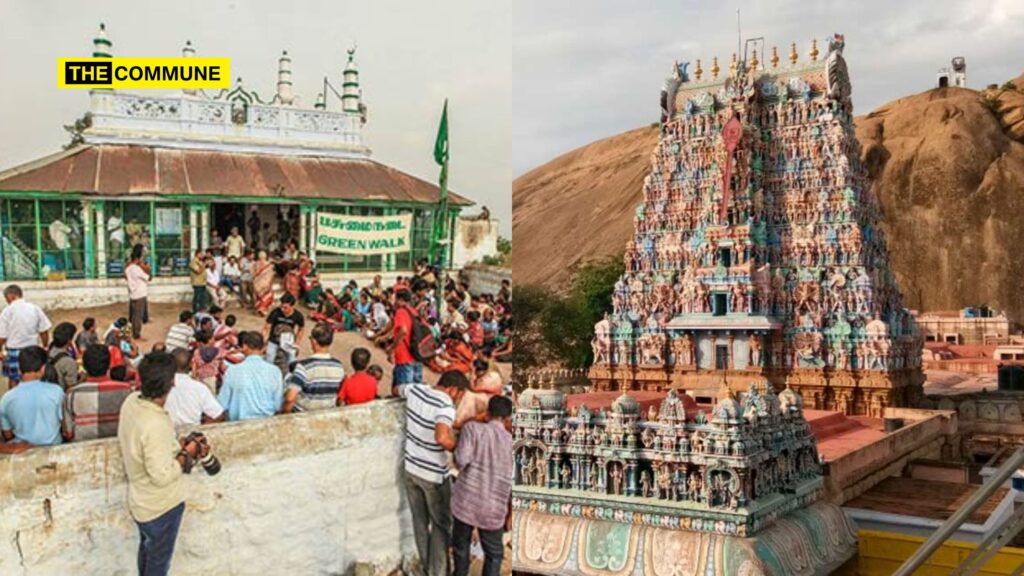
The Madurai Bench of the Madras High Court on Monday (15 December 2025) heard extensive arguments in a batch of appeals challenging a single judge’s order directing the lighting of a lamp at the stone pillar (Deepathoon) atop the Thirupparankundram Hills.
A Division Bench comprising Justice G Jayachandran and Justice KK Ramakrishnan was hearing appeals filed by the Hazarath Sultan Sikkandar Badhusha Avuliya Dargah, the Tamil Nadu government, the Hindu Religious and Charitable Endowments (HR&CE) Department, and other parties opposing the single judge’s directions.
The single judge had earlier held that the stone pillar was not located on land belonging to the Muslim community and that lighting a lamp at the pillar would not infringe upon their rights.
Minority Community Facing Difficulty: Dargah Submits
Senior Advocate T. Mohan, appearing for the Dargah management, submitted that the minority community was facing serious difficulty in enjoying its land, which was granted to the Dargah as early as 1920.
Referring to earlier litigation relating to animal sacrifice at the hills, Mohan said that judicial orders had previously curtailed the Dargah’s rights. He stated that the earlier judgment did not allow the setting up of toilets, electricity supply or water supply on land belonging to the Dargah.
He further said that prayer at the Nellithope area, which belongs to the Dargah, was not permitted earlier on the ground that it might affect the footfall of devotees visiting the Kasi Viswanathar temple.
“Now I can say that crowd is likely to occupy the pathway leading upto the Dargah. It can’t be that minority community is put to so much difficulty to enjoy their land given to them in 1920 and daggers drawn at every stage to defend ourselves against these incursion by them,” Mohan said.
Dargah Not Given Adequate Opportunity: Mohan
Mohan also contended that the Dargah was not initially made a party to the proceedings and was impleaded at a later stage. He submitted that the Dargah was not afforded sufficient opportunity to represent its case.
While the court orally observed that it was not concerned with procedural issues in the single judge’s order, Mohan argued that even procedural unfairness could vitiate an order.
The Bench responded orally, “You take it that all those aspects would be considered. You need not waste time on that. Other seniors have pointed it out. What we now have to look at is whether there’s any legal error.”
Mohan, however, took exception to what he described as the fast-tracking of proceedings.
“As per the writ rules, any respondent would be given eight weeks to file a counter affidavit. The Dargah, which was impleaded as a party, was entitled to eight weeks’ time,” he said, adding that the single judge restricted the time to three days.
“The learned judge thought it fit to restrict it to three days. It’s arguable whether he can (restrict) and secondly, the power must be reflected at least in the docket order which directs me to file a counter,” Mohan said.
He also alleged that his objection to the maintainability of the writ petition was not heard and that he was “cut off from the video conferencing facility itself.”
Mohan further stated that the single judge had visited the site and issued an open invitation to all parties, but the Dargah was not a party to the litigation on that day.
“There Should Be Real, Tangible Interest”
Mohan argued that the single judge had “set up a new case” not found in any pleadings.
“It was nobody’s case that the Dargah was attempting to take over,” he said, adding that the judge relied on pleadings of other parties to sustain the petitioner’s representation.
“You can’t use someone else’s representation to sustain a representation. That’s post facto justification,” Mohan said.
He also questioned the emphasis placed on the distance between the Dargah and the pillar.
“The petitioner in his pleadings has mentioned in two places at 15 meters and 20 meters. This controversy of distance is not something that should’ve engaged the court,” he said.
“Judge simply goes saying it’s a different area. That’s not the point. It’s not for you to come and assert the right. It’s for the temple to take an appropriate decision,” Mohan said.
“There should be a real, tangible interest. Not sentimental interest. Then all the Hindus of Tamil Nadu can file a case saying they’re interested in Ayodhya. Where will it stop? We’ve to draw a line so the courts are not flooded,” he added.
Mohan also took strong objection to the single judge’s observation that opposition to lighting the lamp was at the instance of “certain vested interests.”
Allegation of Vested Interests
Mohan submitted that the petitioner had claimed to be a member of Hindu Makkal Katchi but did not disclose this in the affidavit.
“We find it from his Twitter handle that he claims this and we have stated it in the counter,” Mohan said.
“He says give police protection and ensure law and order. All this is noted. There are some third parties who want to stir the pot,” he said.
“As far as Madurai is concerned, there have never been any problems between the people, the Muslims and Hindus of that area. It’s some vested interest who wants to stir the pot once in a while,” Mohan added.
“If every devotee were to have his own opinion in how something should be done, there won’t be an end to it,” he said.
Mohan argued that if the petitioners were asserting a custom, it must be proved before a civil court, referring to an earlier judgment relating to animal sacrifice.
“When it comes to my custom, I’ve to go to the civil court. But when they assert a custom, the writ court gives directions,” he said.
State and HR&CE Submissions
Senior Advocate R. Shunmugasundaram, appearing for the State HR&CE Department, submitted that the Commissioner had informed the court that he was willing to consider the devotee’s representation on the issue.
Senior Advocate A.K. Sriram, appearing for a party opposing the lighting of the lamp, submitted that the single judge did not examine the merits of the Executive Officer’s order and rejected it merely on jurisdictional grounds.
“The judge said that the Trust board had merely sailed along with the order of EO. But trust board was not made a party. Without making it a party, order won’t stand the test of law,” Sriram said.
He also submitted that the petitioners had not stated from which date the Deepam was allegedly lit at the Deepathoon.
“The temple administration had obtained opinion from the Sthanikars of temple regular place of lighting of deepam in 2013. Four Sthanikars offered opinion saying lamp being lit at Uchi Pillaiyar temple and that it’s not against agamas,” he said.
Sriram contended that Supreme Court rulings on expert opinion in such matters were not considered.
Pillars Not Meant for Karthigai Deepam: HR&CE
Senior Advocate N. Jothi, appearing for the Joint Commissioner, HR&CE, submitted that Section 4 of the Tamil Nadu Temple Entry Authorisation Act relates to the powers of trustees to frame regulations.
When the court asked whether an elected board existed, Jothi confirmed that an elected-nominated board was functioning.
Referring to a 1981 book authored by an archaeology expert, Jothi said, “This particular gentleman says exactly about lighting of lamp. This book should’ve been placed before the court earlier.”
He read passages stating that the book’s first photograph depicted Thirupparankundram hill, where the lamp was ordered to be lit, and that a similar pillar existed at Swamiyar Malai, 20 km away.
“All pillars unfinished. Page 4, another pillar. Page 5, front of two pillars. Last page, same type of thoon. Same design of pillar with same podium and height. Pillar of same type at different places. They’re not made for Karthigai deepam,” Jothi said.
He further cited another work by scholar Venkataswami, stating that Digambara saints from Madhya Pradesh used to reside in hills and used such pillars for lighting during night congregations.
“These pillars were not for Karthigai deepam but for light by the Munis,” Jothi said.
He cautioned that changing the nature of the pillars was prohibited under law.
“Nature of Pillar Cannot Be Changed”
Jothi argued that no light had been lit on the pillar so far and that its nature could not be altered.
“The petitioners cannot ask Karthigai deepam to be lit at every pillar,” he said.
“What’ll happen if order is allowed. It says light lamp at two places. Does it happen anywhere? Murugan may have two wives but light should be lit at one place only,” he said.
He alleged that the petitioners caused “commotion and gave nightmare to officers.”
“This practice should be heavily condemned. The appeal should be allowed and heavy costs should be imposed on them. Payable to Murugan itself,” Jothi said.
Entire Hill Premises Belong to Dargah: Counsel Argues
Another counsel for the Dargah submitted that the single judge wrongly held that the Dargah had not shown how it would be affected.
“The entire premise would be Dargah campus. I’m not able to find out what the judge meant by Dargah campus,” the counsel said.
He argued that adjudication required civil proceedings with adequate time.
“To prove title, party must be given sufficient opportunity to collect all materials and place it before court. The court would’ve appointed a commissioner with an expert,” he said.
While the court observed that a judge’s local inspection was permissible, the counsel argued that the judge’s conclusions post-visit could not substitute proper adjudication.
Court Seeks Solution-Oriented Approach
Referring to a 1996 judgment, the counsel argued that temple activities should remain 15 metres away from the Dargah boundary.
The Bench orally asked, “15 meters away from that place anywhere in the hillock, if some activity of the temple is to be carried out, you have no objection?”
The counsel replied that there was no ritual in existence.
The court observed, “We want to arrive at a solution because several incidents are happening, several litigations. First you demarcate, once it’s demarcated…”
The counsel responded, “If the court gives a declaration, I can’t say anything. But this cannot be gone into in a writ petition.”
“For 2000 years, there was no such practice. Not mentioned in 1862 order. Each time they’re changing their stance,” he added.
Another counsel submitted that Thirupparankundram was a multicultural complex.
The court finally asked, “If the ASI gives a notification saying permit them (petitioners) to do, then there’s no problem?”
The counsel replied that it must be “in accordance with law.”
The matter is scheduled for further hearing on Tuesday, 16 December 2025.
Source: LiveLaw
Subscribe to our channels on WhatsApp, Telegram, Instagram and YouTube to get the best stories of the day delivered to you personally.