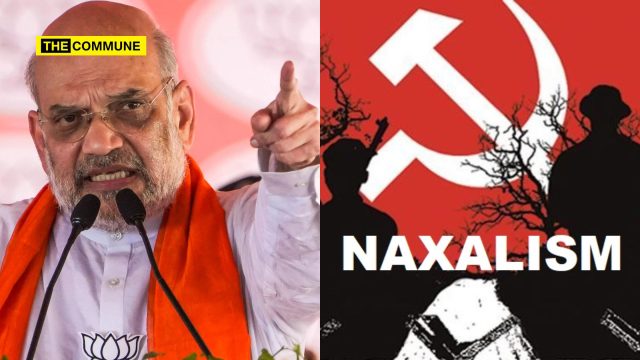
A political exchange has erupted between Union Home Minister Amit Shah and the Communist Party of India (Marxist) (CPI(M)) over the party’s historical role and ideological origins, with competing claims drawing attention to archival material and documented events.
Speaking in Parliament, Union Home Minister Amit Shah said, “In 1969, the Communist Party of India (Marxist), or CPI (Marxist), was established in India. Its primary objective was neither the nation’s development nor the protection of citizens’ rights. Instead, the party’s constitutional aim was to overthrow the parliamentary system through armed revolt, following the examples set by China and Russia. However, unlike those countries, India did not have a monarchy; rather, it had a democratically elected government. “
In 1969, the Communist Party of India (Marxist), or CPI (Marxist), was established in India. Its primary objective was neither the nation’s development nor the protection of citizens’ rights. Instead, the party’s constitutional aim was to overthrow the parliamentary system…
— BJP (@BJP4India) March 30, 2026
The CPI(M), in response to Shah’s remarks on its formation and ideological intent, asserted that it carries forward a “glorious legacy of the freedom struggle” and has consistently raised public issues through democratic means. The party also clarified that it was formed in 1964 following a split in the undivided Communist Party of India (CPI). They wrote, “Stop spreading lies! CPI(M), formed in 1964, carries forward the glorious legacy of the freedom struggle. We have been raising people’s issues in Parliament and on the streets through our struggles. We don’t require certificates from betrayers of the freedom struggle, who are today destroying the basic tenets of the Indian Constitution.”
Stop spreading lies! CPI(M), formed in 1964, carries forward the glorious legacy of the freedom struggle. We have been raising people’s issues in Parliament and on the streets through our struggles. We don’t require certificates from betrayers of the freedom struggle, who are… pic.twitter.com/AE93thUoWG
— CPI (M) (@cpimspeak) March 30, 2026
However, historical accounts indicate that the split within the CPI was rooted in deep ideological divisions, particularly influenced by the global rift between the Soviet Union and China, which intensified during the Sino-Indian War. The CPI(M) emerged as a faction seen as aligning more closely with the Chinese line of communism, while the CPI retained a Soviet-oriented approach.
Archival extracts and reports from the period have been cited by critics to question the CPI’s position during key national moments. A declassified intelligence extract referenced discussions among CPI leaders during the late 1950s and early 1960s that reflected positions perceived as sympathetic to China’s claims during the border tensions.
Further, historical literature such as works examining the Quit India Movement have documented tensions between communist leadership and other freedom movement figures. Accounts from that period suggest that sections of the undivided CPI opposed mass movements led by leaders like Subhas Chandra Bose and criticised calls for direct confrontation with British rule.
Media reports have also highlighted internal disciplinary actions within communist ranks during the 1960s. One such case involved criticism of party members for supporting the Indian armed forces during the Sino-Indian War, which was reportedly viewed as deviating from party positions at the time.
Additionally, visual propaganda from CPI-linked publications during the 1940s has been cited in the debate, including illustrations in party mouthpieces portraying nationalist leaders in a critical light during the World War II period.
To elaborate :
The Communist Party of India (Marxist), or CPI(M), was officially formed on November 7, 1964, following a split in the undivided Communist Party of India (CPI).
The split was driven by ideological differences, which started during the Russia- China split in… https://t.co/e9mvc7Bo8i pic.twitter.com/WtDW88shc8— Monidipa Bose – Dey (মণিদীপা) (@monidipadey) March 31, 2026
Subscribe to our channels on WhatsApp, Telegram, Instagram and YouTube to get the best stories of the day delivered to you personally.