The “Godi Media” label came back in the spotlight after mainstream television reporters faced heckling, boycotts and physical attacks during the recent student protests at Jantar Mantar. Protesters shouted “Godi Media Go Back” at journalists while accusing news channels of being government mouthpieces.
Yet the same protesters later rushed to the very same television studios for prime-time interviews when the cameras were useful to them.
That exposes the hypocrisy behind the label.
If a journalist questions the Opposition or supports a government policy, he is branded “Godi Media.” But when journalists enjoyed political access, state honours and proximity to power during the Congress-led UPA era, the same critics rarely used the same yardstick.
So who exactly is “Godi Media”? And was media-political proximity really invented after 2014?
The record of the Congress era tells a very different story.
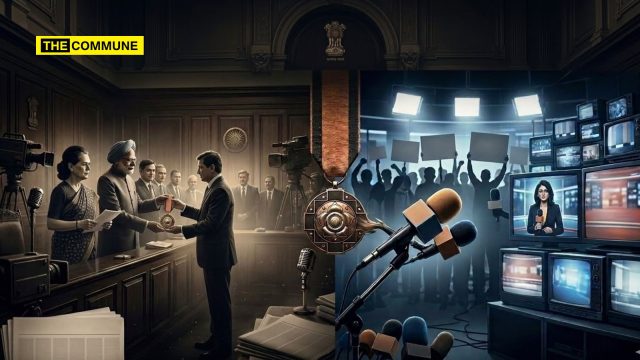
Congress-Backed Awards To Top Journalists
During the UPA years, several prominent journalists and media personalities received Padma awards.
The list includes:
- N. Ram – Padma Bhushan, 2003
- Shekhar Gupta – Padma Bhushan, 2009
- Fareed Zakaria – Padma Bhushan, 2009
- Alok Mehta – Padma Shri, 2009
- Rajdeep Sardesai – Padma Shri, 2008
- Vinod Dua – Padma Shri, 2008
- Barkha Dutt – Padma Shri, 2008
- Mrinal Pande – Padma Shri, 2006
- Sucheta Dalal – Padma Shri, 2006
- Shobhana Bhartia – Padma Shri, 2005
- Mammen Mathew – Padma Shri, 2005
Importantly, not all of these awards were made by the UPA government, N. Ram’s Padma Bhushan, for instance, was awarded in 2003, before the UPA came to power. So using the entire list as evidence of UPA patronage would be inaccurate.
The broader point, however, remains: civilian awards to journalists are not unique to the Modi era.
Then Came The Radia Tapes
The strongest controversy surrounding the old media-political ecosystem was the Niira Radia tapes controversy.
Leaked recordings from 2008–09 captured conversations involving corporate lobbyist Niira Radia and several prominent journalists, politicians and corporate figures. The conversations triggered a major debate over the proximity between journalists, corporate interests and political power.
This was not simply a social-media accusation of “Godi Media.” It became a national controversy over the relationship between India’s political, corporate and media establishments.
So What Is Different Today?
Congress supporters call sections of today’s media “Godi Media” because they believe journalists are excessively sympathetic to the Modi government.
But the counterargument is straightforward:
A journalist interviewing Modi, defending a government policy or taking an anti-opposition position does not automatically make that journalist government-controlled.
The media landscape today is also far more fragmented than it was during the UPA era. Television channels, digital publications, YouTube creators, independent journalists and social-media commentators operate across the political spectrum.
There is also an important distinction between government awards and government control.
A Padma award does not prove that a journalist was rewarded for favourable coverage. Likewise, appearing sympathetic to the government does not prove that a journalist receives government patronage.
The Double Standard
The real question, therefore, is not “Who is Godi Media?”
It is: Why is pro-government journalism today labelled “Godi Media”, while the close proximity between sections of the media, corporate lobbyists and political power during the Congress era is treated as a forgotten chapter?
The Congress era had its own media ecosystem, its own elite access and its own controversies.
The present government may have its supporters in the media too.
But “Godi Media” is a political accusation, not proof that the entire Indian media has become a government mouthpiece.
Subscribe to our channels on WhatsApp, Telegram, Instagram and YouTube to get the best stories of the day delivered to you personally.