


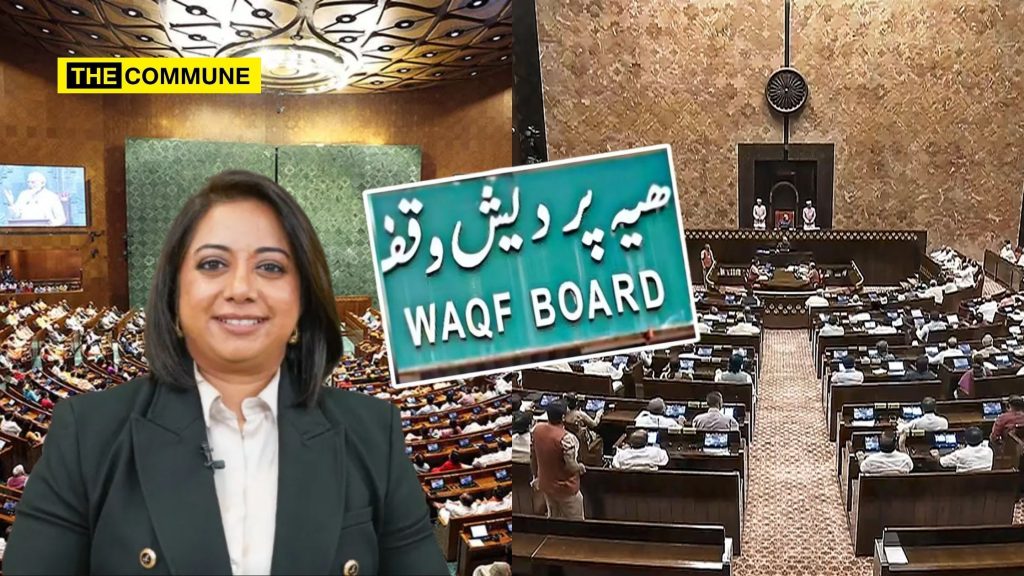
Congress-buttressing journalist Faye D’Souza recently weighed in on the controversial Waqf (Amendment) Bill 2025, using her YouTube channel to explain the ongoing buzz surrounding the legislation. In her video, titled “Waqf Bill Explained,” D’Souza carefully crafted her narrative, focusing on the Waqf Board as the victim, while omitting key aspects of the bill, such as Section 40. This provision, widely criticized for its authoritarian nature, allows the Waqf Board to act as both the accuser and investigator. Under this section, once the Board claims a piece of land as Waqf property, the burden shifts to the property owner to prove it isn’t. However, D’Souza made no mention of this critical detail, instead focusing on other misleading claims from the Congress and its minority-appeasing allies.
In her video, which aired on 4 April 2025, D’Souza presented her explanation of the Waqf Amendment Bill, offering a breakdown of the bill’s contents, alleged its contentious nature, and the events surrounding its passage in Parliament. She described the bill as a source of tension between the government and the opposition, further fueling the ongoing narrative.
Faye D’Souza carefully narrates the opposition’s stance on the Waqf (Amendment) Bill, carefully highlighting key concerns. She notes that the bill proposes empowering an officer of the rank of District Collector or higher to investigate government properties that are being claimed as Waqf. Additionally, she discusses the inclusion of non-Muslim members in both the Central and State Waqf Boards. On the matter of dispute resolution, she explains that government officials are appointed to resolve conflicts between the Waqf Board and the government, with the concern that these officials will ultimately side with the government. In cases where there is a dispute over whether a property is government-owned or Waqf property, a government officer would make the final decision.
D’Souza quotes the opposition parties, who argue that the bill is an attempt to weaken the governance of Waqf properties and undermine the rights of Muslims by increasing government oversight. They claim that the law essentially interferes with the community’s ability to manage its own affairs. Furthermore, the bill addresses the lack of judicial oversight by allowing individuals to approach the courts if they are dissatisfied with a decision made by the Waqf Tribunal, which was previously managed by the community.
However, D’Souza fails to mention the reason the amendment was proposed in the first place. The issue arose from the arbitrary classification of villages, households, and even temples as Waqf properties, despite families having lived there for generations. Under the previous law, these families could only contest such claims in the Waqf Tribunal, not in civil courts, and the decisions made by the tribunal were final. This system created what many viewed as a draconian process.
But D’Souza now criticizes the idea that a government official, sitting as the final authority, would inherently favor the government, dismissing the possibility of an impartial review. However, her argument ignores the context of the previous law, which considered an overreach, leaving Hindu communities with limited recourse and no judicial oversight is irony.
What Is Section 40 Of Waqf Act, 1995, And Why Is No One Talking About It?
Section 40 of the original Waqf Act, 1995, grants the Waqf Board the power to determine whether a property is classified as Waqf property. Under this provision, the final authority to decide the status of a property lies with the Waqf Board itself.
Sub-section 1 allows the Waqf Board to gather information about any property it believes might be Waqf property. If a dispute arises regarding a property’s status, the Board can conduct an inquiry and make a decision on its own.
Sub-section 2 ensures that the Board’s decision is not subject to challenge by any executive body, stating that the decision is final unless altered by the Waqf Tribunal. This provision does not include the involvement of the central or state government in the decision-making process, effectively granting the Board full authority.
Sub-section 3 addresses properties that are not originally Waqf properties but are registered under other trusts or societies. If the Board suspects that such properties are Waqf properties, it can initiate an inquiry. If, after the inquiry, the Board determines that the property is indeed Waqf, it can require the trust or society to either register the property under the Waqf Act or justify why it should not be registered.
Sub-section 4 further strengthens the Board’s authority by stating that after considering any response from the trust or society, the Board can issue an order that is final unless modified by the Waqf Tribunal.
The Waqf (Amendment) Bill, 2025, removes this provision entirely. Section 20 of the Bill explicitly states that “Section 40 of the principal Act shall be omitted.”
Subscribe to our channels on Telegram, WhatsApp, and Instagram and get the best stories of the day delivered to you personally.