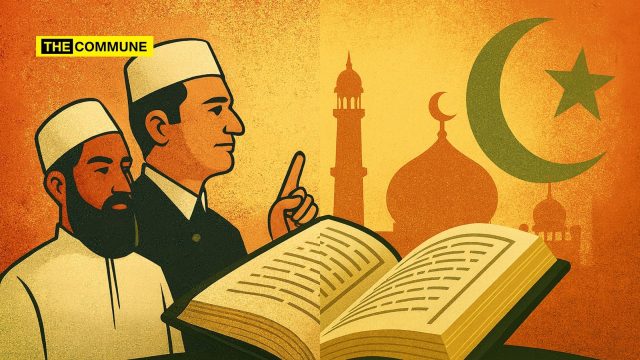
In Indian public life, few assertions are repeated as insistently as the claim that “the Qur’an is eternal, timeless, and valid for all societies and all eras.” The statement is routinely invoked by Islamist groups, conservative clerics, and sympathetic politicians—usually when questions are raised about reform, gender justice, or constitutional supremacy.
It surfaces whenever debates arise about the Uniform Civil Code, Muslim women’s rights, or judicial scrutiny of personal laws. Dissent is dismissed as “interference in religion,” while reform is framed as an “attack on Islam.”
But stripped of theological ornamentation, the claim that the Qur’an is “timeless” functions less as a spiritual belief and more as a political strategy.
Why “Timelessness” Is Repeated So Ruthlessly
This is the moot question, and the one that I have tried to answer in this article. In contemporary India, calling a scripture “timeless” serves a clear purpose: it places religious authority beyond debate.
If a text is eternal:
- It cannot be amended
- It cannot be subjected to democratic reasoning
- It cannot be evaluated against constitutional values
- It cannot be questioned by courts, citizens, or believers themselves
This framing converts social rules into non-negotiable absolutes, instantly delegitimising discussion. That is why the statement appears most often not just in mosques or theological treatises, but in political speeches, television debates, court affidavits, and protest slogans.
In short – “timelessness” is power language.
The Quiet Admission That Undermines The Claim
Here is the irony. The moment one raises concerns about the pejorative references to other communities and non-believers or treatment of women and their rights, the very same voices insisting the Qur’an is timeless also insist that it must be “understood in context.”
Context of history. Context of revelation. Context of social conditions. Context of tribal Arabia.
This is not a modern concession; it is unavoidable.
Once context is admitted, the claim of literal timelessness collapses. A rule that requires historical explanation is not timeless by definition. A command that must be reinterpreted to remain moral cannot be universally fixed. Contextualisation is not decoration—it is transformation.
Scholars Say What Politicians Avoid Saying
Even a small glance at modern Muslim scholarship exposes the contradiction.
Fazlur Rahman, modernist scholar and Islamic philosopher, widely respected across South Asia, argued that Qur’anic directives addressed specific social problems of their time. What matters today are the ethical goals, not the ancient solutions. That means the rules are historical, not eternal. Through his works, most notably “Islam & Modernity (1982)”, he emphasized that the moral values of the Quran endure beyond history and require constant reinterpretation.
In his seminal work, “Critique of Religious Discourse (1992)”, Nasr Hamid Abu Zayd went further, calling the Qur’an a text that entered human language and history, and therefore cannot escape interpretation. For asserting this, he was branded an apostate by the Egyptian court —telling in itself.
There are countless other Islamic scholars who have echoed similar principles. These are not extremist voices. They are mainstream Muslim thinkers. Yet their conclusions are rarely quoted in Indian political debates—because they dismantle the utility of the “timeless” claim.
Why This Is Ultimately A Political Claim
People who embrace the fiction of eternal validity, in practice are ready to accept the following, all of which was once central to the Quran – slavery, tribal warfare and caliphate governance. If centuries-old norms can be set aside silently, then what remains “timeless” is not the text, but who controls its interpretation.
The insistence that the Qur’an is timeless serves three political goals:
- Preserving clerical authority If the text is eternally clear, interpreters must never be challenged.
- Blocking reform: Any change can be dismissed as sacrilege rather than debated on merit.
- Mobilising identity: Critics are framed as enemies of faith rather than participants in a democracy.
This is why “timelessness” is shouted loudest in moments of social contestation—not spiritual reflection.
The Simple Logic That Ends The Debate
A timeless doctrine – (a) Applies unchanged; (b) Requires no historical mediation and (c) Functions identically across cultures
The Qur’an – (a) Requires context to interpret; (b) Reflects 7th-century Arabian society; (c) and Demands moral negotiation to remain relevant
Both statements cannot be true simultaneously.
What survives across time are human interpretations, not divine instructions frozen in amber.
Calling The Qur’an Timeless Is A Power Claim
To say the Qur’an is timeless is not a theological inevitability—it is a political decision.
It seeks to place religious authority above constitutional reasoning, public morality, and democratic scrutiny. Once contextualisation is acknowledged—and it must be—the idea of literal timelessness evaporates.
The Qur’an may retain spiritual or cultural significance for believers. But to present it as an eternally binding, context-free social doctrine in a modern constitutional democracy like India is neither honest nor sustainable.
That claim is not about God. It is about control.
DhiBhu is a political observer who writes on national security, foreign policy, and India’s geopolitical landscape.
Subscribe to our channels on WhatsApp, Telegram, Instagram and YouTube to get the best stories of the day delivered to you personally.