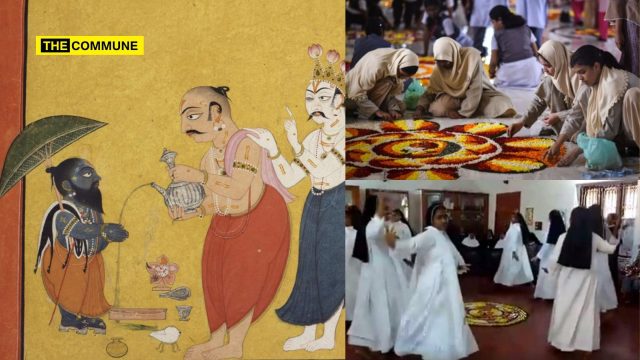
Onam, Kerala’s premier harvest festival, is deeply rooted in Hindu tradition, commemorating the annual homecoming of the benevolent Asura King Mahabali, a story central to the Vamana avatar of Lord Vishnu.
Onam is celebrated in the Malayalam month of Chingam (August–September), lasting ten days, with Thiruvonam being the most important day. The dates shift annually according to the Malayalam lunar calendar. Celebrations include floral carpets (pookkalam), traditional feasts (onasadya), snake boat races, dances, temple rituals, and cultural programs across Kerala and among Malayalee communities worldwide. Since 1961, Onam has been officially recognised as the state festival of Kerala, celebrated not only in India but also across the Gulf countries, the US, UK, Singapore, and other diaspora hubs.
Why Onam is Celebrated
The festival commemorates the annual homecoming of King Mahabali, the legendary Asura ruler of Kerala. Known for his just and prosperous reign, Mahabali was sent to Patallok by Lord Vishnu in his Vamana avatar but granted the boon of visiting his people once every year. This divine reunion is celebrated as Onam, symbolising prosperity, equality, and joy.
Historical References
Historical sources confirm Onam’s roots as a Hindu festival dedicated to Bhagwan Vishnu. A 9th-century Chera copper-plate of King Sthanu Ravi records annadana (food offerings) during Onam. The festival is described in Sangam poetry and in the Malabar Manual (17th century), as well as in Francis Day’s writings, all of which highlight Vishnu’s annual visit to his devotee Mahabali. References also extend back to Pandyan king Nedunchelian’s Thiruvonam celebrations (1850–1800 BCE).
The “Secular” Narrative
In modern times, however, Onam has increasingly been projected as a secular celebration. While Hindu itihasa and astronomical references place Mahabali’s reign as far back as 11,160 BCE, and even Church records acknowledge Onam’s Hindu roots, certain narratives now reinterpret the story. These portrayals often cast Mahabali as a victim and Vamana as a deceiver, framing the festival as a tale of caste conflict rather than a sacred story of devotion, dharma, and divine grace.
This report details 11 key incidents from 1920 to 2025 that highlight this deliberate shift in narrative, moving the festival from the sacred confines of temples and homes into the public, secular sphere as a symbol of state identity and communal harmony, often at the expense of its original religious significance.
#1 1961: State Recognition as a Public Festival
In a pivotal move, the Kerala government led by Chief Minister Pattom Thanu Pillai formally declared Onam the official state festival in 1961. This decision institutionalized Onam, moving its celebrations beyond Hindu households and temples into the state-sponsored, civic realm. The government began organizing and funding official events, framing Onam not just as a religious observance but as a public holiday and a celebration of Kerala’s identity, setting the stage for its secular portrayal.
#2 1980s: Tourism-Led “Onam Week” Cultural Showcase
During the 1980s, Kerala Tourism aggressively promoted Onam as a major tourist attraction. It initiated week-long “Onam Week” celebrations in the state capital, Thiruvananthapuram, featuring multiple stages for folk, classical, theater, and popular arts. This transformed the festival into a broad cultural spectacle, emphasizing performing arts and public festivities over its religious core and marketing it as a secular cultural showcase for a global audience.
#3 2009: Government Magazine Declares It “Pure Secular”
The Kerala state government’s own monthly magazine, Kerala Calling, explicitly described Onam as a “pure secular” festival in its August 2009 issue. This official publication asserted that the festival reflects Kerala’s identity and is celebrated by people “irrespective of religion and caste.” This represented a clear top-down effort to dissociate Onam from its Hindu origins and re-brand it as a pan-Keralite secular event.
#4 2014: Muslim Community Leader Promotes Secular Onam
Hussain Bappu, a Chennai-based Malayali Muslim, became known for actively promoting Onam as a secular festival. Every year, he organizes a grand Onasadya (feast) at his home, inviting people from non-Malayali and non-Hindu communities. Bappu frames the festival as an occasion for communal harmony and a celebration of Kerala’s cultural heritage, consciously separating it from its religious narrative to make it inclusive.
#5 2016: Muslim Educational Society’s Dravidian Narrative
In 2016, the Muslim Educational Society (MES) actively promoted Onam celebrations across its campuses, countering voices that labeled it “un-Islamic.” The MES strategically reframed Onam not as a Hindu festival but as a “Dravidian harvest celebration.” This narrative positioned the festival as part of a shared regional, pre-religious cultural heritage, making it acceptable for participation across communities.
#6 2016: Backlash Against Amit Shah’s “Vamana Jayanti” Greeting
A political controversy erupted in 2016 when BJP President Amit Shah greeted people on “Vamana Jayanti,” depicting Lord Vamana placing his foot on King Mahabali, without mentioning Onam. The post faced massive backlash in Kerala from the public and political leaders, who accused the BJP of attempting to “Hinduise” the festival and impose a divisive narrative, reinforcing the strong public preference for its secular identity.
#7 2017: Shashi Tharoor Highlights Christian Nuns Celebrating
Congress leader Shashi Tharoor amplified Onam’s secular image in 2017 by sharing a viral video of Christian nuns performing the Thiruvathirakali dance around a Pookalam (flower carpet). His social media post, which garnered thousands of shares, presented this as emblematic of Kerala’s unique culture of oneness and communal harmony, using interfaith participation to underscore the festival’s secular character.
#8 2019: Madrasas and Mosques Promote Communal Harmony
In Malappuram in 2019, institutions like the Noorul Islam Madrasa and Huda Masjid actively participated in Onam celebrations. Children from a school associated with the madrasa laid Pookalams and sang songs, while the mosque donated clothes to 50 poor Hindu families. These acts were widely reported as exemplary gestures of communal harmony, further cementing the festival’s secular and inclusive public image.
#9 2024: Syro-Malabar Church Declares Onam “Cultural”
In a significant statement in 2024, the Syro-Malabar Church issued an official note clarifying that Christians should view Onam as a cultural, not religious, festival. It encouraged participation in feasts and decorations as expressions of cultural pride rather than religious ritual. This doctrinal guidance from a major Christian denomination provided a theological basis for the community’s widespread celebration of the Hindu-rooted festival.
#10 2025: CM Vijayan Aligns Onam with “Nava Kerala” Vision
Kerala Chief Minister Pinarayi Vijayan, inaugurating the state’s official 2025 Onam celebrations, explicitly framed the festival as a symbol of the state’s “unity, communal harmony, and fraternal and inclusive mindset.” He aligned Onam with his government’s “Nava Kerala” (New Kerala) vision, leveraging the festival’s secular narrative to promote a political agenda of state identity and progress.
#11 1920-1940: Early Socio-Political Reinterpretation
The foundational shift began in the early 20th century when social reformers and communist leaders reinterpreted the myth. They recast King Mahabali as a symbol of egalitarianism, primitive communism, and a just low-caste ruler betrayed by Brahminical cunning (represented by Vamana). This detachment from its Hindu theological roots by figures like E.M.S. Namboodiripad allowed Onam to be embraced as a secular symbol of social justice and equality.
Subscribe to our channels on Telegram, WhatsApp, and Instagram and get the best stories of the day delivered to you personally.