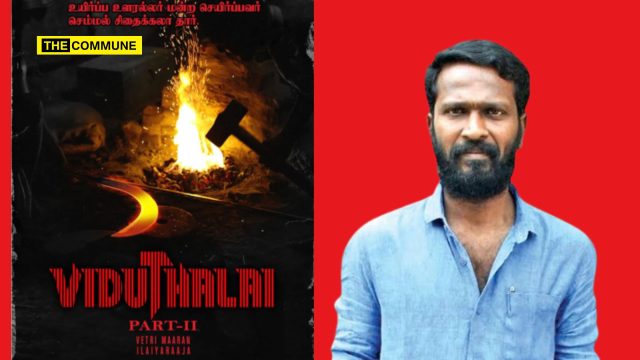
On 28 March 2026, filmmaker Vetrimaaran took the stage at the trailer launch of Neelira – a film about the Sri Lankan civil war and delivered what sounded like a principled stand against the commercialisation of hatred in Indian cinema. “Today, everything is turning into propaganda,” he declared.
“Propaganda has the power to influence memory.” He went on to reference demonetisation, implying that films like Dhurandhar: The Revenge were manipulating public memory of national events for political gain. He did not name the film, but no one needed him to – the internet connected the dots within a short time.
It was a well-phrased speech. It was also an act of extraordinary audacity from a director who spent two films, Viduthalai Part 1 (2023) and Viduthalai Part 2 (2024) doing precisely what he accused others of doing: using cinema to reshape memory, rehabilitate extremist violence, and romanticise a separatist armed movement as a noble liberation struggle.
The Speech That Backfired
“Until we tell our stories, our life is what our enemies say they are. We do not have the democracy to tell our own stories“, said Vetrimaaran who made a two-part film glorifying naxalism and constantly peddling subtle propaganda against the Indian government and BJP’s Hindutva politics in his films.
In his remarks, Vetrimaaran lamented: “Today, everything turns into propaganda. Propaganda has the power to influence memory. We all know who was most affected by demonetization and who lost their lives standing in queues. But that impact changed through hate propaganda. What can we do against that hate propaganda? We have to make films like this.”
Crediting the film Neelira, he said “There are many films that cost millions of rupees, wishing to earn hundreds of crores with hatred and violence. This is a film does which not want to sell hate, caricature a race, a community, or a religious sect.”
For a director whose entire oeuvre reads like a Dravidian manifesto wrapped in gritty realism, this sudden pearl-clutching over “hate propaganda” reeks of hypocrisy.
The internet’s response was swift and pointed. While a section of fans applauded him for calling out Dhurandhar 2, a far larger and angrier section of netizens immediately asked the obvious question: what exactly was Viduthalai, if not precisely the kind of ideologically driven cinema he was now condemning? One user wrote bluntly: “Vetrimaran who literally did Viduthalai (1 and 2), a soft Naxal propaganda film which justifies killing police and people, planting bombs in trains, is speaking about this – not surprised.”
Vetrimaran who literally did Viduthalai (1&2) a soft naxal propaganda Film which justify killing police and people, planting b*mb in train is speaking about this , not surprised. A terror sympathizer as usual
— deepakrajan (@lamelizard14f12) March 28, 2026
What Viduthalai Actually Is
Viduthalai Part 2 is not a work of imagination set in a vaguely political universe. Its characters, ideology, geography, and even organisational structure map almost directly onto a real banned terrorist outfit, the Tamil Nadu Liberation Army (TNLA), declared a terrorist organisation by the Government of India and formally proscribed under POTA on 2 July 2002.
The TNLA’s origin story is precisely what the film fictionalises. When prominent Tamil Naxalite leaders, Pulavar Kaliyaperumal, a schoolteacher, and Thamizharasan, an engineering student from Ponparappi demanded a separate Tamil Nadu from the all-India CPI(ML) leadership, the national party flatly rejected the idea. This led to a formal split and the formation of the Tamil Nadu Communist Party (Marxist-Leninist), TNCP-ML, in 1984–85. Its political wing was the TNCP-ML; its armed wing was the TNLA. The film’s “Vaathiyaar” Perumal is modelled directly on Kaliyaperumal even the title “Vaathiyaar” (teacher) is borrowed from real life. Vetrimaaran has never publicly acknowledged this lineage, preferring the safety of fiction’s deniability.
The real TNLA was not a romantic liberation movement. It bombed police stations to seize weapons, derailed trains, attacked television relay towers and bridges, and conducted targeted killings across Tiruchi, South Arcot, Ariyalur, Dharmapuri, and Jayamkondam. Its attacks included railway tracks in Cuddalore, the Rockfort Express, the bridge used during the Prime Minister’s visit, and television towers across multiple districts. The TNLA was also directly linked to forest brigand Veerappan, with five TNLA activists’ release among Veerappan’s ten demands when he abducted Dr. Rajkumar in July 2000. Thamizharasan himself died on 1 September 1987, when the people of Ponparappi village lynched him and four associates during a bank robbery attempt. This is the movement Viduthalai romanticises.
Vetrimaaran embeds the ideology at the film’s very first frame but not subtly. The title card appears over the hammer and sickle symbol, which then transitions into the same sickle being used by a sugar mill owner to kill Mahalakshmi’s father (Manju Warrier’s character). The symbolism is deliberate and double-edged: the tools of the proletariat are first weaponised by the oppressor class, before being reclaimed as instruments of liberation. This is entry-level Marxist visual grammar, and Vetrimaaran deploys it with full intent.
The narrative architecture that follows is a textbook emotional manipulation sequence. Mahalakshmi, despite belonging to the landowning class, is drawn to Marxist ideology and joins the VJS movement – a classic “class traitor as moral compass” trope designed to signal that the ideology transcends caste and class. The film then employs the same sympathy-building template Vetrimaaran used in Asuran: landlords brutalising labourers, brutal beatings, and the burning of a school filled with children – all designed to manufacture righteous rage in the audience before the movement’s retaliatory violence begins. Mahalakshmi’s father Ashokan kills his own daughter for choosing the movement. The child born of her self-respect marriage in a communist party office is also killed. These scenes are not storytelling; they are emotional loading, designed to pre-justify every act of violence the movement subsequently commits.
Part-time teacher Perumal, radicalised at the sugar mill, becomes a communist and the film frames this as moral awakening, not ideological indoctrination. A northern communist leader, played by Anurag Kashyap, arrives to bless and encourage the movement before departing – a pointed piece of casting that signals the all-India Naxalite intellectual class’s validation of Tamil armed struggle. That Kashyap, a filmmaker closely associated with left-liberal cultural circles, plays this role is not incidental. It is a cultural endorsement built into the film’s DNA.
The film’s present-day sequence, where an honest police officer Soori produces Perumal in court for a life sentence, is presented as the system’s ultimate failure, not its success. Perumal going to prison is mourned, not welcomed. The film closes with the movement’s ideological flame still burning, its martyrs memorialised with red flags, black badges, and drumbeats. The CBFC reportedly blurred out hammer-and-sickle symbols during the theatrical run which itself confirms how overt the ideological iconography was before regulatory intervention, yet the film’s fundamental argument remained untouched.
Thread 🚨
விடுதலை2 குறியீடும்
விளங்காத கம்யூனிசமும்!ஒன்னத்துக்கும் ஆகாத
இந்திய Communist Party of Marxist/Leninistகிட்ட போய் தனி தமிழ்நாடு கேட்டு அதுக்கு ஒத்தகிராம Tamilnadu Communist Party of Marxist/Leninist உருவாக்க, அதோட ஆயுதஅணியினர் தான்இந்த தமிழ்நாடு விடுதலை ராணுவம்!
1/N pic.twitter.com/Ek7n5RNSCX— ராஜாதி ராஜா (@Raja_NIA_) November 27, 2024
This is the film whose director now lectures India about propaganda.
Who Decides What Counts as Propaganda?
Vetrimaaran’s speech was built around the phrase “upholding an ideology” which he presented as the opposite of propaganda. But propaganda has never been defined as content without ideology. It is defined as content that uses emotional manipulation, selective framing, and narrative distortion to advance a political position while concealing that it is doing so.
By that definition, Viduthalai 1 and 2 qualify far more precisely than Dhurandhar 2. Dhurandhar openly celebrates India’s counter-terrorism history, its politics are on its sleeve. The other by Vetrimaaran presents a barely fictionalised Naxalite separatist organisation as a noble liberation movement, never names its real-world inspiration, and relies on its audience not connecting the dots between the screen and the SATP database.
Vetrimaaran is free to dislike Dhurandhar. But the audience is equally free to notice that the director most publicly denouncing propaganda in Indian cinema built his recent filmography on exactly that foundation.
Subscribe to our channels on WhatsApp, Telegram, Instagram and YouTube to get the best stories of the day delivered to you personally.