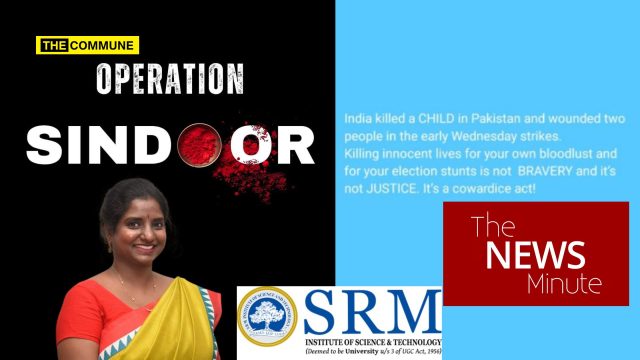
A week ago, the self-styled champion of the rights of the downtrodden, The News Minute, published its report on SRM University’s action against a staff member over her comments during Operation Sindoor.
The university had first placed the staff member under suspension and, in December 2025, proceeded to dismiss her following an internal inquiry. But the manner in which The News Minute chose to report this development is telling.
TNM headlined its story as “SRM Uni dismisses Dalit Christian professor targeted by right-wing for anti-war views”, framing the dismissal entirely as a case of caste- and religion-based persecution.
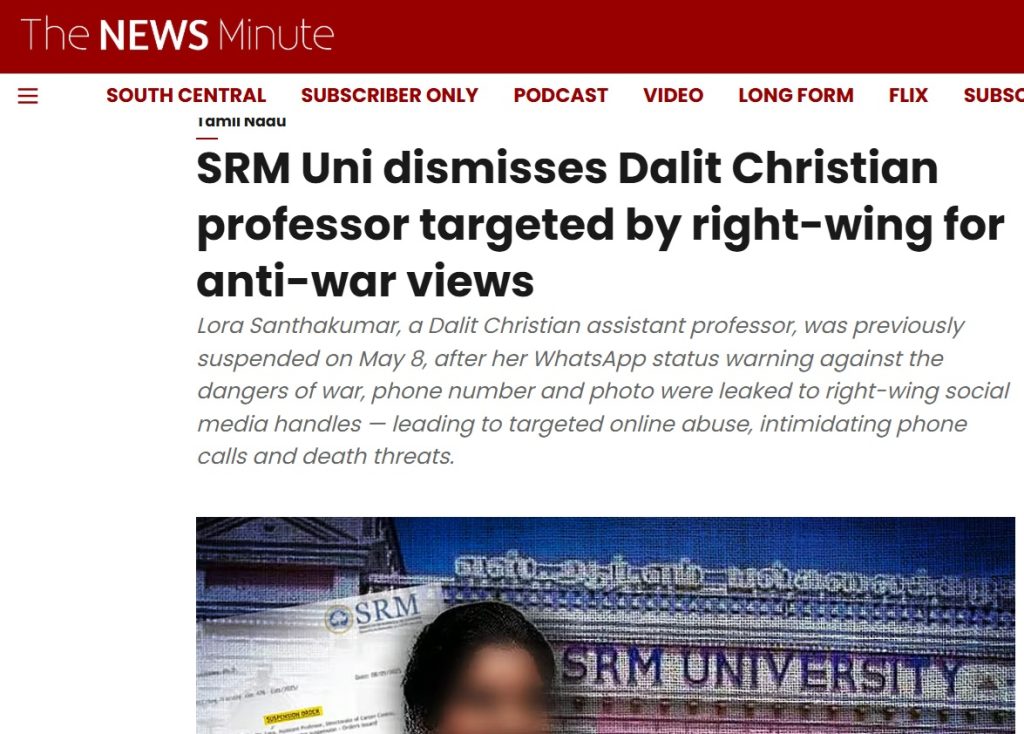
The headline itself suggests that the professor was removed because she was a Dalit Christian and because she expressed anti-war views, with the university portrayed as either complicit in, or cowed by, “right-wing” pressure.
Throughout the report, SRM University is presented largely as a reactive institution acting under external pressure, rather than as a private employer enforcing its own code of conduct following a formal disciplinary process.
What SRMIST Said And What TNM Acknowledged
According to the suspension order dated 8 May 2025, signed by SRMIST Registrar Dr S. Ponnusamy, Lora Santhakumar was placed under suspension “with immediate effect, pending enquiry” for “unethical activities.” The institute subsequently conducted an internal inquiry between 15 July 2025 and 26 September 2025 at its Kattankulathur campus.
TNM itself reported that the inquiry committee, headed by the Director of Student Affairs, with the Deputy Director of Student Affairs as presenting officer, found all five charges framed against her to be proved. These included allegations that her social media posts amounted to unethical remarks against India’s armed forces, actions against national interests, disruption of the institution’s environment, and involvement in what the committee characterised as antisocial and “criminal” activities.
The termination order accessed by TNM stated that she was “unfit to continue her job in the institution” and dismissed her from service with immediate effect, while also granting her the right to appeal to the Vice-Chancellor within 30 days.
Identity Versus Conduct
While TNM repeatedly highlighted Lora Santhakumar’s identity as a Dalit Christian, the report also makes clear, without reconciling the contradiction, that SRMIST had no hesitation in hiring her, retaining her for over 11 years, and placing her in a sensitive role at its Career Development Centre. The institution’s actions, as per the official records quoted, were tied to the content and nature of her posts during a live military operation, not to her caste or religion.
The charge memo and inquiry findings, as reported by TNM itself, did not cite identity as a factor. Instead, they focused on whether her statements, particularly those alleging civilian casualties and accusing the Indian military of “cowardice”, constituted conduct unbecoming of a faculty member and actions against the interests of the nation.
The WhatsApp Status and the Context
Screenshots of Lora’s WhatsApp status that circulated widely online included statements accusing India of killing a child in Pakistan and describing military action as driven by “bloodlust” and “election stunts.” These messages emerged in the immediate aftermath of Operation Sindoor, which the Government of India described as a targeted, precision strike against terrorist infrastructure.
Have you suspended her yet @SRM_Univ ? pic.twitter.com/NA2tVODP10
— Squint Neon (@TheSquind) May 8, 2025
Students and faculty reportedly complained that the posts were misleading, inflammatory, and insulting to the armed forces. It was following these internal complaints that SRMIST initiated disciplinary proceedings.
TNM’s Editorial Emphasis
TNM’s report framed the inquiry as an “eyewash” based largely on Lora Santhakumar’s rebuttals, while downplaying the fact that the inquiry committee accepted the charges as proved. It also foregrounded alleged right-wing targeting while giving comparatively limited weight to the institutional finding that her conduct amounted to major misconduct.
Notably, TNM did not contest that the university followed a formal inquiry process, issued a charge memo, conducted hearings over several weeks, and passed a reasoned order—facts that complicate the narrative of arbitrary dismissal.
A Selective Use of Sympathy
The report devotes considerable space to Santhakumar’s claims that the inquiry was an “eyewash”, that screenshots lacked timestamps, and that her targeting by online actors was not addressed by the committee. These are her assertions, reproduced extensively.
By contrast, the university’s perspective is largely reduced to excerpts from the termination order, without any attempt to contextualise why SRM might consider such conduct unacceptable or why it chose dismissal rather than a lesser penalty.
By leading with caste and religion, emphasising alleged “right-wing” targeting, and minimising the seriousness of the charges upheld by an internal inquiry, The News Minute’s report effectively shifts the debate from professional conduct to identity politics.
What is left unasked is whether a faculty member’s socio-religious background excuses behaviour that an employer—rightly or wrongly—has concluded to be “criminal” and “against the national interests”, using the university’s own disciplinary framework.
Institutional Autonomy and Precedent
As a private university, SRMIST retains the right to enforce codes of conduct for its faculty, particularly during periods of national security sensitivity. SRMIST’s decision, based on its inquiry findings, signals that the university was unwilling to tolerate what it concluded was gross misconduct, irrespective of the employee’s caste or religion – an aspect largely overshadowed in TNM’s coverage.
However, for The News Minute, facts don’t matter – it is always about the identity of the person “persecuted” according to their beliefs. Would they have reported in a similar manner had the person in question been from the so-called upper caste Hindu community? Well, it was a rhetorical question, we know what TNM would have done (or not) – just a passing report or not even that – because it is not newsworthy.
Subscribe to our channels on WhatsApp, Telegram, Instagram and YouTube to get the best stories of the day delivered to you personally.