A few days ago, in the backdrop of the controversies surrounding Kerala Story 2, leftist rag The News Minute came up with some ‘groundbreaking’ research into the ‘numbers’ of who was converting to which religion in Kerala – and they wanted to point out which religion was ‘gaining’ the most.
Haritha John, the reporter, said she found it hard to comb through official records, yes, it must have been hard to twist the numbers to suit the leftist narrative.
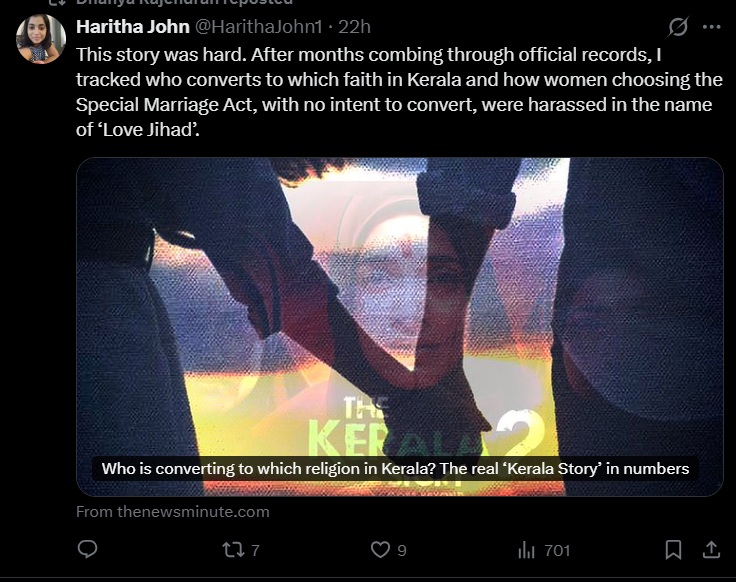
The News Minute also tried to build some buzz around the ‘report’. But it has turned out to be a damp squib. 
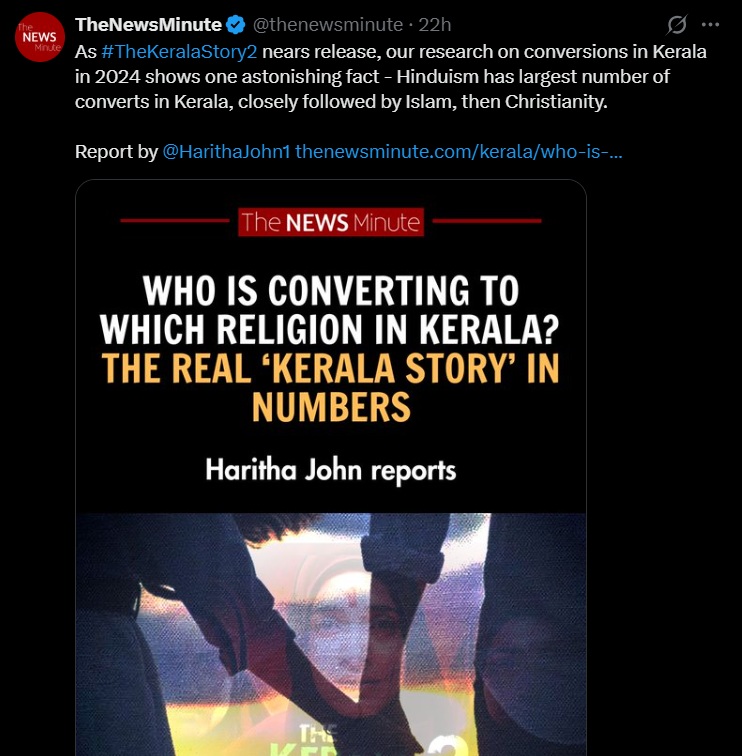
The News Minute says they combed through Kerala’s 2024 gazette and so many records to try and show its audience, that love jihad was a myth, that conversions were a myth in Kerala – a state where Hindus are not the majority.
This report’s central claim is that Hinduism is the ‘biggest’ gainer in terms of conversion. They share this table ‘data’ from the 2024 Gazette to prove their claim is right.
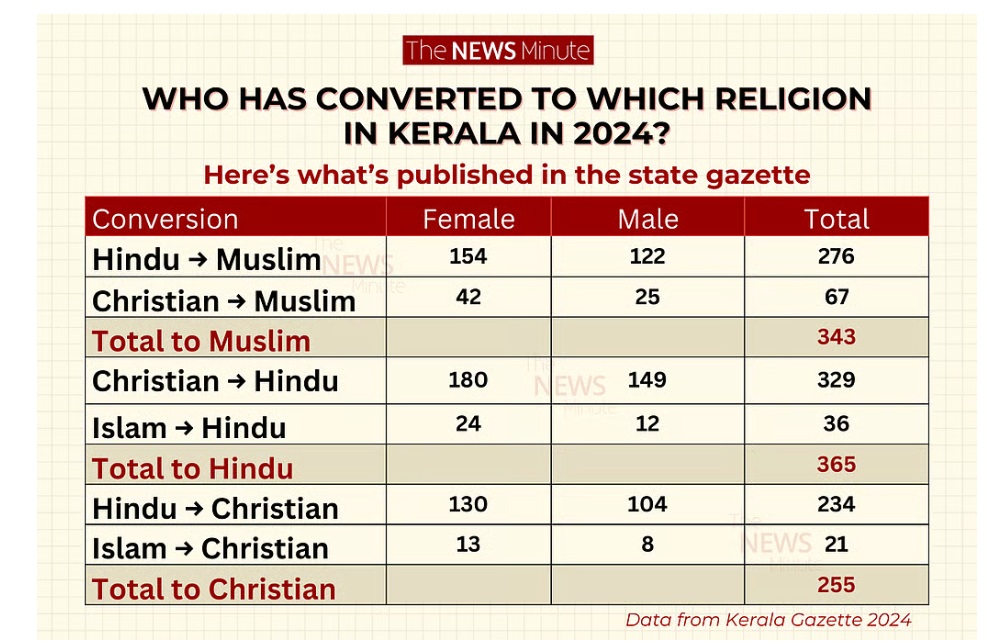
The News Minute highlights figures that support its conclusion, but a broader look at the data tells a different story. Try asking them to analyse it as a whole – they most likely won’t because ‘That is not how you look at data’.
Let us look at their claims:
- 365 people converted to Hinduism in Kerala in 2024, making it the biggest gainer in conversions.
- 262 of those 365 Hindu converts were Dalits who converted to gain Scheduled Caste reservation benefits.
- Only 67 Christians converted to Islam in 2024, of whom 42 were women.
- In 2020, Hinduism accounted for 47% of all registered conversions (241 out of 506).
- Conversion patterns have remained broadly similar over several years, with Hinduism consistently the biggest gainer.
Now let us bust these lies.
Lie No. 1: “Hinduism Is the Biggest Gainer” – Their Own Table Says The Opposite
TNM leads with the claim that Hinduism attracts more converts than any other religion in Kerala, citing 365 people converting to Hinduism in 2024. This is presented as the centrepiece of their debunking.
Now look at the same table they published:
Hindus leaving faith:
- Hindu → Muslim: 276
- Hindu → Christian: 234
Total OUT Of Hinduism: 510
People joining Hinduism:
- Christian → Hindu: 329
- Islam → Hindu: 36
Total IN To Hinduism: 365
NET RESULT FOR HINDUISM: -145
Hinduism lost 145 people net, using TNM’s own numbers. More Hindus walked out the door (510) than walked in (365).
The “biggest gainer” headline is built on gross inflow alone, while deliberately hiding the net loss. This is not a subtle oversight. This is the central deception of the entire piece – burying the headline finding that their own data actually supports: more Hindus are converting to Abrahamic faiths than the reverse.
A standard practice in any honest data journalism is to present both inflows and outflows when calculating net change. TNM chose not to do this. That choice was editorial, not accidental.
Lie No. 2: The Gazette Data Represents The Full Picture Of Conversion
TNM frames “10,000 pages of Kerala Gazette records” as the authoritative source for religious conversions in the state. But gazette notification of conversion is not mandatory for everyone – it is primarily required when a person needs to formally change their name, claim government benefits, or establish their new identity legally.
The Scheduled Caste Reservation Loophole
The most significant category where gazette notification becomes almost compulsory is when Dalit Christians convert back to Hinduism to reclaim their Scheduled Caste reservation benefits – a legal and economic incentive that has nothing to do with spiritual conviction.
TNM itself admits this: 262 of their 365 Hindu converts, that is 71.7%, were Dalits converting for SC status. So Hinduism’s “biggest gainer” status is, in the majority, a bureaucratic paperwork exercise driven by reservation law, not a wave of spiritual and ideological conversion to Hinduism.
The Undercounting Of Islam Conversions
Meanwhile, conversions to Islam for marriage purposes, the most common reason cited across TNM’s own case studies, do not require gazette notification unless the person wants a formal name change. This means:
- The Islam inflow number of 343 is almost certainly a significant undercount
- The Hindu inflow of 365 is artificially inflated by reservation-driven reconversions
The two numbers are not comparable. Presenting them in the same table as equivalent without this caveat is a fundamental methodological failure.
According to Kerala Gazette rules, notification is optional for religious conversion unless it involves a formal name change or benefits claim. Most conversions through marriage under personal laws (Muslim Marriage Act, Christian Marriage Act) do not trigger automatic gazette notification unless the individual seeks legal name change or SC/ST status modification.
This creates a systematic sampling bias:
- Dalit Christians → Hindus: Near-universal gazette notification (driven by SC status claims)
- Hindus/Christians → Muslims (via marriage): Selective gazette notification (only when name change desired)
TNM uses this administratively skewed dataset as if it represents the universe of conversions in Kerala – a methodological fraud at the foundation of the entire analysis.
Lie No. 3: Applying Asymmetric Scrutiny To Hindu, Christian And Muslim Conversion Networks
Here is where TNM’s report abandons even the pretence of balance. The article:
Devotes extensive paragraphs to documenting a Christian far-right surveillance network, CASA, complete with a named source (Kevin Peter) who openly describes monitoring marriage registration offices, collecting addresses, informing parents, using force to bring women back, and coordinating with the RSS.
Documents VHP’s “Dharma Rakshakas” – 100 ground-level workers across Kerala who visit families and intervene when Hindus convert to other religions.
Quotes the Pala Diocese priest claiming to maintain “files on women lured by Muslim men.”
All of this is used to frame the right-wing as the problem – organised coercive networks policing women’s choices.
Now ask: What investigation did TNM do into the organised networks that produced the 343 Islam flow? Zero.
There is no named Muslim community organisation.
There is no equivalent investigation into whether any Islamic body monitors marriages, facilitates conversion, or pressures converts. Not a single paragraph.
In a piece ostensibly about conversions to all three religions, the machinery behind the largest single directional flow (343 → Islam) is never examined.
By TNM’s own logic, if a Christian surveillance network justifies detailed coverage and condemnation, then the absence of any equivalent investigation into Muslim conversion networks is not neutral journalism – it is a deliberate blind spot.
And to use the framing the report itself would never dare apply:
If 329 Christians converting to Hinduism warrants investigation of a VHP conspiracy, then 276 Hindus converting to Islam should warrant an equal investigation of Islamic conversion networks.
The report does one, not the other.
Lie No. 4: Misrepresenting Justice K.T. Sankaran’s 2009 Findings
The report attempts to legitimize its narrative by claiming that in 2009, Kerala High Court Justice K.T. Sankaran asked the police if an organized Love Jihad movement existed, and states: “No such finding was established.”
As published in Indian Express on 9 December 2009, Justice KT Sankaran explicitly stated on record that police reports revealed a “concerted” effort to convert girls with the “blessings of some outfits”.
From the court’s order, he observed that some 3,000 to 4,000 such incidences had taken place over a four-year period. The judge went as far as advising the government to consider enacting laws to prohibit compulsive and deceptive conversions. He noted that “some organisations are indulging in such activities” and called for a comprehensive investigation.
The Supreme Court’s Dual Position In Hadiya Case
The article mentions the Hadiya case but fails to provide complete context. What actually happened:
In 2017, the Supreme Court took a dual position:
- Upheld Hadiya’s individual right to marry (Shafin Jahan)
- Directed NIA to investigate whether an organised network existed to facilitate such conversions and potential radicalization
The NIA was specifically asked to investigate:
- Whether this was limited to a “small pocket” or “something wider”
- Whether systematic forced conversions were taking place
- Links to radicalization and ISIS recruitment
The Supreme Court bench (CJI JS Khehar and Justice DY Chandrachud) stated they wanted a “whole picture” from a “neutral agency.”
TNM does the first (celebrates individual marriage) and ignores the second (the legitimacy of investigating organised networks).
That is not balance – that is selection bias built into the story architecture from the beginning.
The ISIS Recruitment Reality TNM Won’t Touch
The core allegation of “Love Jihad” and the premise of films like The Kerala Story, centers on targeted grooming, deceptive practices (such as faking identities), and subsequent radicalization.
Real-world examples from Kerala:
In 2016, 21 individuals left Kerala to join ISIS, including:
- Nimisha (renamed Fathima) – Hindu woman who converted to Islam, married Bexen Vincent (who converted and renamed Isa), both left for Afghanistan to join ISIS
- Sonia Sebastian (renamed Ayisha) – Christian woman who converted to Islam, married Abdul Rashid Abdullah (identified by NIA as mastermind of ISIS recruitment in Kasargod)
- Merrin Jacob (renamed Mariyam) – Another Kerala woman who joined ISIS with husband
- Rafaela – Third woman from Kerala who fled with ISIS recruits
NIA Findings:
- Abdul Rashid was identified as the ring leader of the Kasargod ISIS module
- Systematic radicalization through conversion and marriage
- Use of matrimonial networks and handlers to arrange marriages
- PFI connections in several cases
- Handlers actively seeking “active members” as grooms
This is TNM’s response to the documented security threat – The article interviews a handful of women who converted willingly and did not join a terror outfit. It then uses these anecdotes to dismiss the entire “Love Jihad” concern.
This is a classic Strawman argument – attacking a weakened, simplified version of the opponent’s claim rather than addressing the actual documented threats.
Pointing to consensual interfaith marriages does absolutely nothing to disprove the existence of organised coercive networks or the documented cases of radicalization.
Lie No. 5: The “Voluntary Coercion” Paradox (Double Standards In Agency)
The article displays severe editorial bias in how it defines “choice” versus “coercion” depending on the religion involved.
When Hindu/Christian families intervene, it is framed as “punishment,” “torture,” “emotional blackmail,” “surveillance”, “patriarchal policing”, “denial of women’s agency” and an extensive sympathetic coverage towards the girls.
When Muslim families set conditions:
From TNM’s interview with Sneha, a Hindu woman who converted to Islam: “Afsal’s family would accept our marriage only if I converted… This was my choice.”
The Fallacy
If a religious conversion is a non-negotiable prerequisite imposed by the groom’s family to accept a marriage, it inherently operates under conditionality and duress. Framing an ultimatum from a Muslim family as empowered “choice” while framing Hindu/Christian parental intervention as “patriarchal policing” is hypocritical.
Both scenarios involve family pressure. Both involve conditions on the relationship. Yet TNM applies completely different moral frameworks depending on which religion is imposing the condition.
Lie No. 6: Using Pew Data Selectively To Dismiss What It Actually Supports
The report cites the 2021 Pew Research Center finding that 98% of Muslims marry within their own community while 95% of Christians and 99% of Hindus do the same as evidence that “Love Jihad is statistically negligible.”
This is a misreading of the Pew data on multiple levels:
The Pew Data Actually Supports Asymmetric Flow
The same Pew study found that two-thirds of Indians believe it is very important to stop inter-religious marriages with Muslims being the most opposed (80%) to their women marrying outside the faith. This creates a structural asymmetry:
- Muslim men face far less internal resistance when marrying non-Muslim women
- Muslim women face extreme internal resistance when marrying outside
The asymmetry in the gazette data (as observed earlier) is entirely consistent with this finding – more non-Muslim women are crossing into Islam than Muslim women are crossing out, exactly as you would predict from Pew’s community endogamy data.
Endogamy Doesn’t Contradict Organised Intervention
Strong endogamy norms and organised community intervention are not contradictory. Precisely because 98% of Muslims marry within the community, the 2% who cross community lines become:
- Highly visible
- Contested
- Subject to pressure from multiple directions
The gazette’s 343 conversions are drawn from that contested 2%.
Category Error: Population Statistics Vs. Individual Conduct
The Pew statistic says nothing about whether organised efforts exist to facilitate or impede specific types of interfaith marriages.
Using a population-level endogamy statistic to dismiss individual-level organised conduct is a category error, comparing macro trends to micro mechanisms as if they measure the same thing.
Lie No. 7: Macro Demographic Change Is Dismissed With Micro Data
The gazette records cover roughly 950-1,000 formal conversion declarations per year in a state of 35 million people.
TNM uses this micro-slice to imply that demographic change driven by religious conversion is not happening in Kerala. But the macro demographic data tells a completely different story.
Kerala Census Data:
- Muslim population share: 26.56% (2011) → 29.14% (2021) = +2.58 percentage point rise in one decade
- Hindu population share: 54.73% (2011) → 52.61% (2021) = -2.12 percentage point decline
- Christian population share: 18.38% (2011) → 17.87% (2021) = -0.51 percentage point decline
Vital Statistics Data (2011-2020):
- Total natural accretion (births minus deaths): 26 lakhs
- Muslim contribution: 16 lakhs (62%)
- Hindu contribution: 6.44 lakhs (25%)
- Christian contribution: 2.88 lakhs (11%)
Of the 26-lakh population increase in Kerala over the decade, Muslims alone contributed 16 lakhs, despite being only 26-29% of the population.
Muslim share in live births increased by 8%, while Hindu share declined by 4% and Christian share by 3.3%.
This means Muslim share in live births is much higher than their total share in Kerala’s population, indicating significantly higher fertility rates.
The 2.5 Percentage Point Surge
According to demographic analysis by the Centre for Policy Studies, “For the ten years of 2011 to 2020, the natural accretion to the population of Kerala has been around 26 lakhs, of which 16 lakhs are Muslims. The share of Muslims in the population in this decade, because of natural accretion alone, would have risen by about 2.5 percentage points, which would be the highest rise in their share in the entire period of modern Census.”
The previous highest was 1981-91, when Muslim share rose by 2 percentage points.
TNM’s Sleight Of Hand
By focusing only on the 950-odd gazette declarations per year, TNM creates the false impression that it has addressed the demographic change question. It has not.
The gazette data and the census demographic data measure entirely different things:
- Gazette: Formal legal conversions (tiny subset, administratively biased sample)
- Census: Total population shifts (driven primarily by differential fertility rates)
Conflating them or using one to dismiss the other is intellectually dishonest.
These demographic shifts are primarily driven by differential birth rates, not gazette conversions – a completely separate phenomenon that the article never engages with because it would undermine the core narrative.
Lie No. 8: “Gendered Islamophobia” – A Label That Erases Gender Data In Their Own Table
The report argues that scrutiny of Hindu/Christian women marrying Muslim men, but not the reverse, constitutes “gendered Islamophobia.”
Look at the gender data in their own table:
INTO ISLAM:
- Hindu → Muslim: 154 women (55.8% of flow)
- Christian → Muslim: 42 women (62.6% of flow)
- Total women → Islam: 196 out of 343 (57.1%)
OUT OF ISLAM:
- Islam → Hindu: 24 women (66.6% of flow)
- Islam → Christian: 13 women (61.9% of flow)
- Total women → out of Islam: 37 out of 57 (64.9%)
Women are the majority of both the inflow into Islam AND the outflow from Islam.
The gendered nature of religious conversion is a universal feature across all three religions in this dataset – not a uniquely anti-Muslim or Islamophobic phenomenon.
Yet the report only applies the “gendered surveillance” critique when Hindu/Christian groups are involved, not when it comes to the 57 Muslim women who converted out of Islam, presumably also navigating family and community pressure.
The Pew Data TNM Won’t Apply To Muslims
The same Pew Research data the report cites shows Muslim communities are most strongly opposed to their women marrying outside (80%) – meaning Muslim women who leave for Hinduism or Christianity are likely facing the most intense internal community resistance of all.
TNM investigates this zero times. There is no coverage of:
- What pressure do Muslim women converting out face?
- Are there organised Muslim community efforts to prevent women from leaving Islam?
- What role do Muslim religious bodies play in policing women’s choices?
The “gendered Islamophobia” framing is selectively applied to deflect scrutiny of Muslim community practices while amplifying scrutiny of Hindu/Christian community practices.
Lie No. 9: One-Sided Victimhood Narratives
TNM presents three case studies, Angel, Sneha, and Anakha, all of whom are women who chose to be in interfaith relationships with Muslim men and were subjected to coercion by Hindu/Christian family members or right-wing groups.
These stories may be entirely true and deserve to be told.
But in a piece claiming to present “the real Kerala story,” TNM presents:
Zero cases from women who allege they were manipulated, deceived or pressured into conversion-linked marriages
This is not because such cases do not exist. Courts across Kerala have heard them, including:
- The Hadiya case (went to Supreme Court)
- The Akhila Ashokan case (High Court annulled marriage citing “Love Jihad” concerns before SC intervention)
- Multiple cases where families alleged identity fraud or grooming
The article also interviews men who converted to Islam and Christianity:
Praveen (converted to Islam): “There were some objections from relatives, but nothing beyond that.”
Suresh (converted to Islam): “I found the truth in Islam. I faced no opposition.”
TNM uses these to establish that:
- Men face little interference → proving the scrutiny is gendered
- Women who convert freely exist → proving “Love Jihad” is a myth
This is classic selection bias:
- Interview women who confirm your narrative (willing converts facing family opposition)
- Interview men who confirm your narrative (no opposition faced)
- Ignore women who would contradict your narrative (those claiming deception or pressure)
Statistical Insignificance Masking Demographic Reality
Kerala’s population: ~35 million
Gazette conversions in 2024: ~963 total declarations
This represents 0.0027% of the population.
Using this microscopic, heavily caveated dataset to draw sweeping conclusions about religious demography in Kerala is statistically trivial.
It serves as a sleight of hand to mask:
- Broader demographic realities (Muslim population rising by 2.5 percentage points)
- Differential fertility rates (Muslims contributing 62% of population growth despite being 27% of population)
- Aggressive, undocumented proselytization efforts
- Informal conversions not requiring gazette notification
By isolating a tiny, legally mandated subset of data where Hinduism artificially appears dominant (due to SC reservation technicalities), TNM creates a narrative wholly disconnected from the macro demographic reality of Kerala.
In attempting to debunk The Kerala Story, TNM has written its own version of motivated journalism – one where the conclusion is decided first and the data is arranged around it afterwards. TNM chose to see only what it wants to perceive as reality and what it wants its readers to perceive too – the propaganda that its paymasters have hired them for.
Subscribe to our channels on WhatsApp, Telegram, Instagram and YouTube to get the best stories of the day delivered to you personally.