



The news of the death by suicide of a newly married woman Rithanya, in Tiruppur, Tamil Nadu, sent shockwaves across the state. It is 2025 and even today to have dowry harassment-led deaths occur in a so-called developed state, should be a matter of shame.
Opinion writers should have asked why, even today, in a state that ranks high on social indicators, a young woman died due to dowry harassment just 78 days into her marriage.
But instead, the “feminists” of the EVR ilk at The News Minute decided to pin the blame on – no, not patriarchy directly, but on… chastity!!
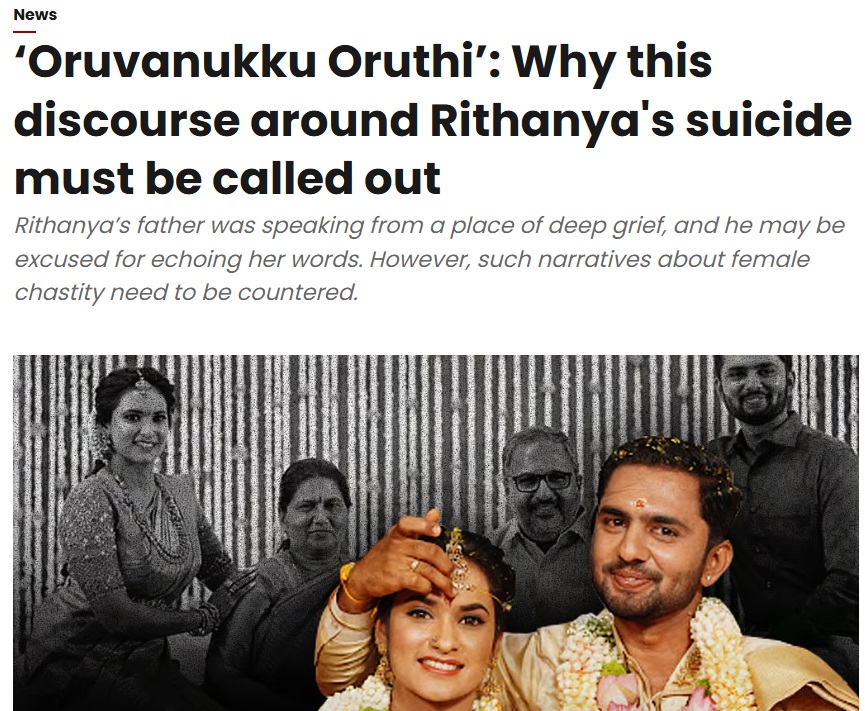

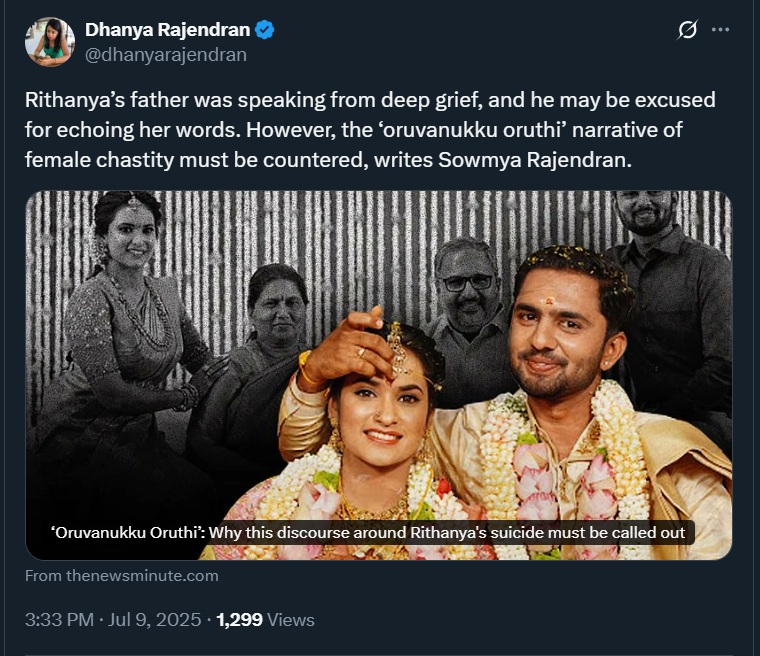
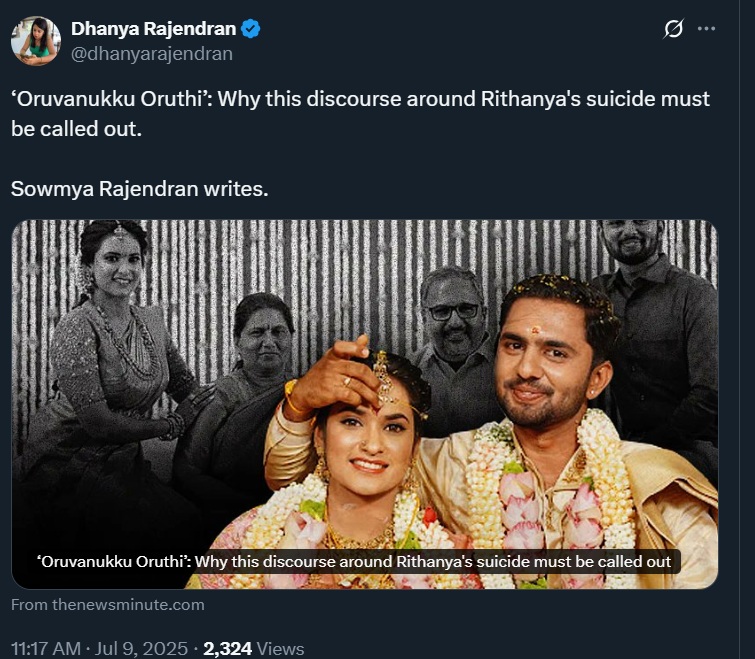
There was a lot of controversy over how the statements of the aggrieved father were reported by Dravidianist media. The lack of empathy among media professionals is telling. TNM, which is an unofficial mouthpiece of the DK-DMK gang, jumps on the bandwagon to mock and suppress the dying voice of the young woman.
The piece is patronizing to say the least and one can see a blatant mischaracterization of Rithanya’s last words. This is deeply disrespectful to the dead woman who can no longer speak.
The article says, “Her father, Annadurai, repeated his daughter’s words, regretting her suicide, but lauding her for upholding the principle of “oruvanukku oruthi”. “
And goes on to explain the “concept”. ““Oruvanukku oruthi” means monogamy, but the phrase is closely tied to ideas about female virginity and chastity. In this context, it implies that a woman who has been bedded by a man is somehow sullied if she sleeps with another one. Her body, once touched by a man, belongs to him, and she becomes “impure” if she walks out of that relationship and chooses a different partner.”
The extended explanation given by the writer is a tone-deaf agenda-driven projection that insults Rithanya who cannot speak for herself.
Rithanya, in her final voice notes, said her husband Kavin Kumar physically tortured her daily and that her father-in-law Easwaramoorthy and mother-in-law Chitradevi mentally abused her, saying that she could no longer live this life, that she no longer had the mental and physical strength to choose another life and she believed in “oruvanukku oruthi”. She further says that her husband’s family was putting on a very nice face in front of society and that they did nothing wrong. She also states that no matter who she tells about what happened, she is advised to endure life. Weeping, she lamented about how no one understood her pain and that she did not want to be a burden to her parents.

Making A Case For Polyamory?
The explanation given for “oruvanukku oruthi” concept by the writer – “In this context, it implies that a woman who has been bedded by a man is somehow sullied if she sleeps with another one. Her body, once touched by a man, belongs to him, and she becomes “impure” if she walks out of that relationship and chooses a different partner.” seems to make it absolutely necessary for a woman to have multiple sexual partners. Are they making a case for polyamory then? Following their ideologue EV Ramasamy Naicker’s words who “championed” for “progressive” ideas like having multiple partners, advocating illicit extramarital affairs, and have limitless sexual lives for women to break from the bondage of family and patriarchy, the writer in this article seems to be pushing for mainstreaming polyamory or rather indulge in extramarital affairs when in a marriage?
Sexual perversion is not new to Dravidianists who follow the path of EVR. TNM is right on that path and that is why you see how they twist the dead woman’s words and make “chastity” the villain for her death – out of nowhere. That is why they are “calling out” this discourse! So brave of them!

How TNM Twists Rithanya’s Words
Rithanya in her final messages states the “oruvanukku oruthi” phrase because she could have given her heart to her husband entirely and could not imagine living a new life. Her last words are not conditioned by patriarchy or chastity, but they are words of despair and hopelessness that she does not have the strength or energy to start a new life.
Who gave TNM the authority to attribute the death to chastity? Instead of addressing the problem of dowry in a state that the likes of TNM hail as a developed state, the writer chose to take the path of “virginity”.
Did Rithanya call and tell the writer, that her words meant what they have made it to be? Is it a crime to not have one after a marriage that “failed”? There are lakhs of women in India and around the world who have walked out of marriages and continued to stay single without remarrying and achieving great heights. Does the writer and TNM not acknowledge that women can live a life like that?
Rithanya’s parents stated that she would return home after incidents of abuse, only to be persuaded by her husband and in-laws with promises that the behaviour would not be repeated. But the abuse continued. After witnessing this repeated cycle, Rithanya may have felt that no one could truly help her. She could have reached out to family or friends, but as mentioned above, she found everyone around her advising her to adjust and continue her life. To conclude that she died by suicide because of notions of chastity is not only unfounded, but also extremely irresponsible.
Incorrect Parallels
The writer goes on to draw a parallel with the story of a dowry harassment victim Mofiya Parveen who chose to continue living with her husband, “According to her family, she too chose to stay back with her abusive husband, rather than walk away, believing that there was only one man she could live with in a lifetime.”
Does the writer who famously writes about avarna-savarna nonsense acknowledge that this is not a Hindu problem now? Would she dare question the Muslim community over dowry harassment?
The woman decided to live with her abusive husband because in Islam, she is as good as a burnt matchstick after marriage. The writer can probably enlighten the audience about the number of remarriages among Muslim women.
Abuse Is Not About Chastity – It’s About Power
As someone who has witnessed domestic violence closely, yours truly can say with certainty – abuse has nothing to do with purity myths. It has everything to do with control, isolation, and emotional collapse. Most survivors stay in abusive relationships not because they fear being called “impure,” but because they have been mentally broken down and feel utterly alone.
TNM and their writer has no business theorizing about a trauma they clearly do not understand. Women don’t need an academic diagnosis in the middle of their pain. Has the writer heard of the abuse cycle? Maybe she can read up about it.
And What About Women Who Misuse the System?
In recent months, many men have taken their own lives after stating that they were falsely accused by their wives under dowry laws. There are women who use these laws to harass, extort, and destroy. When such cases come up, the same TNM writers go completely silent. Why is that? Dowry laws exist for a reason – to protect women like Rithanya and Logeshwari (another young woman who died by suicide owing to dowry harassment); these laws do not exist to be manipulated. But when the likes of TNM ignore the misuse, the credibility of these laws suffers. It becomes harder for real victims to get justice. Why doesn’t TNM or this feminist writer talk about that?
TNM Silenced Rithanya by Rewriting Her
Ultimately, the writer and TNM did what they always accuse others of doing – they took away a woman’s voice and replaced it with their own. They used a grieving father’s words, twisted them, and then mocked the very sentiment behind them. Instead of asking why a woman died in one of India’s most “developed” states, why dowry still ruins lives, or why society still shames abuse survivors, they chose to write an opinion piece about virginity.
Subscribe to our channels on Telegram, WhatsApp, and Instagram and get the best stories of the day delivered to you personally.