
The first instalment of The Kerala Story left people shocked, enraged, aware – of how Hindu girls were being targeted by Islamists in order to achieve their own goals, converting them, making them pregnant as well as brainwashing them to join terrorist groups like ISIS – Kerala Story 2 will take you beyond that. It will give you a hard view of what is happening across the country, to our little girls.
The Kerala Story 2 is yet another hardhitting film that has to be watched by parents, families, especially young girls. We’ll tell you why.
A Brief On What The Film Is About
The Kerala Story 2: Goes Beyond follows three young women, Surekha Nair from Kerala, Neha Sant from Gwalior, and Divya Sinha from Jodhpur, each of whom enters a relationship that ends in coerced religious conversion, abuse, and family rupture.
The film opens with Surekha’s suicide and Neha lying injured after jumping from a building. What follows is three parallel stories cohesively converging around the same pattern: a relationship built on deception, escalating pressure to convert, and parents who are left with no legal recourse and no answers.
The three lead actresses Ulka Gupta as Surekha from Kochi, Aditi Bhatia as Divya from Jodhpur, and Aishwarya Ojha as Neha from Gwalior play their roles to perfection. The film’s real emotional weight falls on the parents and the actors playing them deserve far more credit than any review has so far given them. They show you how it feels to be the parent of a love jihad victim.
Mannan Shah’s music is one of the film’s strongest assets. The BGM does not manipulate the audience at every beat, and the song centred on the mother – O Maayi Ri is genuinely moving without being overexaggerated. The final 15–20 minutes with Shiv Shambho leave a powerful emotional impact, especially if you are a parent. Played at a moment when parents seek justice for their wronged daughters, the song with Manoj Muntashir’s stirring words feels deeply elevating and goosebump-inducing. It ultimately instils hope and the belief that justice will prevail against those who deserve punishment.
Some Words For Those Dissing This Film
Right from the get-go, across the board, leftists and news portals like The News Minute have been dismissing the film, just like they did for the first instalment – they claimed the film was based on WhatsApp University forwards, that it was demonising an entire community, that Namaz tunes were made to sound ominous; The Week called it “Group therapy for saffron-coloured dummies”; the mockery has been repetitive and unfunny.
What these reviews do not tell you, in fact they bury under the ground is that this film is based on real life incidents.
What They Do Not Tell You
Not one of these reviews mentioned Mohammed Umar Gautam. Not one mentioned that in September 2024, a Lucknow court sentenced him, founder of Delhi’s Islamic Da’wah Centre, along with Maulana Kaleem Siddiqui and 10 others to life imprisonment for running an organised conversion racket targeting over 1,000 people. This was an NIA-ATS prosecution that ended in a court conviction. Twelve people are serving life sentences for doing what this film depicts. Not one mainstream review found space to mention it.
They don’t mention Chhangur Baba, arrested by the UP ATS in July 2025, whose network is accused of converting over 1,500 Hindu women – with an actual rate list, categorising women by caste, recovered during the investigation. Pooja Prasanna told her audience those rate cards were a WhatsApp forward from 2010. The ATS recovered one during an arrest in 2025.Well, she is clearly wrong.
They don’t mention Mission Asmita – the July 2025 UP Police operation that dismantled a pan-India conversion and radicalisation syndicate spanning six states, with arrests in Rajasthan, Dehradun, and West Bengal, triggered by the disappearance of two sisters. Not one review mentioned Shekhar Roy and Usama Khan, operators of the Kolkata-Agra conversion corridor, arrested for orchestrating an interstate scheme that systematically targeted women from Bengal and UP. These are police operations with named accused, chargesheets, and arrests.
These reviews dismiss the bulldozer as a caricature lazily linked to UP CM Yogi Adityanath. In the film, however, the bulldozer moment lands as pure catharsis for viewers – much as it did for victims and their families in real life. The same UP government had actually demolished Chhangur Baba’s residence – the man who ran a massive prostitution racket, an important detail the film reflects. Yet outlets like TNM would rather sneer than engage with the facts.
TNM’s Pooja laughs off the “Ghazwa-e-Hind 2047” poster in the film with open mockery. The obvious question is whether she is dismissing the documented ‘2047 vision’ associated with PFI-linked discourse altogether or simply choosing not to engage with its implications. Either way, the flippant tone raises concerns about whether uncomfortable facts are being waved away too casually.
Another highly flawed take, especially from TNM’s Pooja is the “consenting adults” trope. This defence collapses at the first point of contact with the film’s actual content. Divya is under 18, she is not the only one – there are several victims like her who appeared at the promotional event done by the film’s producer/director team.
Divya’s parents try to file a POCSO complaint, but the opposite party proves her to be an adult and the police in connivance with the Islamists’ family sends her off to the perpetrator’s home! Where have you seen/heard this? Let us remind you that this happened very recently in Tamil Nadu too – Read this report.
Dear Pooja & TNM, the feminists that you all are, a minor cannot legally consent and no sophistication changes that – Divya is shown to be under 18 in the film and what was happening to Divya was grooming! Are you denying that?
In what world does staying in a relationship require you to change your religion, abandon your family, and answer to a new name, is this choice or coercion dressed in romantic language – Has anyone ever thought about it?
The leftist seculars and their portals who are dismissing the film as ‘WhatsApp University’ and what not are the first ones to give a Hindu name to an Islamist perpetrator. The film shows a Shraddha Walkar like instance – Pooja or other reviews do not talk about that, in fact TNM had secularised the gruesome murder. The portal casually shared the ‘report’ as “Man kills partner, chops her body and leaves pieces at various places in Delhi. The man strangled the woman in May after an argument over marriage, Delhi police said.”
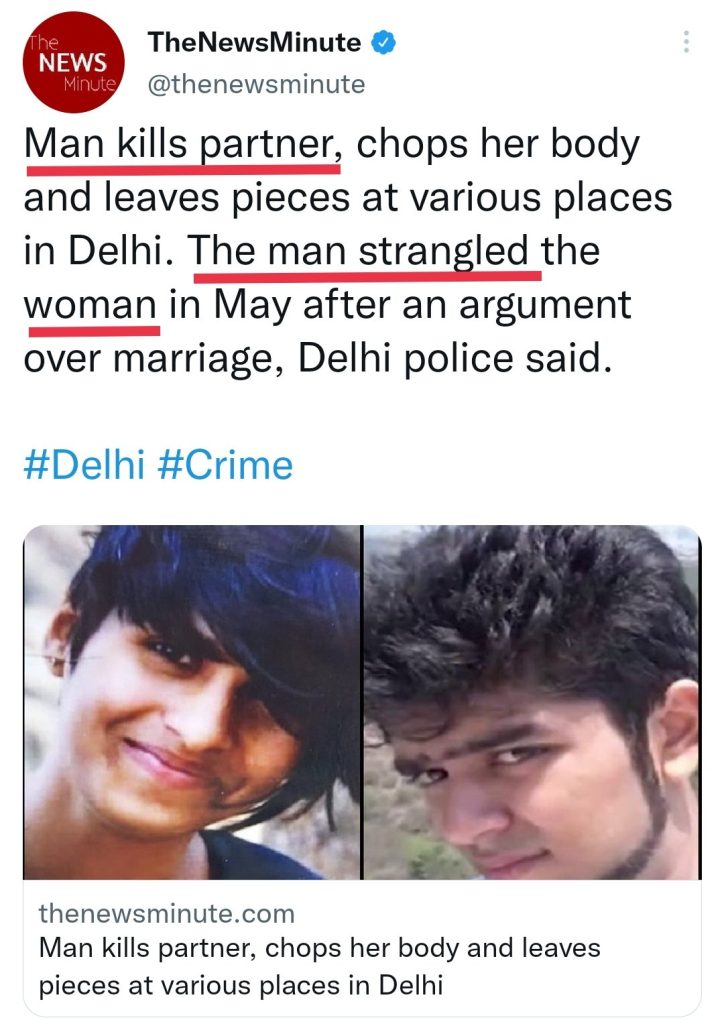
And last but not the least – the most common grouse every single leftist seems to have – the name of the film. It isn’t rocket science to see the film’s title in its entirety – The title is “The Kerala Story 2 – Goes Beyond” – The Kerala Story of love lihad was identified first in Kerala before spotting similar modus operandi across the country. In Kerala, it made women enroll with terror organisations too. In other parts of India, it served the purpose/goal of Ghazwa-e-Hind and continues to do so.
It was not just Hindus who were crying hoarse, it was the Christians too. Can TNM or Pooja or Dhanya Rajendran deny that? Will they diss the stories of other girls who have been rescued by Hindu Seva Kendram or Aarsha Vidya Samajam? Whatever gymnastics they do with numbers to prove forced conversions do not exist, truth always reveals itself. Read more on this here.
The Kerala Story 2 Needs To Be Watched
The Kerala Story 2 is not a perfect film. It is direct to the point of bluntness and makes no effort to appear balanced. But it is documenting something real – confirmed by courts, by the ATS, by NIA chargesheets and it is doing so while keeping the camera on the people who have been most consistently ignored in this conversation: the parents. For that alone, it deserves a more honest engagement than it has received.
Do not pay heed to the negative reviews. Watch it, both parents and young adults need to.
Subscribe to our channels on Telegram, WhatsApp, and Instagram and get the best stories of the day delivered to you personally.