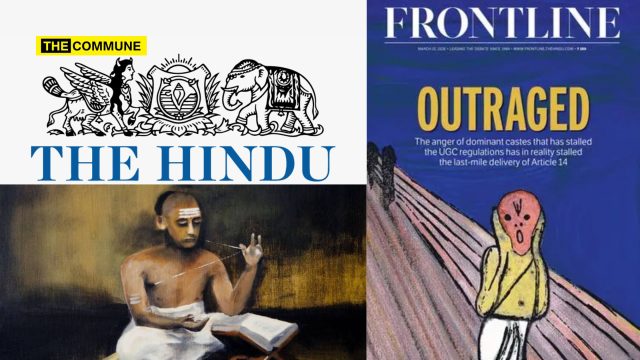
Frontline – the national magazine published by The Hindu – has plastered its March 2026 cover with a grotesque anti-Brahmin caricature that recalls the darkest techniques of 20th-century racial propaganda.
The Hindu which has gone on to become a Leftist-Dravidianist rag peddling propaganda instead of objective news has crossed a line from partisanship into something far uglier — the visual demonization of an entire community.
Rather than grappling with the substance of the nationwide debate over the University Grants Commission’s newly proposed Equity Regulations, 2026, the magazine chose to splash its cover with a grotesque caricature of a Brahmin figure onto Edvard Munch’s famous artwork The Scream — complete with exaggerated cultural markers — styled in a manner disturbingly reminiscent of early 20th-century racial propaganda.
The visual imagery is similar to how the Nazis portrayed Jews as ugly creatures to peddle hate against them.
The technique is depressingly familiar:
- Reduce a community to exaggerated physical and cultural stereotypes.
- Frame them as hysterical or morally suspect.
- Present them visually as a monolithic adversary.
History has seen this before. Anti-Jewish caricatures in Nazi Germany operated through precisely this grammar of distortion — not to argue policy, but to embed contempt in the public imagination.
The Hypocrisy Is Staggering
Imagine the reaction if a national magazine caricatured a minority community using exaggerated religious symbols. The outrage would be immediate — and rightly so. Editorial boards, academic circles, and activist groups would denounce it as hate speech.
But when the target is Brahmins, a community already demonized in sections of political discourse, suddenly caricature becomes “social critique.”
Bigotry does not become virtuous simply because it is directed at a group considered socially dominant. Dehumanization remains dehumanization.
The Dangerous Normalization Of Anti-Brahmin Caricature
Anti-Brahmin imagery has long been weaponized in certain ideological traditions — portraying Brahmins as conspiratorial, parasitic, manipulative, or hysterical. These visual tropes parallel historical propaganda methods used to stigmatize Jews in Europe.
The similarity is not accidental. Caricature has always been the lazy shortcut of those unwilling to argue on merit.
By placing such imagery on its cover, Frontline did not merely comment on a regulatory debate. It reinforced a cultural narrative that treats an entire caste identity as a legitimate object of ridicule.
Similar To The Dravidianist Trope
What Frontline’s latest caricature reflects is not an isolated lapse in taste — it fits into a much wider pattern of ideological hate messaging that has been circulated in parts of Indian public discourse for decades. A detailed analysis of Dravidianist propaganda demonstrates how visual and textual tropes eerily mimic the mechanics of early 20th-century Nazi imagery, transposed onto the Tamil Brahmin community.
Tamil Brahmins have been repeatedly depicted in Dravidian literature and pop culture as physically grotesque, morally sinister, and existentially threatening — characteristics long reserved in Nazi propaganda for Jews. Common caricatureal elements include exaggerated pot bellies, scary expressions, and religious markers like the sacred tuft or dhoti being twisted into symbols of menace rather than identity.
Through what psychologists call the Picture Superiority Effect, such grotesque visuals embed prejudice far more effectively than written argument ever could. Repeated use of zoomorphic depictions — showing Brahmins as octopuses, worms, or parasitic blobs — drives home a narrative of Brahmins as both dominant and threatening, just as Nazi cartoons once did with Jews.
Subscribe to our channels on WhatsApp, Telegram, Instagram and YouTube to get the best stories of the day delivered to you personally.