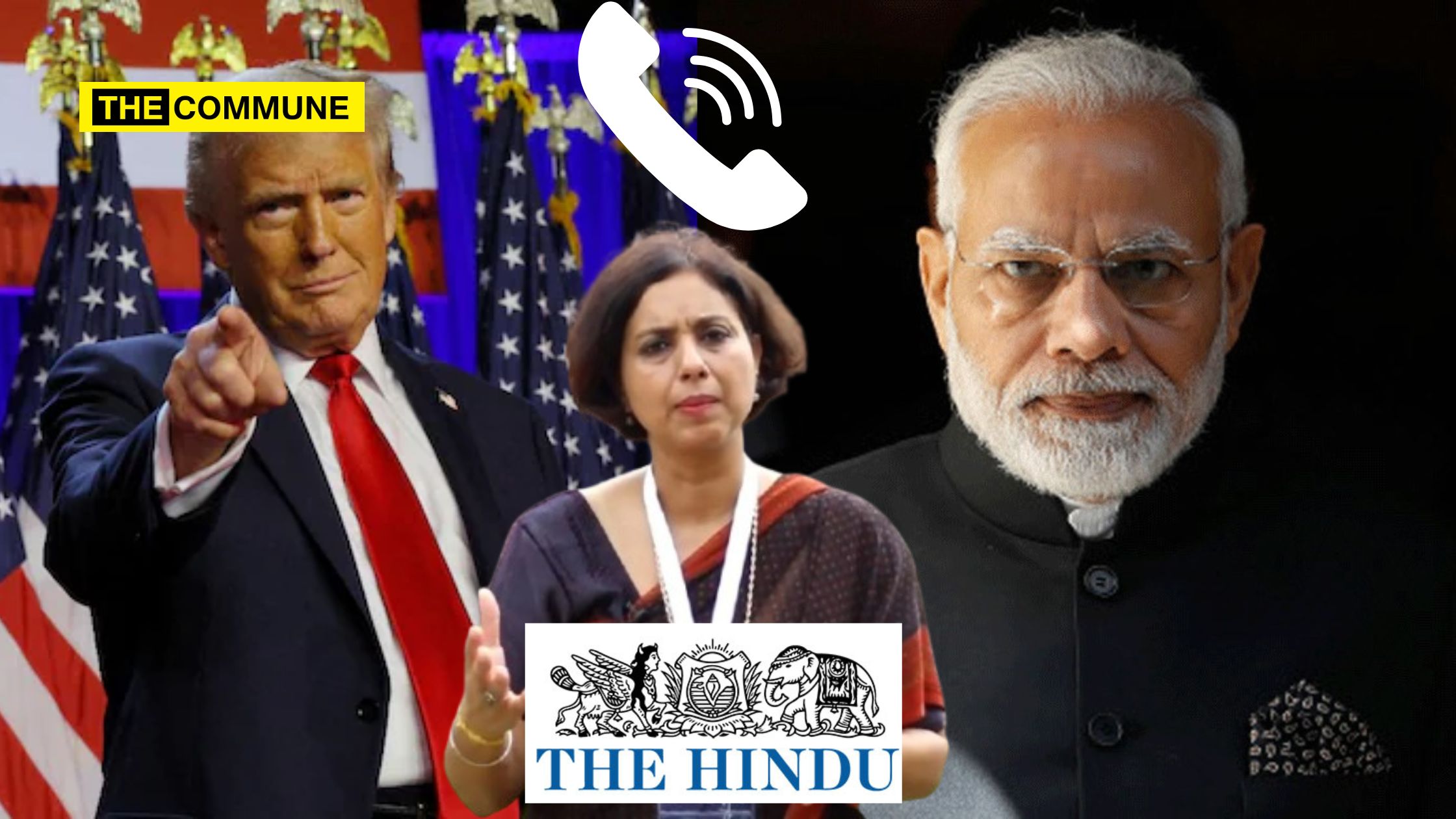
Senior journalist and Diplomatic Affairs Editor at The Hindu, Suhasini Haidar, is in the news for making misleading claims regarding the readout of Prime Minister Narendra Modi’s phone conversation with US President Donald Trump, falsely suggesting that the Indian government had issued statements only in Hindi to obscure details from international audiences.
Haidar, in a post on social media platform X, had questioned why the Foreign Secretary’s statement and the official readout of the Modi-Trump call were “issued only in Hindi and not in English, which would be understood in the US and internationally.” She insinuated that this was unusual, given President Trump’s past claims about mediation between India and Pakistan—a claim India has repeatedly rejected. She wrote, “A bit strange that both the readout of the Trump-Modi call and FS statement are issued only in Hindi and not in English, which would be understood in the US and internationally, where Mr. Trump’s repeated claims of mediation have been heard.”
A bit strange that both the readout of the Trump-Modi call and FS statement are issued only in Hindi and not in English, which would be understood in the US and internationally, where Mr. Trump's repeated claims of mediation have been heard. https://t.co/CGxfgbskKe
— Suhasini Haidar (@suhasinih) June 18, 2025
However, Haidar’s insinuation has now been thoroughly debunked.
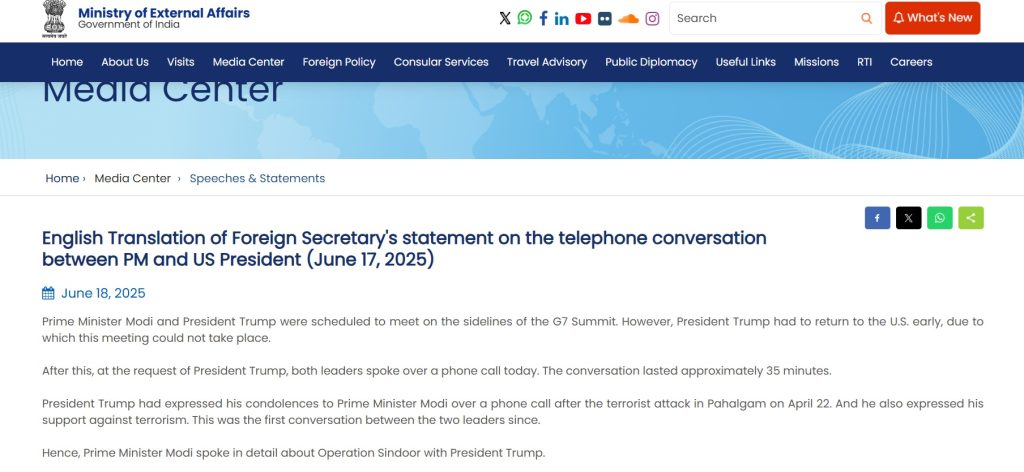
Contrary to her claim, the Ministry of External Affairs (MEA) had in fact issued a comprehensive English translation of the phone call as per Misri’s statement on the MEA website on the same day as the phone call took place – 18 June 2025. Titled “English Translation of Foreign Secretary’s statement on the telephone conversation between PM and US President (June 17, 2025)”, the document clearly outlines the key points discussed between the two leaders — including India’s categorical rejection of any third-party mediation in its dispute with Pakistan.
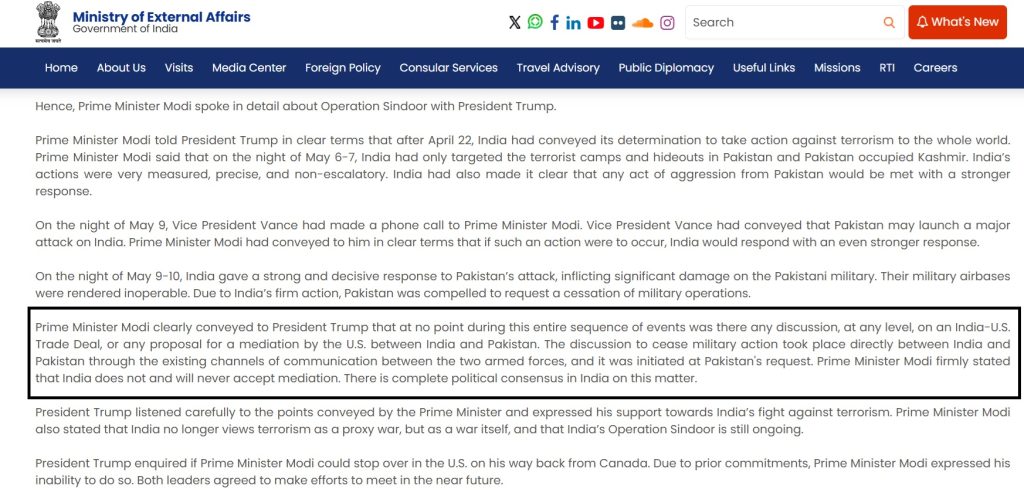
The English version, publicly accessible and prominently displayed on MEA platforms, details Prime Minister Modi’s strong statements on the Pahalgam terror attack, the objectives and execution of Operation Sindoor, and India’s unwavering position that terrorism will now be treated as an act of war, not a proxy conflict. It also clarifies that at no point during the series of events did the topic of an India-U.S. trade deal or any proposal of U.S. mediation arise — a clear rebuke to the legacy of President Trump’s past claims about being asked to mediate between India and Pakistan.
Further details in the translation underscore the diplomatic maturity with which India handled the crisis — including direct communication with Pakistan’s military through pre-existing channels, without involving third parties.
Haidar’s assertion that the statement was issued “only in Hindi,” especially when such a sensitive matter involved international stakeholders, appears either misinformed or deliberately misleading. Journalists of her stature are expected to verify facts — particularly when the information is readily available on a government website and crucial to national and diplomatic narratives.
Why Suhasini Haidar’s Narrative Falls Apart
The English translation was available within hours of the Hindi statement. There was no attempt to hide details. The MEA routinely issues statements in Hindi first, followed by English translations—a standard practice. The statement directly refuted Trump’s past mediation claims, making Haidar’s suspicion of a “cover-up” baseless. By omitting the fact that an English version existed, Haidar implied a deliberate opacity that simply wasn’t true.
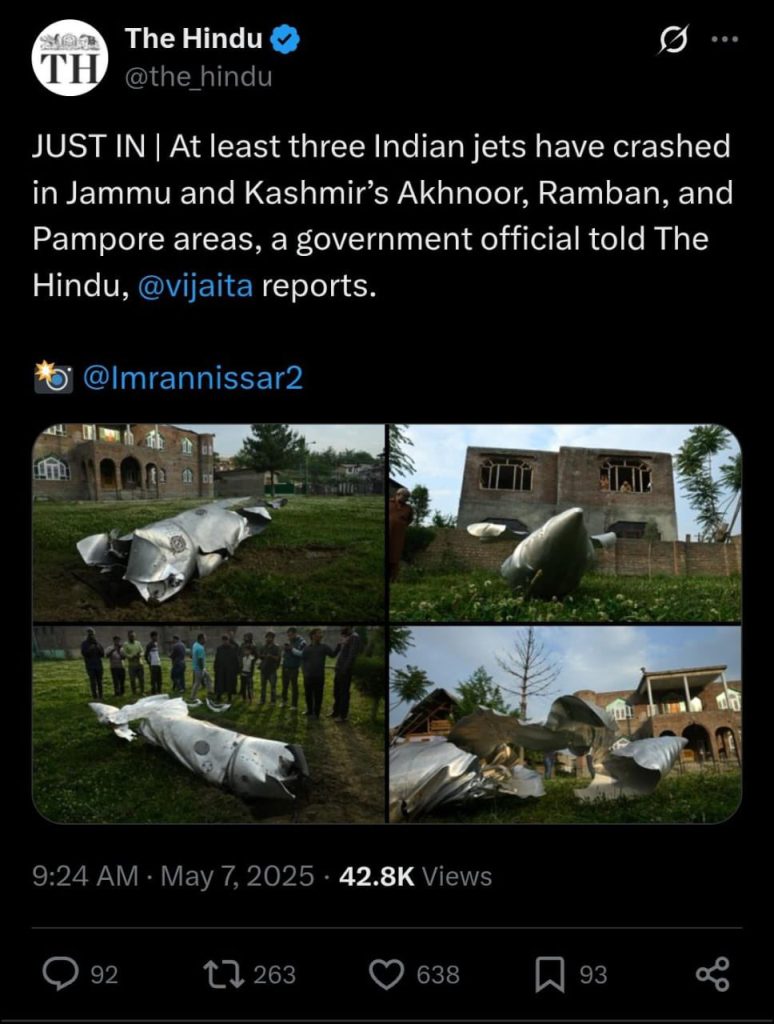
It is noteworthy that Haidar is associated with The Hindu which has a habit of publishing fake news. During Operation Sindoor, they made a social media post falsely suggesting Indian jet crashes—a claim swiftly refuted by defense experts as mere fuel tank jettisoning. The post read, “Just In|At least three Indian jets have crashed in Jammu and Kashmir’s Akhnoor, Ramban, and Pampore areas, a government official told The Hindu, @vijaita reports.” After the lie was called out, the post was deleted.
In 2020, Haidar falsely claimed on X that the Ministry of External Affairs (MEA) had asserted all of India’s foreign policy achievements began only five years ago during S. Jaishankar’s speech at the Raisina Dialogue. This was quickly debunked by listeners who confirmed Jaishankar made no such statement.
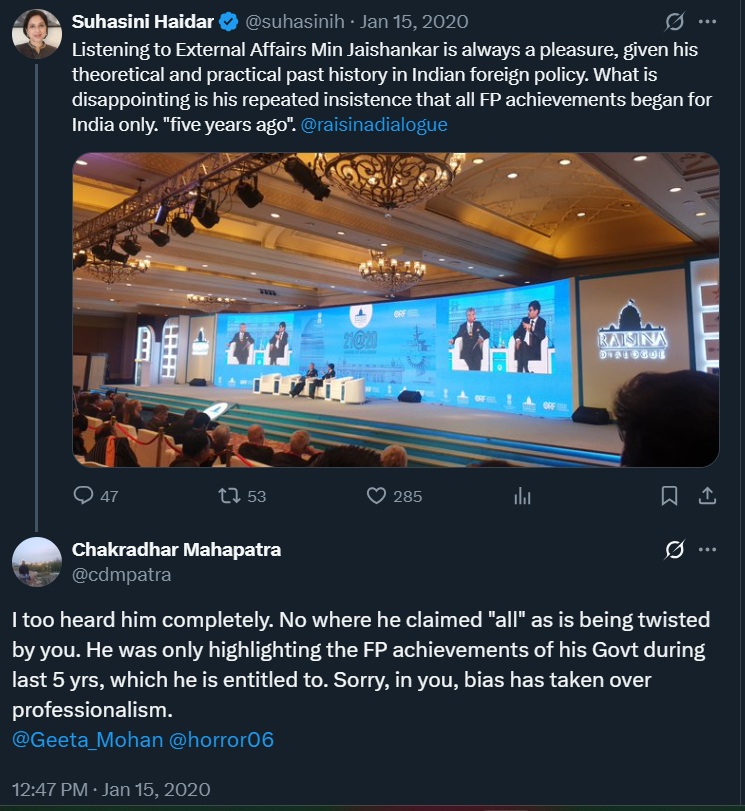
When confronted, Haidar deflected by noting Jaishankar had only been a minister since 2019, ignoring the broader reference to the government’s term.
Fair point, but please consider that Dr. Jaishankar has been in this government since June 2019
He was a career diplomat before that, from 1977-2018.— Suhasini Haidar (@suhasinih) January 15, 2020
She has previously misrepresented issues, including Article 370 and India’s diplomatic standing, often promoting a biased narrative against the current government without factual basis.
In 2020, in her The Hindu op-ed titled “The new worry of depleting diplomatic capital”, Suhasini Haidar peddled several demonstrably false claims to portray India’s foreign policy under the Modi government as floundering. She falsely claimed that only three Democrats attended the 2019 Howdy Modi event, when in fact six attended, with a seventh pulling out due to unrelated domestic issues. She misleadingly presented non-binding U.S. congressional resolutions as official diplomatic statements, while omitting that similar critiques occurred during the Congress era. She wrongly accused India of ignoring Bangladesh PM Sheikh Hasina’s requests on the Rohingya crisis, despite India’s aid—reported even by The Hindu. Haidar also fear-mongered over USCIRF’s calls for sanctions, failing to disclose its longstanding bias, including similar rhetoric under UPA rule.
At a time when India is redefining its security doctrine and diplomatic posture through operations like Sindoor, such misrepresentations by senior journalists only serve to mislead the public and create unnecessary distrust.
Subscribe to our channels on Telegram, WhatsApp, and Instagram and get the best stories of the day delivered to you personally.