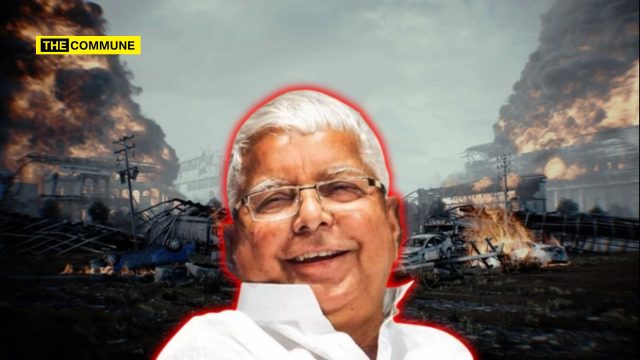
For over fifteen years, Bihar was caught in the grip of a regime that many remember today not for social justice or empowerment, but for terror, lawlessness, and systemic collapse. Lalu Prasad Yadav, who swept to power in 1990 as a “charismatic champion” of the poor and backward castes, and later his wife Rabri Devi, soon presided over a period so infamous it became etched into the national lexicon as “jungle raj.”
This phrase didn’t emerge from thin air. It described a lived reality: a state where kidnapping for ransom was normalized, women feared stepping outside their homes, children were exiled by their parents for safety, and criminals wielded more power than police officers. Today, as Bihar continues to recover from that trauma, the dark imprint of those years – 1990 to 2005 -remains a potent warning of what happens when populist politics devours governance.
The Rise of Lalu – and the Collapse of the State
When Lalu Yadav became Chief Minister, his slogan “gareeb ka raj” (rule of the poor) resonated with millions. He represented long-marginalized OBCs and promised to upend the entrenched upper-caste dominance in Bihar’s power structure.
But the dismantling of the old elite was not replaced by an inclusive system. Instead, the state’s institutions were hollowed out. Police, courts, bureaucracy – all fell prey to corruption, criminal intimidation, or political interference. Gangsters like Mohammad Shahabuddin became law unto themselves, running extortion and murder operations from their political perches with state complicity.
Crime exploded. Bihar’s infamous kidnapping industry didn’t merely target businessmen or professionals; it devoured even children. By the late 1990s, abduction had become so rampant that the term “kidnapping tax” entered everyday parlance. Families that could afford it began pulling their children out of Bihar altogether, sending them to boarding schools across India. Those who remained lived in constant fear.
Women: Prisoners in Their Own Homes
Perhaps no group bore the brunt of Lalu’s misrule more than women. With law enforcement paralyzed, sexual violence surged. Women from upper-caste families were often targets of politically charged humiliation; marginalized women suffered in silence with little hope of justice.
The case of Champa Biswas, wife of an IAS officer who was abducted and assaulted, shook the conscience of even hardened cynics. If the powerful weren’t safe, who was?
Families responded by pulling girls out of school, enforcing curfews, or rushing into early marriages—anything to protect daughters from a climate of terror. Public life became a male preserve. Even government hospitals and police stations, supposed safe zones, offered little refuge for women.
The Great Exodus: Children Sent Into Exile
The “boarding school phenomenon” became a symbol of elite and middle-class Bihar’s despair. Families from Patna, Muzaffarpur, and Bhagalpur began sending their children to Pune, Delhi, and Bangalore, not for better academics, but for survival.
Parents continued living in Bihar, often under stress and financial strain, just to fund their children’s safety elsewhere. Some never brought their children back. Others watched as their sons and daughters grew up with only fragmented ties to their home state.
Meanwhile, public schools in Bihar deteriorated.
As families fled, teachers lost motivation, infrastructure crumbled, and dropout rates soared. Jungle raj had not only chased away Bihar’s next generation, it had gutted its future.
“Bhurabal Hatao”: Caste Politics and the Cult of Division
Lalu’s tenure wasn’t merely an administrative failure, it was a period of deep social division. While the backward caste mobilization under his leadership was historic, it was also weaponized against upper castes in dangerous ways.
The slogan “Bhurabal hatao”, (literally meaning “remove brown hair”), but actually a coded reference to upper castes like Bhumihars (landowners), Rajputs, Brahmins, and Lalas (Upper caste Kasyatha) – became a populist war cry. Though never officially endorsed, it was widely circulated and, more importantly, implemented through discrimination and, in some cases, violence.
Upper-caste professionals faced social ostracization. Land grabs became common. Shops and establishments owned by “bhurabal” castes were vandalized or boycotted. The atmosphere of caste confrontation wasn’t about uplifting the oppressed, it was about humiliating the erstwhile dominant.
The Vanishing Surname: Identity in Hiding
One of the most profound psychological consequences of this era was the phenomenon of upper-caste families erasing their own surnames. In India, surnames are social identifiers – markers of community, history, and caste. Under Lalu Raj, they became liabilities.
Fearful of being targeted, families stopped using “Singh,” “Mishra,” “Prasad,” or “Verma.” In school forms and job applications, names were shortened or altered to double names – second/last names would be Kumar or Ranjan or Raj – a few popular people from that era with double names include Prashant Kishor, Ajeet Bharti. While this was common among the boys/men, women used Kumari as their last name.
Children grew up unaware of their full caste identities, a phenomenon sociologists have likened to cultural amnesia.
This wasn’t a social revolution; it was self-erasure born of fear.
The Economic Freefall
The reign of jungle raj was also an era of devastating economic stagnation. Investment dried up. Professionals and business families fled. The extortion racket ensured that any entrepreneurial ambition was strangled at birth.
Even rural Bihar didn’t escape. Agricultural infrastructure collapsed. Flood relief schemes became scams. Corruption was so endemic that it ceased to shock. In urban centers, power cuts were routine, roads cratered into dust, and hospitals resembled haunted ruins. Meanwhile, unemployment surged. Young people either migrated or languished in frustration. For those who stayed behind, poverty became both chronic and normalized.
Fodder Scam and the Symbolism of Loot
Nothing encapsulates Lalu Yadav’s misrule more than the infamous Fodder Scam. Public funds meant for cattle feed amounting to nearly ₹1,000 crore were siphoned off through fake invoices and collusion at every level of government.
While the scam eventually led to Lalu’s conviction and incarceration, it also became emblematic of the era’s rot. It was not just theft; it was the collapse of governance masquerading as socialism. The very institutions tasked with delivering justice and services had become criminal enterprises.
The Collapse of Trust
What jungle raj truly destroyed was not just infrastructure or economy but public trust. Courts became temples of delay. Police became enforcers for the powerful. Bureaucrats, even honest ones, either fell in line or faced transfer and humiliation.
This complete loss of institutional credibility meant that Bihar’s citizens looked not to the state for help, but to private solutions – bribes, musclemen, or migration. In many ways, this breakdown of faith was more damaging than even the kidnappings or caste wars.
Nitish Kumar’s Long Recovery: From Ruin to Reform
When Nitish Kumar assumed office in 2005, Bihar was in institutional collapse. Decades of corruption, criminal-politician nexus, and complete administrative paralysis had left the state in ruins. Over the next two decades, Nitish undertook a methodical recovery project – one that emphasized both structural governance and social transformation.
His government cracked down on organized crime and overhauled the police force, bringing notorious gangsters to justice. Infrastructure was prioritized: rural roads were built, electricity reached previously neglected villages, and schools began functioning again. Governance, long absent, slowly returned. Courts processed cases, services resumed, and most crucially, public trust began to recover.
Central to Nitish’s model was the empowerment of women. Recognizing their potential as agents of change, he launched targeted welfare schemes – free bicycles for schoolgirls, the Jeevika self-help group network, and direct cash transfers like the Dus Hazari Yojana. These initiatives brought women into public life, enabled them to vote, work, and contest elections, and created a new generation of politically aware citizens.
By 2025, this transformation bore electoral fruit. In a historic shift, women voters outnumbered men by nearly 10 percentage points at the ballot box. Many were beneficiaries of Jeevika or girls who had come of age after the fall of jungle raj. Their vote wasn’t just about development; it was a moral verdict. The trauma of the 1990s jungle raj was not forgotten, and when Lalu Yadav’s son, Tejashwi, tried to bring the RJD back to power, it was these women who firmly shut the door.
While Nitish’s tenure hasn’t been without flaws, his frequent political realignments drew criticism, his impact is undeniable. Two decades on, Bihar is not a model state, but it is a functioning one. And that, given where it started, is a profound achievement.
In rejecting the past and embracing governance, Bihar’s voters – especially its women, cemented a historic transition: from jungle raj to janata raj.
Subscribe to our channels on WhatsApp, Telegram, Instagram and YouTube to get the best stories of the day delivered to you personally.