


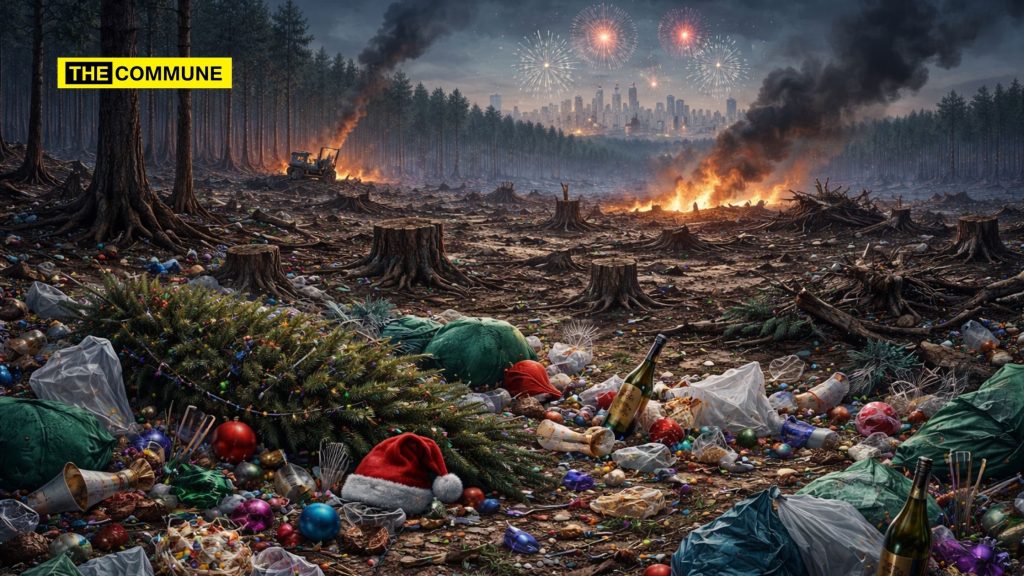
Christmas and New Year celebrations are widely portrayed as seasons of joy and festivity. However, behind the celebratory narrative, multiple incidents across the world have repeatedly highlighted serious public safety and environmental concerns. This report compiles seven major incidents linked to Christmas and New Year celebrations between 2021 and 2025, focusing on dangerous air pollution levels, waste accumulation, and health risks caused largely by fireworks, firecrackers, and associated activities.
#1 Makati Records Worst Air Quality on New Year’s Eve
On 2 January 2025, the Department of Environment and Natural Resources (DENR) reported that air pollution levels in Makati City, Metro Manila, reached their highest point during New Year’s Eve celebrations. According to the DENR, the widespread use of firecrackers and fireworks led to a sharp deterioration in air quality, pushing pollution levels into the “very unhealthy” category. Officials attributed the spike primarily to particulate matter released from fireworks.
#2 Hazardous Air Quality in Phoenix Valley After New Year
Air quality in the Phoenix metropolitan area, commonly referred to as the Valley, deteriorated to hazardous levels on New Year’s Day, 2 January 2025, according to local authorities. Officials reported elevated concentrations of fine particulate matter (PM2.5) following New Year celebrations. The pollution was attributed largely to fireworks, residential burning, vehicle emissions, and stagnant weather conditions that trapped pollutants close to the ground. Authorities warned residents of the health risks posed by the hazardous air quality, especially to vulnerable groups, as pollution levels remained elevated at the start of the new year.
#3 Jakarta Sees Surge in Waste After New Year Celebrations
Following the 2025 New Year’s Eve celebrations, the Jakarta Environmental Agency reported the collection of 132 tonnes of waste across the city. While the figure was lower than the initially predicted 150 tonnes, it still marked an increase of two tonnes compared to waste collected after the 2024 New Year’s Eve celebrations. The agency deployed approximately 3,900 cleaning personnel ahead of the festivities to manage the anticipated surge in waste.
#4 Fireworks Push Palos Verdes Air Quality Into ‘Unhealthy’ Range
On 31 December 2024, New Year’s Eve fireworks worsened air quality in the Palos Verdes Peninsula in California, according to the South Coast Air Quality Management District. Following the celebrations, particulate matter levels rose into the “unhealthy” range. Health experts issued advisories urging residents, particularly children, the elderly, and individuals with respiratory conditions, to limit outdoor activities while air quality remained poor.
#5 Fireworks Trigger Severe Pollution Spike Across Germany
On 3 January 2017, reports indicated that New Year’s Eve fireworks caused dangerously high pollution levels across several German cities. In Munich, particulate matter concentrations briefly surged to 1,346 micrograms per cubic metre, approximately 26 times higher than the European Union’s daily limit of 50 micrograms. National data showed that fireworks released nearly 4,000 tonnes of particulate matter during the celebrations, accounting for about 15% of Germany’s annual particulate emissions from vehicles.
#6 Munich Pollution Levels Soar Far Beyond EU Limits
In a related report dated 3 January 2017, Munich recorded particulate matter levels reaching 26 times the EU-recommended daily limit following New Year’s Eve fireworks. According to environmental reports, the celebrations ejected approximately 4,000 tonnes of particulate matter into the atmosphere, equivalent to about 15% of Germany’s annual vehicle-related particulate emissions. The spike was driven by intense fireworks displays across the city.
#7 Beijing Suffers Heavy Pollution During New Year Celebrations
Beijing experienced one of its worst New Year pollution episodes on 1 January 2017, as heavy smog engulfed China’s capital following New Year celebrations. Concentrations of hazardous particles were reported to be 20 times higher than acceptable levels. PM2.5 readings in many areas of Beijing, as well as parts of Tianjin and Hebei Province, exceeded 200 as early as the afternoon of 30 December 2016.
Last Word
These incidents collectively underline how Christmas and New Year celebrations have evolved into a global event of mass waste generation and environmental stress. What is marketed worldwide as a season of joy now routinely results in severe air pollution from fireworks, mountains of plastic and packaging waste, and short-term but intense public health risks across cities in Asia, Europe, and North America. The pattern is not confined to one country or culture; it is replicated annually wherever large-scale, consumer-driven celebrations take place. The data shows that modern Christmas festivities are no longer just cultural or religious observances, but industrial-scale events that leave behind polluted air, overburdened waste systems, and lasting environmental damage—raising serious questions about the sustainability of how the season is celebrated globally.
Subscribe to our channels on WhatsApp, Telegram, Instagram and YouTube to get the best stories of the day delivered to you personally.