


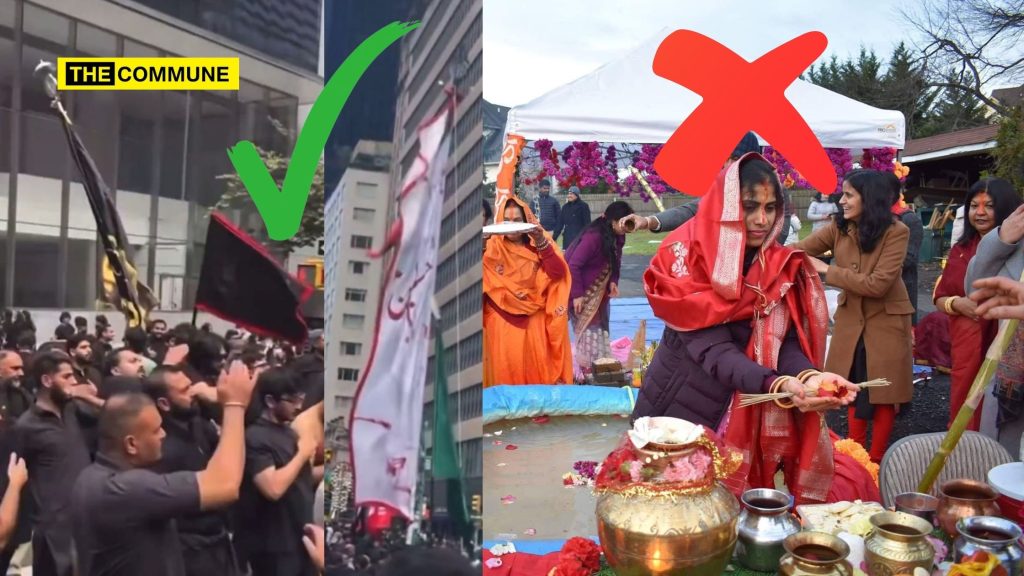
There’s a spectacle that unfolds every year on Park Avenue in New York City, one that is both profound and deeply public.
Thousands of Shia Muslims gather for the Ashura Procession, a solemn commemoration of the martyrdom of Imam Hussain. Dressed in black, they march, chant, and engage in rituals like chest-beating, transforming a iconic Manhattan boulevard into a river of religious devotion. Similar gatherings, lectures, and mourning sessions fill Islamic centers across Brooklyn and Queens throughout the month of Muharram.
One thing I find amazing if that if Hindus do something similar in US, you would find a bunch of Hindus raining down upon them, making videos shaming them or saying this happened because of Modi. No one else does this on their own community/religion.
And you wonder why Vivek… pic.twitter.com/QrsYb0ayp2
— Arnab Ray (@greatbong) November 6, 2025
But observe this scene and then consider a hypothetical: imagine a procession of thousands of Hindus performing a similarly intense, public religious ritual on the same streets. The reaction, particularly from within our own community, would be starkly different.
You would instantly find a cohort of Hindus raining down upon them. There would be a flurry of social media videos shaming them, calling them “backward,” and attributing their newfound public confidence not to their own rights as citizens, but to a political climate in India. The refrain would be familiar: “This is happening because of Modi.” It’s a bizarre form of self-flagellation that is almost unique to the Hindu diaspora.
And then we wonder why a figure like Vivek Ramaswamy might feel compelled to apologize for or downplay his faith in public life.
The truth is, the reason you see Hindus in the US coming out into public spaces with more visible displays of religiosity now is precisely because others have been doing it for years. The Ashura Procession is just one example. A standard has been set in the West: public religious expression is a valid form of cultural identity.
For decades, Hindus, often wary of standing out or being misunderstood, largely kept their worship within temple walls. Now, as a new generation asserts its place, it is simply following the path that other communities have already paved. Yet, when Hindus walk this path, the rules seem to change. The same public display that is a protected right for others is suddenly labeled as “egregious” or “political” when performed by Hindus. And the most vocal critics are often from within. If anyone dares to question this hypocrisy, the accusation of “phobia” is instantly deployed, shutting down all debate.
Let’s be clear: fifteen years ago, these large-scale public religious displays by other communities were less visible. And coincidentally, so were those by Hindus. The recent increase in Hindu public expression has nothing to do with the RSS or Modi. It has everything to do with a natural evolution in a multicultural society – a desire to claim the same space and the same rights that every other immigrant group has fought for and won.
The problem isn’t that Hindus are becoming more public. The problem is that a segment of Hindus refuses to grant their own community the same grace and autonomy they effortlessly afford to others. Until that changes, we will continue to see this painful double standard, where our faith is the only one expected to apologize for its own existence.
Subscribe to our channels on WhatsApp, Telegram, Instagram and YouTube to get the best stories of the day delivered to you personally.