


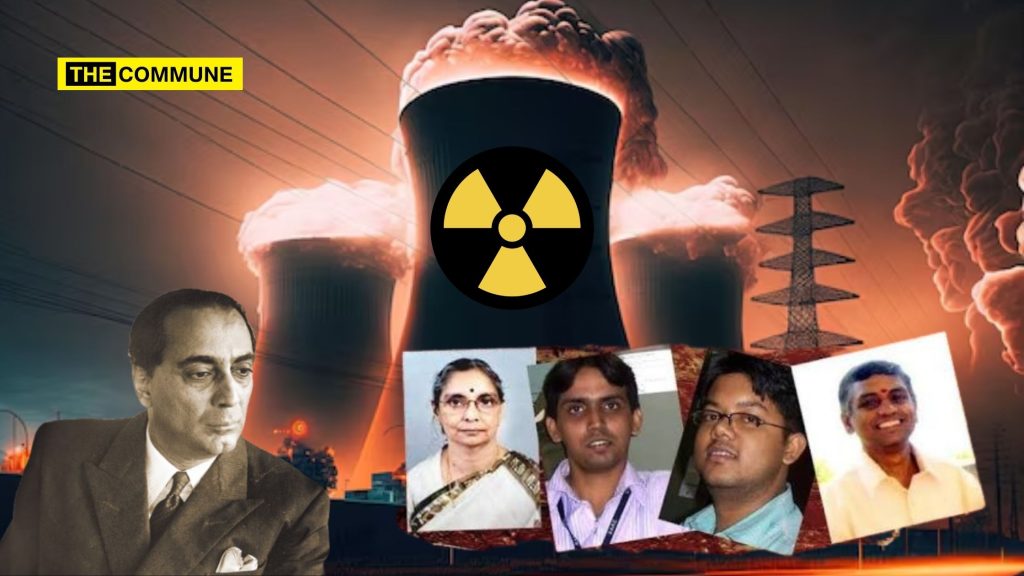
According to data from the Press Information Bureau (PIB), a total of 2,564 employees of the Department of Atomic Energy (DAE) died while in service between 1995 and 2014, including 69 cases officially recorded as suicides. A related annexure tabled in the Lok Sabha further reported 71 suicides between 1995 and 2015, along with two murders in 2008 and 2013.
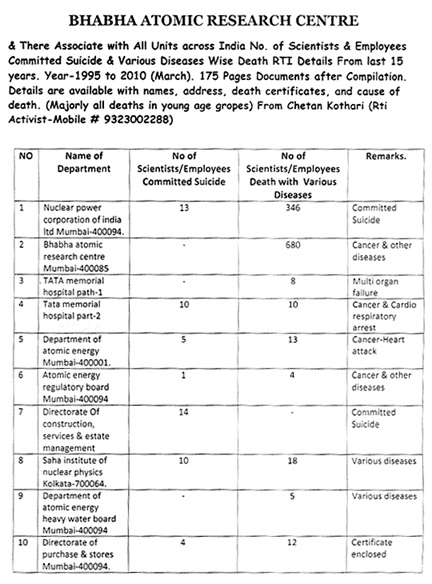
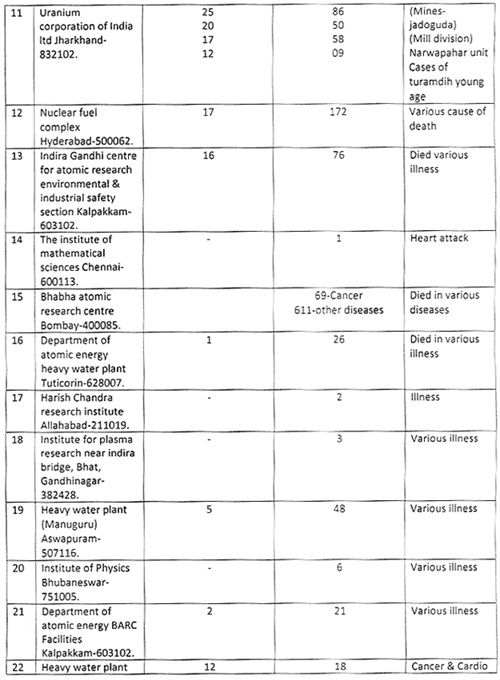
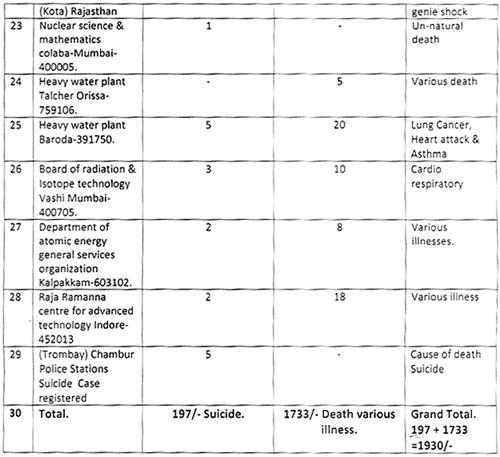
In contrast, findings obtained through the Right to Information (RTI) Act suggest a more alarming pattern. Mumbai-based RTI activist Chetan Kothari revealed that from 1995 to 2014, 197 employees from India’s nuclear and related establishments had died by suicide, while 1,733 others had succumbed to serious illnesses such as multiple organ failure, lung cancer, liver cirrhosis, and other chronic conditions. A separate RTI filed by Rahul Sehrawat disclosed that 11 nuclear scientists died under mysterious circumstances between 2009 and 2013.
This report aims to present a comprehensive examination of all available data and perspectives—official statements, RTI findings, and documented incidents—concerning unnatural and unexplained deaths in India’s nuclear establishment. It also includes a curated list of specific cases of nuclear scientists who died under mysterious circumstances between 1966 and 2014.



Part 2: RTI By Rahul Sehrawat
Between 2009 and 2013, a total of 11 nuclear scientists and engineers in India died under unnatural or mysterious circumstances, as revealed in a Right to Information (RTI) response dated 2 September 2015, to Haryana-based applicant Rahul Sehrawat. The data, provided by the Department of Atomic Energy (DAE), highlights a disturbing pattern of deaths involving explosions, hangings, drownings, suspicious fires, and an unresolved murder.
Of these 11 cases, eight individuals were scientists and engineers employed at DAE-operated laboratories and research centers. The remaining three were affiliated with the Nuclear Power Corporation of India Limited (NPCIL). Two of the NPCIL deaths were ruled as suicides, while one was recorded as a road accident.
Some of the most unsettling incidents include:
- 2010: Two C-grade scientists from BARC, Trombay, were found hanging in their official residences. One case was attributed to chronic illness by police, while the other remained under investigation.
- 2010: A mysterious fire at a BARC chemistry lab claimed the lives of two research fellows, with no clear cause identified.
- 2012: A C-grade scientist was discovered dead at his residence in Rawatbhata, Rajasthan.
- Mumbai: An F-grade scientist was found murdered in his home, with evidence of strangulation. The case remains unsolved.
- RRCAT, Indore: A D-grade scientist reportedly died by suicide; the case was closed as such by local authorities.
- Kalpakkam, 2013: A scientist allegedly died by suicide after jumping into the sea—an incident still under official inquiry.
- Mumbai: Another scientist was found hanging, with investigators citing personal reasons.
- Karwar, Karnataka: A scientist reportedly ended his life by jumping into the Kali River, also attributed to personal distress by police.
These deaths, scattered across various DAE facilities including BARC, RRCAT, Kalpakkam, and NPCIL units, have raised serious concerns about the mental health support, workplace pressures, and adequacy of investigative procedures within India’s nuclear establishment.
Part 3: List of Reported Incidents of Nuclear Scientists Who Died Under Mysterious Circumstances
In several reported cases of suicide among nuclear scientists in India, the exact reasons behind their deaths remain unconfirmed. In other instances, the causes of death have been officially recorded but continue to raise serious questions due to the surrounding circumstances. These unexplained or suspicious fatalities have often involved highly skilled personnel working in sensitive roles at premier scientific and atomic research institutions.
Below is a compiled list of 20 nuclear scientists who died under mysterious or unexplained circumstances between 1966 and 2014. This list reflects patterns that remain inadequately investigated or publicly clarified, further underscoring concerns raised by activists, media reports, and parliamentary questions regarding the safety and well-being of India’s scientific community.
#1 Mysterious Death Of Homi J. Bhabha In 1966 Air Crash
On 24 January 1966, Homi Jehangir Bhabha, architect of India’s nuclear program and founding director of TIFR and AEET, died when Air India Flight 101 crashed near Mont Blanc en route to Vienna. Officially deemed an accident, no definitive cause was provided. Speculation persists that the crash was orchestrated by the CIA to derail India’s atomic ambitions. A controversial 2008 report quoted a CIA officer claiming a bomb exploded in the aircraft’s cargo hold. Months before his death, Bhabha had declared India could build a nuclear bomb within 18 months, intensifying geopolitical tensions at the time.
#2 Kaiga Nuclear Scientist’s Mysterious Death In Kali River (2009)
On 8 June 2009, Lokanathan Mahalingam, a 47-year-old senior scientific officer at the Kaiga Atomic Power Station in Karnataka, went missing during his morning walk. He was last seen near the station but didn’t carry his phone or money. Five days later, his decomposed body was recovered from the Kali River despite no witnesses seeing him leave the premises. Although police suspected suicide, his family rejected this claim, raising doubts over the circumstances. Naval divers from Karwar’s Seabird base were brought in after initial search efforts failed. Mahalingam was associated with the simulation training unit and had no access to sensitive nuclear information, according to NPCIL. This wasn’t his first disappearance, adding to the mystery. Despite post-mortem findings indicating drowning, unanswered questions and the secrecy surrounding the case led many to suspect foul play, though no conclusive evidence has emerged.
#3 Ex-BARC Scientist Uma Rao Found Dead In Suspected Suicide (2011)
On 29 April 2011, 63-year-old Uma Narasimha Rao, a retired scientist from BARC and president of the Indian Women Scientists Association, was found dead at her Govandi residence in Mumbai. She allegedly died by suicide, with a note attributing her action to chronic depression and stating that no one should be held responsible. Her domestic help discovered her unconscious on the floor, and she was later declared dead at the hospital. Rao reportedly consumed an overdose of sleeping pills and had been suffering from a painful digestive disorder. While police treated it as a suicide, family and colleagues expressed doubts, stating she showed no signs of depression. Uma Rao had worked in food technology and cell biology divisions at BARC, later transitioning to media relations. Her husband, also a BARC scientist, had passed away in 2001. Police filed an accidental death report and continued investigations.
#4 Ravi Mule Murder Case Raises Alarming Questions at Kaiga Plant
On 8 June 2009, Ravi Mule, an employee of the Nuclear Power Corporation of India Ltd (NPCIL) at Kaiga, went missing and was later found murdered under mysterious circumstances. The case, like that of fellow NPCIL scientist N. Mahalingam, who also died under suspicious conditions the same year, remains unresolved (as above). Frustrated by police inaction and lack of cooperation from NPCIL authorities, Mule’s brother, Jnaneshwar, began his own investigation. He publicly displayed banners appealing for information, claiming fear among locals and lack of police will to act. Allegations have surfaced that powerful interests may be obstructing the probe, with suspicions of deliberate delay and even transfer of key investigating officers. NPCIL union leaders have called for a CBI inquiry, expressing deep concern over the recurring and unexplained deaths of nuclear scientists within the Kaiga township.
#5 BARC Engineer M. Iyer’s Mysterious Death Suspected To Be Murder
On 23 February 2010, M. Iyer, an engineer at the Bhabha Atomic Research Centre (BARC), was found dead in his Mumbai apartment under suspicious circumstances. While initial police theories speculated a bizarre accident or suicide, forensic findings raised serious doubts. Iyer had suffered internal skull hemorrhaging with no external injuries, and there were no fingerprints or signs of struggle at the scene—an indication of possible involvement by highly skilled perpetrators. Though the case initially puzzled investigators and stalled, it was eventually registered as a murder. Iyer’s death mirrors a disturbing pattern of unexplained fatalities among India’s nuclear scientists, many of which remain unresolved.
#6 Mysterious Deaths Of INS Arihant Engineers Raise Alarms
On 6 October 2013, two engineers, K.K. Josh and Abhish Shivam—key contributors to India’s nuclear-powered submarine INS Arihant and associated with the Kudankulam Nuclear Power Plant—were found dead on railway tracks near Visakhapatnam Naval Yard. Strangely, their bodies bore no signs of trauma typically seen in railway accidents, leading to widespread suspicion. While the Ministry of Defence labeled the deaths as a “routine accident,” the families and public expressed doubt, alleging foul play and demanding a thorough investigation. Despite the sensitive nature of their roles in national defense, the case was handled by local police rather than higher investigative agencies. A PIL later filed in the Bombay High Court highlighted a disturbing trend of unexplained deaths among Indian nuclear scientists, suggesting possible efforts to derail India’s strategic programs. The court sought official responses from atomic energy authorities, but the deaths remain officially unexplained.
#7 BARC Lab Fire Kills Two Young Scientists; Mystery Remains
On 29 December 2009, two PhD researchers, Umang Singh and Partha Pratim Bag, tragically died in a mysterious fire inside the Radiation and Photochemistry Division lab at BARC, Trombay. The blaze broke out while the duo were conducting antioxidant studies—despite no known inflammable materials being present. Firefighters arrived after a 45-minute delay, by which time the lab was engulfed and both scientists were found charred beyond recognition. Shockingly, there were no fire extinguishers, and families had to submit DNA samples for identification. The cause of the fire remains unexplained, deepening suspicions, especially as other lab members were away. While authorities maintain no radiation or reactor materials were involved, bereaved families received no clear answers. Singh’s and Bag’s grieving parents allege neglect, poor communication, and even insensitive police interrogation.
#8 Young IGCAR Scientist Found Dead Under Unexplained Circumstances
On 23 April 2012, Mohammad Mustafa, a 24-year-old scientific assistant at the Indira Gandhi Centre for Atomic Research (IGCAR) in Kalpakkam, was found dead in his residential quarters. His wrists were slashed, and the door was locked from the inside. A note allegedly written by him stated that no one was responsible for his death, but it offered no further explanation. Mustafa, originally from Calicut, Kerala, had joined BARC a year earlier and was confirmed as a permanent employee just two months prior. Colleagues described him as mentally stable and not under work-related stress. His roommate discovered the body after returning from duty and alerted the police. While the case was treated as a suicide, the absence of a clear motive, coupled with his recent confirmation and stable profile, has left questions unanswered about the true circumstances of his death.
#9 Young BARC Scientist Found Dead In Apparent Suicide
On 3 March 2010, Titus Pal, a 27-year-old scientist at the Bhabha Atomic Research Centre (BARC), was found hanging in her apartment on the 14th floor of Nilgiri building within the BARC campus in Trombay, Mumbai. Just three days earlier, she had celebrated her birthday with family in Kolkata before returning to work that morning. Her father, Subrato Pal, became concerned when she failed to make her usual evening call. After repeated unanswered calls, he contacted her neighbor, who discovered her body. Authorities have classified the death as a suicide, but no motive was identified. Colleagues and family were reportedly unaware of any distress she may have been experiencing. The sudden and unexplained nature of her death added to a growing list of mysterious incidents involving young nuclear scientists in India.
#10 Scientist’s Mysterious Death Sparks Calls For CBI Probe
On 18 August 2009, Dalia Nayek (35), a senior scientist at the Saha Institute of Nuclear Physics (SINP), Salt Lake, died after allegedly consuming mercuric chloride. Neighbors rushed her to the hospital after hearing her cries, but she later succumbed. Police suspect suicide, but her cheerful demeanor and imminent plans to move to the UK raised doubts. Colleagues revealed she abruptly left work after a mysterious phone call, and a senior scientist—close to her for over a decade—took her to the hospital but failed to inform SINP. The unlocked door and use of a non-lethal poison further deepened suspicions. SINP’s women staff demanded a CBI probe, citing safety concerns and potential foul play. Dalia’s family also questioned the suicide theory but have not filed a complaint. Police have not ruled out external involvement and continue to investigate the senior colleague’s role in the case.
#11 Scientist Dies by Suicide, Senior Booked for Abetment
On April 10, 2010, Tirumala Prasad Tenka (30), a scientist at the Raja Ramanna Centre for Advanced Technology (RRCAT), was found hanging in his residence in Rajendra Nagar. Police recovered a suicide note in which Tenka alleged mental harassment by his senior, G.S. Lodha, who has since been booked under IPC Section 306 for abetment to suicide. A native of Andhra Pradesh, Tenka had been with RRCAT for five years and worked in the Indus Synchrotron Utilisation Division. He had completed his training at the RRCAT school in 2005 and was promoted quickly. RRCAT Director P.D. Gupta expressed shock over the loss, calling Tenka a talented scientist.
#12 Unexplained Deaths of Two Pioneering Scientists
Dr. Suresh Shah and Dr. Harishankar Kashyap, both close associates of Dr. Vikram Sarabhai, tragically died under mysterious circumstances during the formative years of India’s space and nuclear programs. Though official records remain vague, it is widely believed that the two scientists lost their lives in separate accidents—each unexplained and shrouded in secrecy. Their deaths contributed to a troubling pattern of suspicious incidents involving prominent Indian scientists at critical junctures in national research. As key figures working alongside Dr. Sarabhai, Shah and Kashyap were closely involved in high-stakes scientific advancements. The lack of transparency surrounding their untimely demise continues to raise questions, feeding long-standing speculation about the vulnerabilities faced by scientists involved in strategic and sensitive research areas in India’s early technological rise.
#13 The Mysterious Death of Dr. Vikram Sarabhai
Dr. Vikram Sarabhai, revered as the father of India’s space program and founder of ISRO, died unexpectedly on 30 December 1971, at just 52. He was found dead in his hotel room at his favorite resort in Kovalam, Kerala, after inaugurating the Thumba railway station and witnessing a Russian rocket launch. Official reports cited a heart attack, yet the suddenness and circumstances sparked enduring suspicions of foul play. Close associates like Kamla Chaudhary recalled Sarabhai’s claim that he was being watched by both American and Russian agencies. No postmortem was conducted—his family, including daughter Mallika and son Kartikeya, deferred the procedure, with his mother Sarladevi reportedly making the final decision. Strangely, despite his high-profile position and existing security precautions, no formal scientific inquiry followed. His untimely death, much like that of Homi Bhabha before him, remains a subject of speculation and quiet controversy.
#14 BrahMos Missile Engineer Dies Suddenly of Heart Attack
A 30-year-old engineer with the Defence Research and Development Organisation (DRDO) in Lucknow, identified as Akashdeep Gupta, died after a sudden health deterioration on the night of 21 October 2025, a day after Deepavali. Police suspect a heart attack, though confirmation awaits a post-mortem report. Gupta, who worked on the BrahMos missile system, lived in Alambagh with his wife Bharti, a bank employee. He had taken leave to celebrate Diwali with his family and had played cricket earlier that evening. After returning home and feeling unwell post-dinner, he was rushed to hospital, where he died. Hospital authorities later informed the police about the incident.
#15 Other Notable and Unexplained Deaths in India’s Scientific and Defence Community
Several scientists and engineers associated with India’s nuclear, space, and defence programs have died under troubling or mysterious circumstances. Below is a summary of notable cases:
- Avdesh Chandra – A scientist at BARC, he allegedly died by suicide by hanging in the year 2000.
- Ashutosh Sharma – Scientist at BARC, died by hanging in 2010 under suspicious circumstances.
- Soumik Chowdhary – Another BARC scientist, also reportedly died by hanging in 2010.
- Akshay P. Chavan – An employee at BARC, he allegedly died by suicide in April 2010 by jumping from the balcony of his flat.
- Subhash Sonawane – A tradesman in BARC’s waste management division, suspected to have died by suicide in April 2010. His body was recovered from a well in Mumbai’s Anushakti Nagar. BARC stated he was undergoing treatment for schizophrenia.
- Jaswant Rao – Assistant mechanical engineer with Indian Rare Earths, suspected to have died by suicide in 2008.
- G. K. Kumaravel – A key developer in the Arjun tank project, he died in a road accident. Some sources consider the crash suspicious.
- Baldev Singh – HAL’s Chief Test Pilot and Squadron Leader (Retd), he played a crucial role in developing flight control laws for the Light Combat Aircraft (LCA). He worked with UK and US agencies during evaluation phases. Circumstances of his later life and death remain unclear.
- S. Ravi Balu (1960s–2011) – An aerospace engineer at the Aeronautical Development Establishment (ADE), Bangalore. He was reportedly involved in UAV research. Balu died in 2011 after being hit by a motorcycle, sparking speculation linking his death to his sensitive work.
These incidents, spanning multiple years and institutions, have raised questions due to the pattern of unexplained or inadequately investigated deaths among India’s top defense and nuclear personnel.
Subscribe to our channels on Telegram, WhatsApp, and Instagram and get the best stories of the day delivered to you personally.