


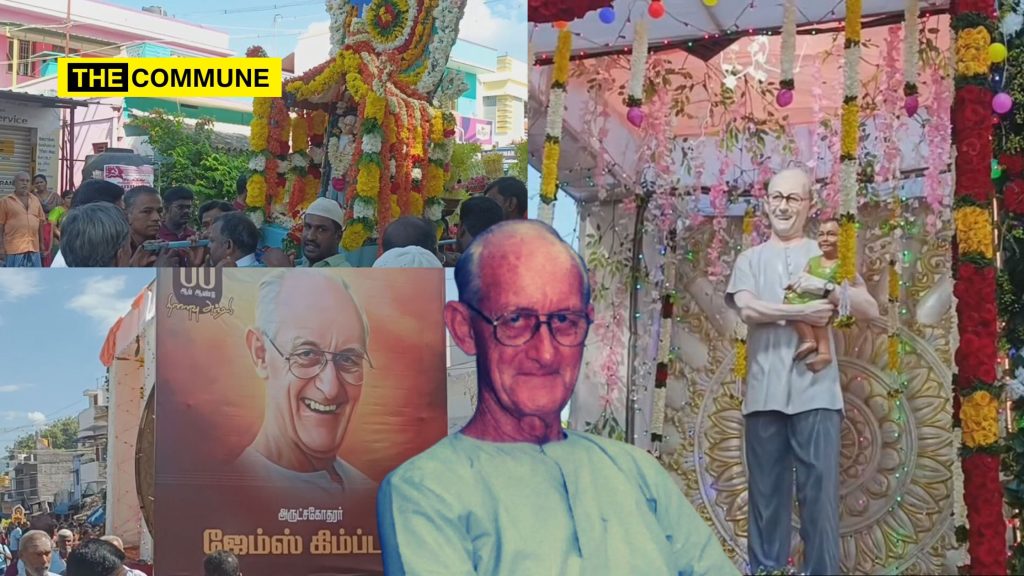
In the villages of G. Kallupatti and Genguvarpatti near Vathalagundu, a curious annual spectacle unfolds every October. Thousands gather to honor a British missionary, Brother James Kimpton with processions, floral tributes, and annadhanams. The late missionary, fondly called “Thatha” (grandfather), is now celebrated like a local deity, his image paraded in chariots through temple-lined streets.
#NewsUpdate | திண்டுக்கல்: வத்தலகுண்டு அருகே ஜி.கல்லுப்பட்டி கிராமத்தில் 1974ம் ஆண்டு தங்கியிருந்து சுற்றுவட்டார கிராமத்தில் ஏழை, எளிய மக்களின் நலன்களுக்காக பாடுபட்ட ஜேம்ஸ் கிப்ம்டன் எனும் வெள்ளைக்கார தாத்தாவின் நினைவு தினம்
முளைப்பாரி எடுத்து, ஊர்வலமாக வந்து நினைவிடத்தில்… pic.twitter.com/dgVcvAptlZ
— Sun News (@sunnewstamil) October 5, 2025
A Missionary’s Second Home in Tamil Nadu
Born in Wales in 1925, Kimpton joined the Catholic De La Salle Brothers, a missionary order blending education with evangelization. After being expelled from Sri Lanka in 1964 due to that country’s decision to curb foreign religious interference, he found fertile ground in Tamil Nadu. In 1974, he founded Reaching The Unreached (RTU) in G. Kallupatti, a charitable society that quickly expanded into a sprawling welfare empire across Theni and Dindigul districts.
RTU’s projects included orphanages, schools, women’s self-help groups, HIV support programs, and housing schemes, all funded by Western religious and secular organizations. While the visible outcome appeared philanthropic, the institutional control and ideological structure remained firmly under the Catholic order’s grip.
Charity as a Tool of Religious Influence
Kimpton’s public persona was that of a saintly foreigner devoted to the poor, but his alleged model of “service without conversion” followed a well-known postcolonial missionary formula using welfare as a moral gateway rather than a pulpit. The constant presence of Christian symbols, the use of Western names like “Boys’ Town,” and the subtle introduction of biblical moral narratives in daily life quietly normalized Christian authority among Hindu villagers.
This approach did not need overt conversion drives. Instead, it replaced traditional community structures with missionary-administered ones, orphanages instead of gurukulams, foreign-funded schools instead of local schools, imported models of charity instead of dharmic seva. Over time, it fostered a deep dependence on foreign-controlled institutions, ensuring that gratitude and faith flowed upward toward the Church.
Dependency and Displacement of Local Dharma Institutions
The massive scale of RTU’s activities effectively displaced native systems of social support. Rather than empowering local self-governance or temple-based welfare traditions, the organization centralized authority in missionary hands. Even after Kimpton’s death in 2017, the institution remained within Catholic administration under the Capuchin Friars, a clear signal that the project was never meant to become community-owned.
The dependence created through these welfare structures has had enduring consequences. Generations of rural families have come to equate education, healthcare, and charity with Christian institutions, slowly eroding the role of local mutts, temples, and dharma sabhas in social life.
The Deification of a Missionary
Perhaps the most revealing symptom of this long-term influence is the near-deification of Kimpton himself. Villagers now perform rituals for him with molapari, processions, and offerings, practices traditionally reserved for local deities. This phenomenon, while framed as affection, reflects a deeper cultural confusion: the absorption of a foreign missionary into Hindu ritual frameworks, turning spiritual reverence into cultural submission.
Such syncretic devotion blurs the lines between respect and religious influence. It demonstrates how sustained missionary presence, cloaked in welfare, can reshape local belief systems until even villagers begin to sanctify their colonizer.
A Continuing Pattern in Rural Tamil Nadu
Kimpton’s legacy is not isolated. It represents a broader pattern of how Christian missions operate in India’s interior: building goodwill through service, embedding foreign values under the language of “compassion,” and gradually replacing traditional Hindu frameworks of social responsibility.
The result is a slow but steady erosion of indigenous cultural confidence. While Tamil Nadu’s temples and mutts once sustained entire villages through annadhanam and vidya daanam, today the same functions are often outsourced to missionary NGOs with international funding and long-term ideological goals.
A Lesson in Cultural Vigilance
Brother James Kimpton’s story is often presented as one of selfless service, but viewed through the lens of Dharma, it also serves as a cautionary tale. It shows how foreign religious networks can embed themselves deep within rural India, transforming the very meaning of service, charity, and worship.
For a civilization that once viewed seva as sacred duty rooted in Dharma, the veneration of a missionary as a village god is not a mark of harmony, it is a warning of how cultural memory can be reshaped through dependence. As Tamil Nadu continues to navigate questions of faith, identity, and influence, the cult of “Thatha” Kimpton stands as a reminder that every act of foreign charity in a vulnerable land carry more than food and medicine, it carries a message, and a mission.
Subscribe to our channels on Telegram, WhatsApp, and Instagram and get the best stories of the day delivered to you personally.