


The Kerala Muslim Jamaath has formally demanded the bifurcation of Ernakulam district, citing demographic changes and evolving social conditions in the region. Responding to political remarks on the 2003 Marad ‘riots’, Sayyid Ibrahimul Khaleel Al Bukhari said there was no purpose in revisiting the incident and that it should not be discussed again as it would reopen old wounds. So, what happened in 2003?
A Beach Of Bodies
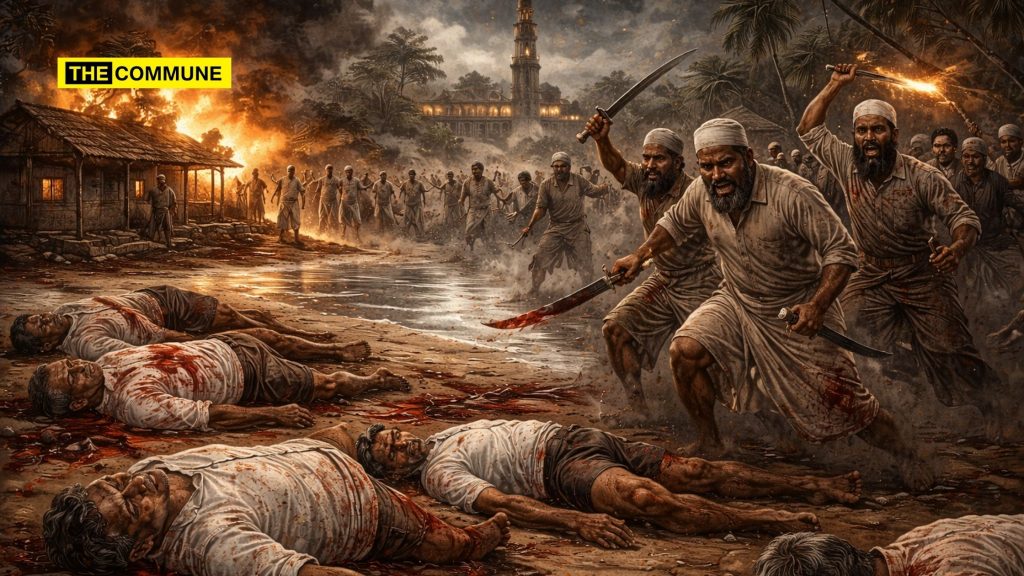
The night of 2 May 2003, the usually tranquil Marad beach in Kozhikode, Kerala, transformed into a killing ground; it witnessed one of the most brutal and least-discussed communal massacres in post-Independence India. Eight Hindu fishermen belonging to the Mukkuvan community – Chandran, Dasan, Gopalan, Krishnan, Madhavan, Rajesh, Pushparaj, and Santosh, were hacked to death by an armed Muslim mob in a brutal, one-sided attack. One assailant, Muhammad Azhar, was also killed, bringing the death toll to nine.
This was not a spontaneous riot, nor a “clash” between communities. It was, as a judicial commission would later establish, a pre-planned, cold-blooded communal massacre – a jihad executed with chilling precision, whose roots lay in a deep-seated conspiracy involving political parties, fundamentalist organisations, and a compromised state apparatus.
Despite judicial findings, mass convictions, and the recovery of weapons and explosives from a mosque, the incident has for two decades been persistently diluted in public discourse as a “riot” rather than acknowledged for what official records describe: a massacre born of conspiracy, planning, and administrative failure.
A Communally Fragile Coast: Marad Before 2003
Marad is not an anonymous village. It is part of Kerala’s long coastal belt where Hindu Mukkuvan fishing communities lived for generations alongside Muslim settlements. By the late 1990s and early 2000s, however, this belt had become deeply communally polarised, shaped by political mobilisation, economic displacement, and repeated episodes of violence.
Tensions escalated sharply after 3-4 January 2002, when clashes triggered by a trivial dispute over drinking water spiralled into communal violence that left five people dead – three Muslims and two Hindus. That episode, far from being resolved, became the emotional and political fuel for what followed.
The Night Of The Massacre: A Planned Slaughter
On the evening of 2 May 2003, a mob of around 90 Muslim men, armed with swords, choppers, spears, iron pipes, and explosives, assembled at Marad beach. They were not a random crowd. The judicial commission and subsequent criminal investigations revealed a conspiracy hatched over nearly a year, with planning meetings taking place at various locations, including the local Marad Juma Masjid.
The eight Hindu fishermen, unsuspecting, were ambushed and mercilessly hacked to death. Reports from post-mortem examinations would later reveal gruesome mutilation of the victims’ private parts, indicating a savagery intended to terrorise the entire community. The attackers also hurled country-made bombs, though many failed to explode.
From “Retaliation” To Conspiracy
The 2003 killings were repeatedly framed by interested parties as spontaneous retaliation. This claim collapsed under judicial scrutiny.
A one-man judicial inquiry headed by Justice Thomas P Joseph concluded unambiguously that:
- The massacre was not spontaneous
- It was a one-sided attack on Hindus
- It was the result of a larger criminal conspiracy
- Islamist organisations and local political actors were actively involved in planning and execution
The commission specifically named activists linked to the Indian Union Muslim League (IUML) and the National Development Front (NDF) as central to the conspiracy, stating it was “quite unlikely” they acted without the knowledge or blessings of their leadership at the local level.
The Mosque As Arsenal And Sanctuary
One of the most damning facts of the Marad case emerged in its immediate aftermath.
Several assailants ran into the Marad Juma Masjid after the killings. When police attempted to enter, they were physically obstructed by a group of local women forming a human barricade. Once officers forced entry, they recovered:
- Around 90 country-made bombs
- Swords, choppers, spears
- Petrol bombs and iron pipes
The commission noted that this stockpile appeared to be a reserve for an even larger massacre, had the police not intervened when they did.
The Conspiracy: Political Patronage And Organised Terror
The Justice Joseph Commission’s findings were damning and explicit. It concluded:
- The massacre was a “one-sided attack on the Hindus, without any provocation, by the Muslim fundamentalists/terrorists.”
- There was a “larger conspiracy involving Muslim fundamentalists/terrorists and other forces.”
- “The IUML activists are actively involved in the planning and execution of the massacre… It is quite unlikely that the IUML activists were thus involved without the blessings of their leadership at least at the local level.”
- “The NDF activists are actively involved…” (The NDF later morphed into the Popular Front of India – PFI, which was later banned by GoI).
The commission named local IUML leaders, including PP Moideen Koya and Mayin Haji (Chairman of the Calicut Development Authority), stating they were either involved in the conspiracy or had prior knowledge. It painted a picture of a coordinated operation where a fundamentalist organisation (NDF/PFI) provided the foot-soldiers and ideology, and a mainstream political party (IUML, a perennial ally of both Congress and CPI(M) in Kerala, provided the political cover and local ecosystem.
When IUML representatives were summoned before the commission, they attempted to justify the massacre as mere “retaliation” for the 2002 killings and even tried to deflect blame onto the RSS and BJP, a narrative that found little traction given the one-sided nature of the carnage.
This nexus was further illustrated by the commission’s scrutiny of the administration. It indicted the then Kozhikode District Collector, TO Sooraj Mohamed, stating the “allegation of communalism raised against him cannot be ignored as baseless.” Shockingly, after the mosque was sealed following the recovery of weapons, Collector Sooraj allowed E Ahamed, then an IUMP MP and Union Minister of State for External Affairs, to enter the sealed premises to offer prayers amidst the explosive situation.
The then Assistant Commissioner of Police, M Abdul Raheem, was also severely criticized. His appointment was found to be “shrouded by suspicious circumstances,” and the commission stated that allegations of his links with the forces behind the massacre “cannot be ignored as baseless.”
Trials, Convictions, And Delayed Justice
In January 2009, a special court in Kozhikode delivered its verdict – 63 accused were convicted, 62 were sentenced to life imprisonment, and most were linked to IUML, NDF, and allied groups.
Over the years, further legal proceedings continued. Acquittals were overturned, additional accused were convicted, and even as late as 2021, courts handed down double life sentences to remaining perpetrators, underscoring how prolonged and contested the process of justice has been.
In 2016, bowing to persistent pressure, the CBI registered a fresh FIR to finally investigate the larger conspiracy, foreign links, and funding, specifically naming some IUML leaders.
Relief, Rehabilitation, And Unequal Aftermath
In the immediate aftermath, more than 2,000 Muslim women and children were moved to relief camps amid fears of retaliation. These camps received organised support through mosque networks and Mahal committees.
Hindu victims, by contrast, reported minimal institutional support, relying largely on community organisations. Rehabilitation of Marad itself was stalled for months as displaced residents were unable to return, reflecting the depth of communal fracture the massacre left behind.
The Silenced Narrative And The Larger Pattern
The Marad Massacre reveals a chilling continuum of communal violence in Malabar’s coastal belt. The commission itself linked it to the history of tension in the area. The text also references earlier incidents: the 2002 violence, and going further back, attacks like the one on the Naduvattam Temple during the Ezhunnallippu festival in 1954, and the violence in Payyoli in 1952.
Economically, a silent demographic shift was underway. Historically poor Hindu fishing communities (Mukkuvans) were gradually being displaced by Muslim fishermen buoyed by remittances from the Gulf. The commission even hinted at a plan for the “extermination of 27 families” from the coast, terming it a form of “land jihad,” where the coast was seen as a strategic route for smuggling and terror logistics.
Yet, this bloody history stands in stark contrast to the national media narrative. While the 2002 Gujarat riots remain a constant reference point in national discourse, framed often as state-sponsored pogroms, the Marad massacres of 2002 and 2003 -brutal, pre-meditated, and with clear political and organisational culpability, have been relegated to the footnotes. No prominent intellectuals, activists, or politicians visited the grieving Hindu families in Marad. When social activist Medha Patkar visited Kerala in August 2003, her discussions focused on Gujarat and the Iraq war, not the massacre in Marad.
The Marad Massacre is not a relic of the past. The organisations implicated, the IUML, the PFI (now banned), its political wing SDPI, continue to shape Kerala’s politics and social fabric. The massacre is a grim lesson in how communal violence is manufactured, executed, and memory-managed. It is a testament to the fact that the most dangerous extremism is not that which operates in the shadows, but that which has learned to operate within the system, with political patronage and a guarantee of impunity. In the silence that surrounds Marad, the echoes of the killers’ swords can still be heard.
Subscribe to our channels on Telegram, WhatsApp, and Instagram and get the best stories of the day delivered to you personally.