


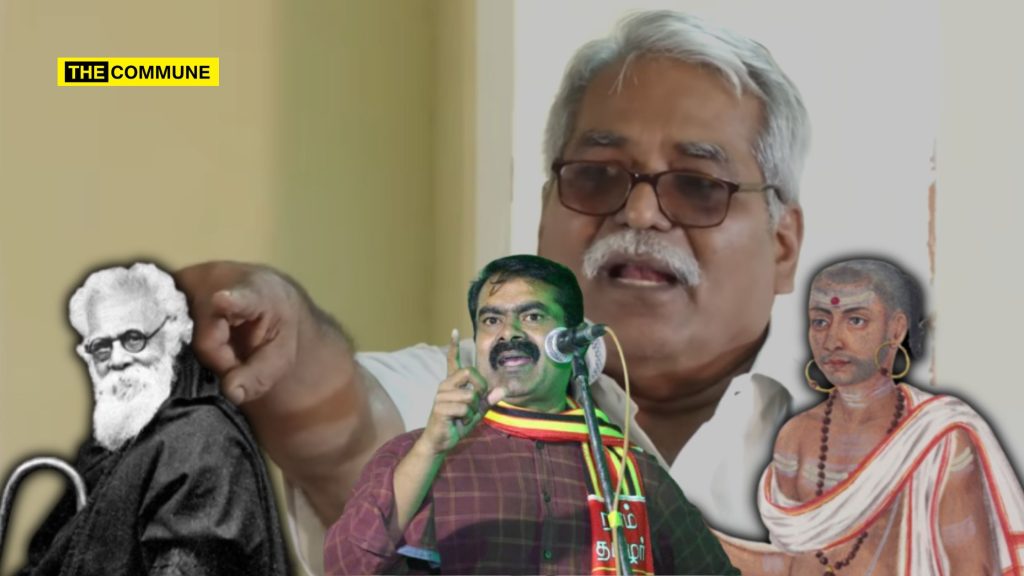
When society does not speak the language of the Dravidianists, but that of nationalism and Dharma, the Dravidianists panic. They abuse the Brahmins in their anxiety. That is what happened when Dravidianist Prof Jayaraman made a speech recently in the aftermath of NTK Chief Seeman giving a speech about Mahakavi Subramaniya Bharathiyar.
Here is a transcript of the speech:
Attacking Seeman without naming him, he said, “If someone cannot distinguish between Tamil nationalism and livelihood-based opportunist politics, then that person should not run a party. That party should be dissolved. Otherwise, it is nothing but deception. In the evening, a man buys four kilos of jaggery. The next day, he stuffs it into an old asafoetida tin and sells it as medicine. That is called fraud. That is a crime. If you don’t know what Tamil nationalism is, you should learn it. You should not stand on a stage and say, “Tamil nationalism” without understanding it.”
He continued, “This nation has fought for its liberation from the past. Didn’t Periyar ask for Tamil Nadu’s liberation? When he said, “Tamil Nadu for Tamils,” what did that mean? Everyone thought he meant a state. Periyar meant an independent nation. A long struggle happened. It has continued till today. Periyar, Pavalar Perunchithiranar stood firm. Fighters like Thozhar Thamizharasan, Pulavar Kaliyaperumal stood in the field. Their organisation functioned until 2002. Even today, that spirit exists. If people can be cheated by falsely defining Tamil nationalism, whose fault is that? Where is the mistake? We do not know.”
Explaining what nationalism was, he said, “Just remember this: the word “nationalism” appears only in 1772. Nations existed before that. When nationalism was born, it had a meaning. That is why today we speak of French nationalism, Scottish nationalism, Tamil nationalism. Nationalism is the liberation ideology of a nation. Tamil nationalism is the liberation ideology of the Tamil national people. The foundational slogan of Tamil nationalism is liberation. It cannot have any other meaning. Does a dog have another name? A dog is a dog. A tiger is a tiger. Can we all sit together and decide to call a street dog a tiger? No. Tamil nationalism is extremely fundamental. These youngsters must become clear. Don’t lecture me too much. There is a word “nation.” Nation does not mean land. It does not mean map. Nation refers to a people — a national people. So, what is nationalism? Nationalism means nation becoming a nation-state. That is the definition.”
He continued, “So what is Tamil nationalism? What is nationalism? Nationalism means a nation becoming a nation state. This is the definition. Tamil nationalism means the Tamil national people creating a sovereign Tamil nation. That alone is Tamil nationalism. Don’t twist it and say something else. Speak with some sense of responsibility. Such tricks cannot be ideology. Mobilising a people, awakening their historical unity, and guiding them towards creating a sovereign nation — that is Tamil nationalism.”
Bringing EV Ramasamy into the topic, he said, “From 1938 onwards, what Periyar spoke and practised was Tamil nationalism. That essence is what later came to be called Dravidianism. Now people deliberately confuse by inserting Dravidianism. I won’t speak much about the word Dravidian. First, Dravidian refers to South Indian geography. Second, it refers to a language in South India. Thayumanavar in the 18th century said, “If someone fluent in Sanskrit comes, I will speak in Dravidian.” If a scholar of Tamil comes, he says he will speak some things in Sanskrit. If you say there was a language called Dravidian, it is Tamil. Telugu is not called Dravidian, and Telugu people are not called Dravidians. We must be very, very clear about this. The name Dravidian belongs only to the Tamil language. “Ava” (indicating Brahmins) said the language they speak was Dravidian and we, in the lower strata, called Tamil as Tamil.”
He continued, “In 1899, Tamil scholar Sabapathi Navalar published a book titled History of the Tamil Language. Its name was Dravida Prakasikai. One thing having two names – like food is called soru and saadham. Some people used “Dravidian” as a prestige term and “Tamil” as inferior. Robert Caldwell in 1856 scientifically proved that South Indian languages belong to one family. He had to name the family of Dravidian languages. He said he couldn’t find a better term than “Dravidian.” Tamil speakers are Tamils; speakers of the Dravidian language family are Dravidians. So, a person who speaks Tamil,
when it comes to the language family, is a Dravidian, and when speaking Tamil, he is also a Tamilian.”
Further, he said, “Then anthropology came. Sir William Jones classified Sanskrit, Greek and Latin as Aryan languages. Similarly, Thomas Huxley in 1865 classified South Indian people anthropologically as Dravidians. Now the problem is over. The term referred to the land, and the language referred to Tamil and its linguistic sphere. The term ‘Dravidian language’ refers to all of them together: Tamil, Telugu, Malayalam, and Kannada. Besides this, another meaning emerges, and that’s what the Dravidian movement adopts. If you ask how, it’s based on the idea that Aryans are in the northern part of India, Dravidians in the southern part, and Mongolians in the northeastern region, including Manipur; all these groups are present there. Regarding the people in South India—that is, the Dravidians—Robert Caldwell writes that they are a distinct race, that they were made Shudras, and that the Aryan Brahmins came to South India and made them Shudras. Robert Caldwell, in his 1856 comparative grammar of the Dravidian languages, writes about this, and that’s when they get intensely angry. They understood that it was these Aryans who had called them Shudras and subjected them to such humiliation; this didn’t happen naturally, nor did God create them that way. After that, as you well know, it comes up in Manonmaniam Sundaranar’s poem, where he praises Tamil, the southern language that will not perish and be destroyed like the Aryan language. That’s how it comes about.”
Pushing the Aryan-Dravidian theory, he continued, “Then, who takes this up? Ayothidasa Pandithar takes this up. It was Ayothidasa Pandithar who identified himself as Dravidian and brought this identity to the forefront. I must tell you that what I’m saying now is a very important point, because it was Ayothidasa Pandithar who did this for the first time. How did he do it? Look here, we all call ourselves Dravidians and Tamils now, but in the 18th century, there was no such name as Tamils, nor was there a name like Dravidians. There were only castes; people were identified only by their castes. Many people think that we were born wearing pants and shirts, and with pullingo hairstyles. That’s not the case. The word that identifies all Dravidians did not exist then. The word ‘Tamils’ existed, but it didn’t include all Tamils. This is a very important point, please understand. So, what happened was, Ayothidasa Pandithar took up that word. In 1885, Ayothidasa Pandithar and Reverend John Rathinam together established an organization called the Dravidar Kazhagam. The Dravidar Kazhagam was established in 1885 by Ayothidasa Pandithar. The word ‘Dravidian’ appealed to everyone. Did you read Robert Caldwell? Yes, I did. We are all Dravidians, not Aryans. Tamil did not originate from Sanskrit, he clearly stated. Not only that, he said that the Aryan Brahmins had insulted us by calling us Shudras, and he wrote that we are the sons of this soil. Caldwell and other scholars discussed this among themselves. See how that change comes about.”
He continued, “The important point in that, comrades, is that Robert Caldwell, after examining comparative grammar, didn’t say, “What’s in this? What’s in that? Everything originated from one language, from the Dravidian language, from Tamil.” In his time, even Tolkappiyam wasn’t available in print. The Indus Valley Civilization excavations and research hadn’t taken place then. Based solely on Nannool, which was the only text available to him, he conducted his research. I am amazed by Robert Caldwell’s contribution. We haven’t discussed his extensive work. People might think, “Couldn’t he have simply said it’s a South Indian language family?” Ellis did refer to it as the South Indian language family. But he didn’t stop there. He searched in North India, even in present-day Pakistan, where the Brahui language, a Tamil language, exists. So, the term “South Indian language family” wasn’t sufficient. He says that he wandered around in places like Siberia in Russia, where it’s covered in ice, where wolves roam and tear apart and devour their prey, searching among the people of those regions to see if any roots of this South Indian, this Dravidian language family, were evident. It was very easy for me to get lost, he says. It was with such effort that he wrote “A Comparative Grammar of the Dravidian Languages.”
He continued, “If it took the Tamil University three years just to translate it, then such a magnificent work might have its flaws, but dismissing it so casually is wrong. However, what I wanted to say was from a different perspective. When the second edition came out in 1875, that’s when he did something significant. He wrote that there are people called Paraiyars here, and these Paraiyars are ostracized and treated like some other race. He said that he has written about the Dravidian race, and that the Paraiyars are also Dravidians, belonging to the same race. People would ask, “He is very dark-skinned,” and he addresses that too.
If someone works in the sun all day, day after day, they will naturally be dark-skinned. If he stays in the shade, he will become fair. Who is saying this? Caldwell. The anger stemming from that hasn’t subsided yet. For Brahminism, there needs to be a reason for every resentment, right? You say that you can forgive someone for saying that these Paraiyars, these lower castes, belong to the same family. Robert Caldwell had already said this. Comrade Pozhilan also mentioned something. Comrades, understand this clearly: the Tamil Lexicon was created by the University of Madras. The work was completed in 1937. In that 1937 edition, if you look up what is written about Tamils, it gives three meanings: one, two, three. One of the meanings is “Tamil castes excluding the Paraiyars.” Paraiyars are not Tamils. So, understand, they didn’t include the Paraiyars in the definition of Tamil. That’s how it was. Today, thinking that people don’t know, understand how much work has been done. This generation doesn’t know, and we haven’t taught them either. So what happened? I started talking about Ayothidasa Pandithar. From there, Ayothidasa Pandithar, other scholars, and Periyar, all said that they were Dravidians, and that Dravidians are non-Aryans, and that non-Brahmins are Dravidians. And in that context, Rettamalai Srinivasan coined the term ‘Adi Dravidar’ in 1892. In 1891, Ayothidasa Pandithar and Rettamalai Srinivasan created the Adi Dravida Mahajana Sabha. There was a person called Thanthai Periyar, and from 1928 onwards… Between 1938 and the following 10 years, he conducted 25 Adi Dravidar conferences. Take that list and understand from it that the credit for uniting and bringing everyone together under the single word ‘Tamils’ belongs to Periyar and other leaders whom we respect. Today, everyone is a Tamil. Even back then, Tamil Nadu had already come into existence, hadn’t it? We are all Tamils, aren’t we? Then why, when someone says ‘Dravidian’, do some people take off their shirts, put on sacred ash all over their bodies, wear a garland, and stand submissively before Brahmins, begging for sacred ash and applying it? He might be a Tamil then. But when he defiantly twirls his mustache, his name is Dravidian. When a Tamil stands tall with self-respect, he is called a Dravidian, that’s all. When he was speaking at a place that day, Comrade Minor and others were also present. I think it was during that time that I asked a simple arithmetic question. I asked, “What is four minus two?” Comrades would easily say six. “What is five minus two?” They would say three. There’s no doubt about that. Tamils minus Brahmins equals what? This was the question. Tamils minus Brahmins equals Dravidians. That’s what Periyar said. What? How can you call me a Dravidian? That’s the only way I can explain it. Whether you like it or not, if you have the sacred thread, you are a Dravidian.
He added, “There was a magazine called Dravida Abhimani in 1884, a journal called Dravida Varthamani, also in 1884, Dravida Pandiyan, run by John Rathinam in 1885, Dravidar Kazhagam in 1885 by Ayothidasa Pandithar and John Rathinam, Dravida Nesan, a Saivite journal in 1891, Dravida Manthiri weekly in 1893, Dravida Bhanu in 1895, Dravida Pandiyan weekly in 1896, Dravida Kokilam in 1899, Dravida Mahajana Sabha by Ayothidasa in 1891. The term Dravidian is the name given to the anti-Aryan ideology established by Tamils. There is no need to be confused about this. So, these Dravidians, Dravidians mean non-Aryans. How to identify Aryans? They wear the sacred thread. Those who don’t wear it… I saw a video clip this morning, a small clip. A Brahmin religious preacher was saying, “My grandfather was there, there were grave diggers and village watchmen. A Nadar boy came into the street. They tied him upside down and skinned him alive,” he says. They tied a Nadar boy upside down and skinned him alive for coming into the street. A Brahmin is giving this testimony today, right? Do you see how much things have changed from that time to today? Who brought about this change? You think, “What did Periyar do?” You haven’t lived in a world without Periyar.”
Rubbishing the temple entry movements led by Brahmins, he said, “They say that in 1936 and 1939, Vaidyanatha Iyer was the one who took people inside the temple. All that came much later. In 1926, Periyar’s Self-Respect Movement, in 1925, they entered the Suchindram temple. Temple entry happened in 1927. I’m from Mayiladuthurai. In Mayiladuthurai, the Self-Respect Movement members entered the temple. Many temples followed suit. In 1929, in Periyar’s hometown, Erode, under the leadership of Kuthusi Gurusamy, the oppressed people entered the Kottai Eswaran temple. The doors were locked from the outside. They stayed inside for two days. Periyar, who was out of town, came and released them. Understand what all happened. We need to understand that we were under a massive system of caste-based oppression. So, who brought the word ‘Dravidian’ into the field? It was Ayothidasa Pandithar. After that, almost 59 years later, the Dravidar Kazhagam was formed in 1944. You can’t oppose the word Dravidian in the name of opposing Periyar.”
Once again, taking aim at Seeman, he said, “To be precise, I’ll tell you why this ‘Brahmin crowbar’ term came about. The ‘Brahmin crowbar’ didn’t come to oppose Periyar; it came to oppose Ayothidasa Pandithar. He couldn’t tolerate that oppressed caste. The anti-Dravidian campaign they are conducting today is a campaign against the downtrodden people, against the Dalits. That’s how it has been happening. See how subtly the Brahmins are doing it today. Because in 1924, Periyar marched in Vaikom. In Vaikom, he marched for the right of people to walk on the roads. The oppressed people did not have that right. But what happened after that? The Dravidian movement continued to fight little by little. Then what happened? They entered the temples. After that, Dr. Ambedkar guaranteed some rights in the constitution. But in 1925, the RSS started. Today it’s been 100 years. What they want is to create a Hindu nation in 100 years. They don’t want a Hindu nation for everyone. The Shudras here should only do Shudra work. They can wear pants, they can study, but they should only do Shudra work. They should only do their caste-based occupations. That’s why they say, “Wear pants, do you want to study?” If you keep saying that, they’ll quickly take away everything. Do you know the salary? Why are you only sending your child to a big international school? Will they study in an international school in English medium? Don’t the children of ordinary people need education? Periyar considered everyone as his own children.”
Winding up, he said, “Two people stood there challenging. Brahminism stood there challenging. They asked, “What is your name?” RSS, Rashtriya Swayamsevak Sangh, they asked, “What is your name?” He said, “My name is E.V. Ramasamy, some affectionately call me Thanthai Periyar.”
He continued, “Both of them started their work at the same time. In 1924, he was dragging everyone onto the streets, and he was jailed twice. At the same time, the RSS started its work there. In 1970, Periyar said, “This is a thorn in my heart. They are going everywhere, but we, the Shudras and Panchamas, cannot enter the sanctum sanctorum. I am going to conduct a protest,” said Periyar. Kalaignar Karunanidhi was the Chief Minister at that time. He said, “No, no, I will enact a law that people from all castes can become priests,” and he enacted the law. But they stopped that law using the court. After that, they gave training to everyone. Then in 2006, they made it a law. In 2015, they said that if they are qualified, they can be appointed. However, they have stopped it in the Supreme Court. This government came to power in 2021. What they have done is, since women are more oppressed than men, they appointed three women – Ranjitha, Ramya, and Krishnaveni – as assistant priests. What’s more, Ranjitha is a Dalit girl, Ramya is from the MBC community, and Krishnaveni is a girl from the Valluvar community. They have appointed 90 women as temple singers (Othuvars). They have stayed this using the Supreme Court by filing a case. That bearded man is looking and smiling. Hey RSS, you and I started our work at the same time. Now do you see? He’s saying, what is he saying? You said that no one could climb Mount Everest except Tenzing Norgay, but so many people have climbed it. You said that no one could set foot on the moon, but Armstrong and Aldrin set foot on the moon; Collins was the only one who remained in the rocket. What did you say? You can set foot on Mount Everest. You can set foot on the moon. You said that we couldn’t put our foot inside the garbagruha? Look at our children, he says, and the bearded man is stroking his beard, and he sends a man from there, giving him a crowbar. I’m coming with a crowbar, a Brahmin’s crowbar. When these crowbars come here, they don’t just get dented, they get shattered, they get crushed. A great war is going on. He says, the leader of this party says it’s a Dravidian-Tamil war. How can there be a Dravidian-Tamil war? It’s an Aryan-Dravidian war that’s happening, it’s an Aryan-Tamil war that’s happening. You’re saying that Brahmins are taking up crowbars, but we are removing the Brahmins from among the Tamils, and we, as Dravidians, are standing in the battlefield. No matter who you are, if you come as a mercenary for the Brahmins, you will be crushed. You will have no place; you will be disgraced in history. You go back to selling your herbal remedies as usual. There’s a crowd that will believe anything you say.
He added, “I only talk about principles, that’s all I talk about. Instead of expecting him to understand by listening to that, someone commented below the writing, which I thought was very well-written, “Oopi 200.” I didn’t know what Oopi 200 meant. For a long time, I thought it meant Uttar Pradesh, because in history, isn’t UP Uttar Pradesh and MP Madhya Pradesh? I didn’t know the meaning of 200. Then they said it means “comrade,” that you’re writing this after taking 200 rupees. Is that what it means?
They don’t understand one thing: there are people who cannot be bought even with 200 crores, who will stand on the battlefield. They don’t know that. But my language is not understandable to them. My language is not understandable to them. Now, in computers, there are Java, JavaScript, Ruby, and all sorts of languages. I don’t know all that. Who knows? Only the computer knows. And then the computer people know. So, my language is not understandable to them. But there are two people who know how to speak in a language that is understandable: Comrade Manoj and Comrade Minor. I think they understand now. We need to be a little clearer about political history and these ideological concepts. We need to train the next generation.”
Read The Commune’s counter to Prof. Jeyaraman here.
Subscribe to our channels on WhatsApp, Telegram, Instagram and YouTube to get the best stories of the day delivered to you personally.