A few days ago, fantasy fiction writer Devdutt Pattanaik wrote an article in The New Indian Express where he called Bharat’s first great political scientist, a “fantasy”.
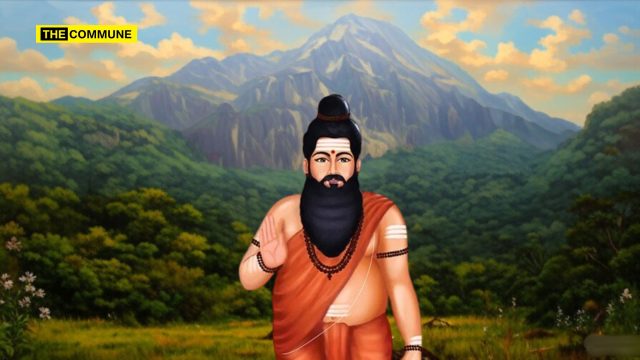
Now, we have “scholars” from Tamil Nadu doing something similar. They are calling Sage Agasthya, the sage who carried the Himalayas in his shoulders and Tamil in his heart, something similar – they are saying he never existed!
A report in Dravidianist web portal The Federal carries an interview of such “Tamil scholars” who are saying so.
Why Did This Start?
The Union Ministry of Education’s upcoming “Agasthya Expedition”, organised under Kashi Tamil Sangamam 4.0, is the reason. An entire section of Tamil writers and researchers argue that Sage Agasthya is purely mythological and unsupported by literary or manuscript evidence, but there are scholars who are able to provide evidence, in the form of multiple classical Tamil texts that explicitly reference the sage.
The expedition, planned to trace Agasthya’s supposed journey from Tenkasi to Kashi, is scheduled to begin on 2 December 2025. Organisers describe it as a cultural exploration of sites associated with the sage. Critics, however, have questioned the exercise, alleging an attempt to manufacture history.
Critics: “No Proof Agasthya Existed; Expedition Based on Mythology”
According to the original set of scholars quoted by The Federal, including Prof. S. Saravanan of the University of Madras and Indologist R. Balakrishnan, there is “no literary or manuscript evidence” establishing Agasthya’s historical existence. They argue that sage Agasthya appears only in later mythological narratives, not in early Tamil literature. They also claim that Agasthya authored Tamil grammar or taught Tholkappiyar are “baseless”.
They also argue that the sage’s name does not appear directly in Sangam literature, except through late medieval commentaries.
Additionally, they claim that there are attempts to portray Agasthya as the father of Tamil grammar or as a hero of Tamil tradition constitute “cultural politics” and “belittling Tamil”.
As reported in The Federal, Balakrishnan said he surveyed nearly 400 books and found “no evidence” of Agasthya as a historical figure. Prof. Saravanan described Agasthya as a mythological construction whose identity evolved through Brahminical interpretations over centuries.
Earlier literary attempts, such as KN Sivaraja Pillai’s Agastya in Tamil Land (1932), have also noted that the Agasthya figure may have undergone improvisation and narrative layering.
The KTS organisers at IIT-Madras, when contacted, stated only that the expedition would “visit places associated with Sage Agasthya” and reportedly did not respond to questions about evidence for his existence.
Real Scholars Reject Claims, Cite Extensive Tamil Sources Mentioning Agasthya
The criticism has, however, triggered a strong rebuttal from other Tamil scholars such as TS Krishnan, who say the claims of “no literary evidence” are demonstrably false.
They point to a wide range of Sangam, post-Sangam, bhakti and medieval works that explicitly refer to Agasthya:
From Sangam Literature
Paripadal contains a well-known line referencing the star Agastya, named after the sage associated with Podhigai:
“பொதியில் முனிவன் புரை வரைக் கீறி மிதுனம் அடைய”
(The star Agastya — named after the sage residing in the Podhigai hills.)
Post-Sangam Epic Literature
In Manimegalai, Agasthya is said to have released the sacred Kaveri from his kamandala:
“அமர முனிவன் அகத்தியன் றனாது கரகங் கவிழ்த்த காவிரிப் பாவை”
Shaivite Canon
Thirumandiram records Shiva’s instruction to Agasthya to travel south and restore balance:
“நடுவுள அங்கி அகத்திய நீ போய் முடுகிய வையத்து முன்னிர்”
Thevaram hymns by Appar and Sambandar also contain references to Agasthya.
Medieval and Later Texts
Kamba Ramayanam describes him as:
“தென் தமிழ்நாட்டகன் பொதியில் திருமுனிவன்”
(The sage who resides in Podhigai, in the southern Tamil land.)
Copper Plate Inscriptions
Pandya-era copper-plate charters refer to Agasthya as the Kula Guru (royal preceptor) of certain Pandya kings – an epigraphic acknowledgment.
Counter-scholars argue that given this breadth of textual and inscriptional evidence, the claim that Agasthya appears “nowhere in Tamil literature” reflects poor scholarship or ideological posturing, not evidence-based research.
This is the kind of ‘Tamil Scholarship’ we see these days.
“No literary or manuscript supports the existence of Agastya.”
Really?Let’s begin with the Sangam classic Paripadal:
பொதியில் முனிவன் புரை வரைக் கீறி மிதுனம் அடைய
(The star Agastya — named after the sage who resides in… pic.twitter.com/jBLmUoBuy9— 𑀓𑀺𑀭𑀼𑀱𑁆𑀡𑀷𑁆 🇮🇳 (@tskrishnan) November 25, 2025
Conclusion
The debate over Sage Agasthya’s existence ultimately collapses when confronted with the sheer weight of classical Tamil evidence. Across Sangam poetry, post-Sangam epics, bhakti literature, medieval inscriptions, and royal copper-plate charters, Agasthya appears not as a stray mythic allusion but as a continuous, culturally central presence woven into Tamil civilisation for over 2,000 years.
When a figure:
- appears in Paripadal,
- shapes the narrative world of Manimegalai,
- is commanded by Shiva in Thirumandiram,
- is sung by Appar and Sambandar,
- is honoured in Kamba Ramayanam,
- and is recorded in Pandya royal grants as Kula Guru,
then the claim that “there is no literary or manuscript evidence” is not just incorrect; it is untenable.
Historians may debate which Agasthya lived, when he lived, or whether multiple sages bore the name. But denying Agasthya’s existence altogether requires ignoring the entire Tamil canon and the cultural memory of millennia.
The evidence is clear:
Agasthya exists as one of the most cited and enduring civilisational figures in Tamil literature, spirituality, medicine, and royal tradition.
To call him “non-existent” is not scholarship.
It is selective erasure.
And Tamil texts, from Sangam to bhakti to medieval epigraphy, simply do not permit that erasure.
Subscribe to our channels on WhatsApp, Telegram, Instagram and YouTube to get the best stories of the day delivered to you personally.