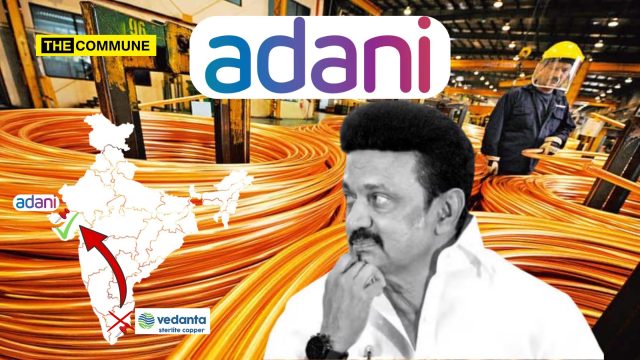
Years after the closure of copper plants in Tamil Nadu—which shifted India from a net exporter to a reliant importer of copper—a new development signals a turnaround. This week, a copper smelting facility owned by Indian billionaire Gautam Adani began processing ore, amid rising global demand and a critical shortage of supply.
Located in Gujarat, the Kutch Copper plant has an annual capacity of 500,000 tons and is part of Adani’s broader strategy to reduce India’s dependence on copper imports. Although the facility was initially set to launch in 2024, delays—caused by a global shortfall in copper concentrates—pushed back operations.
According to sources familiar with the matter, the plant has begun receiving and processing raw material, though reaching full operational capacity could take up to 18 months—significantly longer than the usual 2–3 month ramp-up timeline. Full-scale production will require around 1.6 million tons of copper concentrate annually.
Industry research firm CRU Group estimates that the global shortfall between copper ore supply and smelter demand will hit 1.2 million tons in 2025—the largest gap recorded in over a decade.
An Adani Enterprises spokesperson confirmed that Kutch Copper has entered operational mode and is currently focused on scaling up to full capacity as swiftly as possible.
Smelters around the world are grappling with the challenge of securing copper concentrate, as increased competition from new facilities has drastically reduced processing margins.
The squeeze is partly due to integrated copper plants that have come online at mining sites in Indonesia and the Democratic Republic of Congo, diverting concentrate supplies from independent smelters.
However, a more significant factor is the rapid rise of standalone smelting operations that rely heavily on the open market for raw materials. This group includes Adani’s new Gujarat plant, along with large-scale Chinese facilities like the 500,000-ton-a-year smelter launched earlier this year by Tongling Nonferrous Metals Group Co.
Why Tamil Nadu’s loss has become Gujarat’s gain
Once a major contributor to India’s copper production, Tamil Nadu witnessed a sharp industrial decline after the closure of the Sterlite Copper plant in Thoothukudi (Tuticorin) in 2018. Now, Gujarat is emerging as a major player in copper smelting, thanks to a new plant launched by the Adani Group—signaling a shift in India’s copper map.
Sterlite Shutdown in Tamil Nadu
Until 2018, India was a net exporter of refined copper, with Sterlite Copper (a unit of Vedanta Ltd) producing nearly 40% of the country’s copper output. The plant in Thoothukudi had a capacity of 400,000 tonnes per year and played a crucial role in meeting domestic and export demands.
However, large-scale protests—allegedly fueled by foreign-funded NGOs, activists, and media outlets—led to its closure. Groups like The Other Media (TOM), supported by overseas Christian organizations, were accused of manipulating public sentiment and social unrest. Prominent activists and media platforms also amplified the anti-Sterlite narrative, resulting in the loss of thousands of jobs and a major economic blow to the region.
As copper production in India dropped, the country became increasingly reliant on copper imports, reversing its earlier status as an exporter. Commerce Minister Piyush Goyal confirmed that the fall in copper exports was directly linked to the shutdown of the Sterlite facility.
Gujarat Steps In: Adani Group’s Strategic Investment
While Tamil Nadu lost its industrial edge, Gujarat has capitalized on the opportunity. The Adani Group is currently building a $1.2 billion copper smelting complex at Mundra, under its subsidiary Kutch Copper Ltd.
The project is designed to:
- Produce 500,000 tonnes per year in Phase I (operational by 2024).
- Reach 1 million tonnes annually by 2029.
- Recover valuable by-products like gold, silver, platinum, phosphoric acid, and sulphuric acid.
This project is part of a broader national strategy to reduce dependence on copper imports and align with India’s energy transition goals. Copper is critical in green technologies such as electric vehicles, solar energy, and battery storage systems.
With India’s per capita copper consumption at just 0.6 kg (far below the global average of 3.2 kg), the Adani facility is expected to meet rising domestic demand and position India competitively in the global market.
From Political Protests to Economic Shift
The contrast is striking. At the height of the Sterlite protests, some critics sarcastically remarked, “If the copper plant is so safe, set it up in Gujarat.” That suggestion has now become reality. Adani’s copper project is not just an industrial investment—it is a symbol of what Tamil Nadu lost due to politicized activism and what Gujarat has gained by welcoming industry and infrastructure.
The Sterlite episode also exposed what some analysts call the NGO-Activist-Media (NAM) ecosystem—a network accused of leveraging foreign funding and ideological positions to shape public opinion and influence state policy. The Indian government has since tightened controls over FCRA-registered NGOs and foreign funding to prevent similar disruptions.
A Missed Opportunity for Tamil Nadu
The closure of the Sterlite Copper plant in Thoothukudi has had long-lasting socio-economic consequences for Tamil Nadu. Once a major contributor to India’s copper output, the plant’s shutdown in 2018 turned a prosperous region into one grappling with unemployment and economic hardship—while Gujarat moved in to fill the gap.
Mounting Protests from the Ground
Years after its closure, frustration continues to grow among residents of Thoothukudi and surrounding areas. On 16 June 2025, villagers from South Veerapandiapuram, Saminatham, and nearby communities gathered outside the Thoothukudi District Collector’s Office. Their demand was simple: reopen the Sterlite Copper plant and the associated thermal power station. Many of the protesters were former employees, who now struggle to survive as low-paid laborers. According to their statements, over 300 youth from these villages had worked at the plant, and the shutdown pushed them into economic instability.
Surprisingly, the call for reopening the facility has come not just from locals, but also from the Indian National Trade Union Congress (INTUC)—a key ally of the ruling DMK in Tamil Nadu. INTUC national secretary Kathirvelu openly questioned the inconsistency in allowing copper smelters to operate in other states while Sterlite remains shut. He pointed out that if pollution was the concern, it should be addressed with uniform regulations across India.
INTUC maintained that the economic cost of closure has been immense. Thousands of jobs were lost—not only within Sterlite itself but across hundreds of ancillary businesses that depended on the plant’s operations.
Wider Impact Across Industries
The plant’s closure didn’t just affect direct employees. On 6 January 2024, members of the Namakkal Lorry Owners’ and Trailer Owners’ Associations staged protests, claiming the shutdown paralyzed the logistics sector in the region. Over 6,500 trucks were impacted, and more than 600 vehicle owners had to seek alternative sources of income. Daily revenue losses were estimated at around ₹10 crore. Protesters proposed restarting the plant under strict environmental guidelines to balance development and sustainability.
In February 2025, the Thoothukudi Contractors’ Association joined the demand, highlighting job losses for 20,000 workers and severe financial strain on 400 SMEs, with income levels dropping by 40%. They have called for a Government Order to restart operations.
Community Voices
On 13 May, representatives from the Thoothukudi People Livelihood Protection Association met with MP Kanimozhi, urging her to support efforts to revive the copper plant. Their appeal noted that the facility had supported 20,000+ families across 50 villages for over two decades. Around 64 contractors had invested in trucks and machinery solely to serve Sterlite’s logistics operations. When the plant was shut, many were left facing crippling debts, having mortgaged personal property to finance their businesses.
Association president S. Thiyagarajan criticized the misleading narrative that labeled Thoothukudi as the “cancer capital” due to the plant’s presence. He pointed to multiple independent environmental assessments that found no such link, yet the perception persisted, fueling protests and ultimately the closure.
The plant’s shutdown, driven by both public outcry and political pressure, ultimately cost Tamil Nadu a vital industrial asset.
Tamil Nadu’s Setback, Gujarat’s Gain
While Tamil Nadu struggles with the fallout, Gujarat has stepped up. The Adani Group is developing a $1.2 billion copper manufacturing facility in Mundra, with plans to reach 1 million tonnes of annual capacity by 2029. With India aiming to double copper consumption by 2030, the plant will meet surging demand driven by electric vehicles and renewable energy.
What began as a regional protest has resulted in national industrial realignment. Tamil Nadu, once a cornerstone of India’s copper industry, has become a cautionary tale—while Gujarat is now poised to become a new hub for copper production. In hindsight, Sterlite’s closure reflects a missed opportunity shaped by activism, policy decisions, and political optics—leaving a legacy of economic loss and industrial migration.
(With Inputs From Bloomberg)
Subscribe to our channels on Telegram, WhatsApp, and Instagram and get the best stories of the day delivered to you personally.