


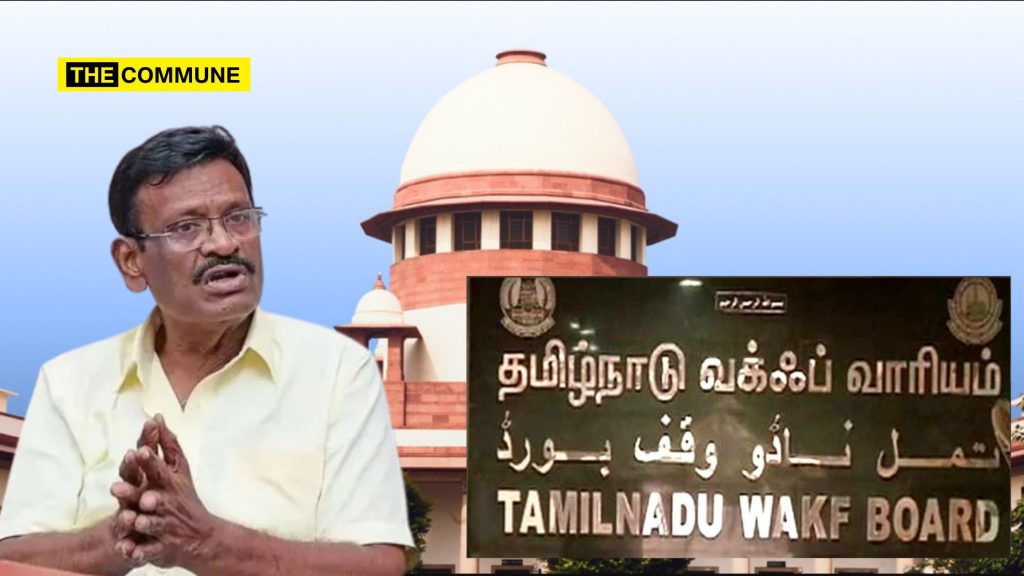
On 27 September 2025, S.M. Nasar, DMK Minister for Minorities Welfare and Non-Resident Tamils Welfare, stated that the Waqf Board in Tamil Nadu would not undergo reconstitution until the Supreme Court delivers its final judgment on the legal petitions challenging the Waqf (Amendment) Act, 2025.
In an official statement, Nasar explained that the DMK, along with several other parties, had filed a petition in the Supreme Court opposing the amended Act. Following this, the court issued an interim order on 15 September, which temporarily suspended specific provisions of the amendment while allowing the rest of the Act to remain operative.
He further clarified that the Tamil Nadu government would not proceed with reconstituting the Waqf Board under the new provisions, which he criticized as being pushed through hastily by the central government, until the Supreme Court issues a conclusive ruling on the matter.
Supreme Court Upholds Waqf (Amendment) Act, 2025, Stays Specific Clauses
On 15 September 2025, the Supreme Court refused to halt the overall implementation of the Waqf (Amendment) Act, 2025, including the requirement that individuals and institutions register Waqf properties they use. However, the Court intervened on specific controversial clauses, putting them on hold until state governments finalize their respective rules.
A bench led by Chief Justice B.R. Gavai and Justice A.G. Masih observed that, after thoroughly examining the legal trajectory of Waqf legislation from its inception in 1923 to its current iteration there was no legal basis to suspend the entire Act. Nonetheless, the judges acknowledged that certain provisions warranted temporary protection due to potential misuse.
One such provision is Section 3(1)(r), which requires that only individuals who have practiced Islam for a minimum of five years are eligible to establish a Waqf. The Court noted that, without a defined process to verify this requirement, its enforcement could lead to arbitrary decisions. The clause has therefore been suspended until proper state-level mechanisms are put in place.
Another clause placed under judicial scrutiny relates to state-appointed officers being authorized to report if a Waqf property encroaches on government land. The Court flagged this as a serious overreach, warning that allowing executive officers to unilaterally determine property rights undermines the constitutional separation of powers. It ruled that no land rights or third-party claims can be enforced unless established through a valid legal process.
While the Court allowed the provision enabling non-Muslims to be appointed to Waqf Boards, it clarified the cap: no more than four non-Muslims in a 20-member board, and a maximum of three in an 11-member board.
Rampant Waqf Land Grab Claims in TN
The sudden wave of Waqf land claims came as a shock to many villagers across Tamil Nadu, who unexpectedly found themselves unable to sell or transfer ownership of their own land to family members all due to broad and sweeping assertions made under the earlier version of the Waqf Act. While recent amendments have aimed to curb the arbitrary powers of Waqf Boards, the burden on ordinary citizens hasn’t eased entirely.
The latest flashpoint emerged from Virudhachalam, where a villager was reportedly blocked from transferring his land to his son. The incident reignited public concern and drew attention to a series of similar cases unfolding across the state.
Recent Instances Of Waqf Land Grabs
Mangalampettai, Virudhachalam
Villagers gathered in protest outside the Mangalampet sub-registrar’s office after officials refused to process a land transfer, claiming the plot belonged to the Tamil Nadu Waqf Board. The issue arose when Periyasamy, a resident of M. Akaram village, attempted to register land in his son Karthikeyan’s name. The protest, backed by Hindu Munnani and BJP representatives, was eventually resolved after talks with local authorities.
Kattukollai, Vellore
In April 2025, around 150 families received notices stating that their land now belonged to a dargah. The notice, issued by one Syed Ali Sultan Shah, demanded they vacate or pay tax to the religious institution, triggering widespread unrest.
Thiruchendurai, Trichy
In September 2022, the Tamil Nadu Waqf Board claimed ownership of the entire Thiruchendurai village in Tiruchirapalli, including temple lands, sparking significant concern among residents. This claim emerged when local farmer Rajagopal was required to obtain a No Objection Certificate from the Waqf Board to register his land sale, despite having proper revenue documents. The claim was recently debated in parliament, including over the 1,500-year-old Manendiyavalli Sametha Chandrasekhara Swamy temple. The Tamil Nadu Registration Department has acknowledged issues with encroachments and disputed properties but struggled to justify the Waqf Board’s claims over temple lands.
Thiruparankundram, Madurai
Indian Union Muslim League member and Ramanathapuram MP Navas Kani, who also serves as the Tamil Nadu Waqf Board chairman, has claimed that the dargah at the Thirupparankundram Temple hill is Waqf property.
Peyazhwar Temple, Chennai
Tamil Nadu Waqf Board President Abdul Rahman announced that many Hindu temples are present on Waqf properties, including the 1000-years-old Peyazhwar Temple, on land allegedly owned by the Kutchery Road Mosque.
Balasamudram, Dindigul
In a striking parallel to the Thiruchendurai village land dispute, another property conflict involving the Tamil Nadu Waqf Board has come to light, this time in the Balasamudram Municipality of Dindigul district. With claims dating back to 2020, the Waqf Board asserts ownership over the entire municipality, leaving around 10,000 residents in limbo. Unable to sell their ancestral properties due to unresolved legalities, the community’s frustration culminated in a petition to local authorities in May 2023.
Anganakaundan Puthur, Erode
In 2023, the Tamil Nadu Waqf Board asserted ownership over land allocated to 73 Scheduled Caste families in Anganakaundan Puthur, Erode District. The Tamil Nadu government provided this land in 1980 after a flood, and since then, it has been their home for 40 years. The Waqf Board’s claim has caused significant challenges, including transferring land titles, registering deeds, and obtaining loans.
Veppur Village, Ranipet
In January 2023, the DMK government wrongly reclassified 57 acres of agricultural land in Veppur village, Ranipet District, as Waqf Board property. This land, which Hindu families had farmed for decades, was abruptly claimed by the Waqf Board without proper notice or due process, causing considerable distress among the affected farmers.
Min Nagar, Kanchipuram
In January 2025, residents of Min Nagar in Kanchipuram district faced challenges after the Tamil Nadu Waqf Board claimed 2.43 acres of land they’ve lived on for over 40 years. The Kanchipuram Registrar’s Office confirmed the claim, hindering property registrations. The land was purchased in 1982 by employees of the Kanchipuram Electric City Office.
While amendments to the Waqf Act have tried to introduce checks, unresolved disputes continue to impact thousands across Tamil Nadu. Many of these claims date back decades or lack transparency, leaving ordinary citizens entangled in legal and administrative deadlock. As protests grow and more cases surface, pressure is mounting on both state and central authorities to review and address these recurring land conflicts with urgency and fairness.
(With Inputs From The Hindu)
Subscribe to our channels on Telegram, WhatsApp, and Instagram and get the best stories of the day delivered to you personally.