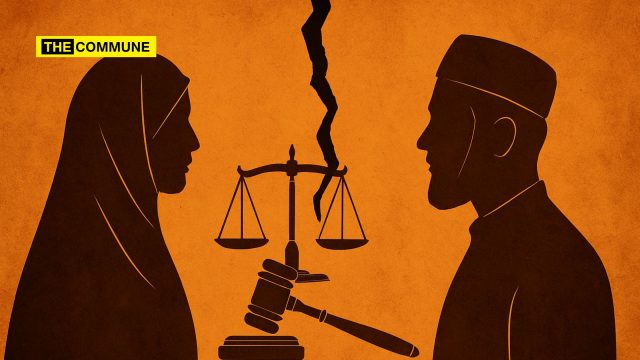
The Supreme Court on Wednesday raised serious concerns over the validity and procedure of talaq-e-hasan, a form of triple talaq under which a Muslim man can divorce his wife by pronouncing “talaq” once every month for three months. A Bench of Justices Surya Kant, Ujjal Bhuyan, and NK Singh made the observations while hearing multiple petitions challenging the practice.
The court, which had declared instant triple talaq (talaq-e-biddat) “bad in law” eight years ago, revisited the broader issue of divorce among Muslims and questioned whether talaq-e-hasan could withstand constitutional scrutiny today.
“How is this allowed in modern society?” the Bench asked, seeking detailed submissions on all existing forms of divorce in Muslim personal law.
Case of Woman Denied Child’s School Admission
During the hearing, the court also took up the case of petitioner Benazir Heena, whose child’s school admission was delayed because her former husband did not sign the divorce documents. Her counsel told the court that her husband, Ghulam Akhtar, had divorced her through his advocate and subsequently remarried.
“She will indulge herself in polyandry because of her husband. In the 11-page talaq notice, the sign of the husband is missing. Talaq was pronounced by the husband’s advocate,” her counsel said.
Her husband’s lawyer argued that this was a common practice in Islam. In response, Justice Kant asked, “Can this be a practice? How are these new innovative ideas being invented?”
The Bench further criticised the practice of issuing divorce notices through lawyers instead of direct communication.
“What prevents the husband from directly communicating with her? He has such an ego that even for divorce, he cannot speak to her. How can you promote this in a modern society? It is the dignity of a woman,” the court remarked.
The judges added that if talaq is invoked under religious practice, procedures must be “followed as it is prescribed.”
Court Summons Husband, Seeks Details on School
The Bench also sought details of the school that denied admission to the child and expressed concern about the broader implications of such practices on Muslim women across the country.
“We salute this woman who has chosen to fight for her rights. But there may be a poor woman who does not have resources. If she remarries, her earlier husband comes and says she is indulging in (polyandry)? Should a civilised society allow this kind of practice?” the court observed.
The Supreme Court directed that the husband be present at the next hearing, stating, “Let him come here and unconditionally provide what she wants.”
The matter has been posted for further hearing, with the court seeking complete information on the various forms of divorce recognised in Muslim personal law.
(Source: NDTV)
Subscribe to our channels on WhatsApp, Telegram, Instagram and YouTube to get the best stories of the day delivered to you personally.