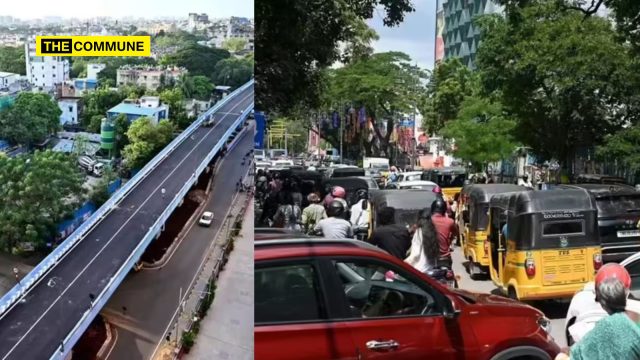
The newly inaugurated ₹164.9 crore steel flyover connecting South Usman Road with CIT Nagar has failed to deliver the relief from traffic congestion that it was expected to bring. The 1.2-kilometre-long structure, which was opened by Chief Minister M.K. Stalin last week, links with the existing 800-metre North Usman Road flyover, forming a two-kilometre elevated stretch through one of Chennai’s busiest commercial zones.
In the days following its inauguration, commuters travelling from CIT Nagar to North Usman Road reported that while the drive over the new flyover took only a few minutes, they were still forced to wait at the four-way Vivek’s Junction immediately after the flyover’s exit. Traffic police currently regulate movement manually, as there is no revised signal plan to manage the increased volume of vehicles being channelled directly from Anna Salai.
Before the flyover was constructed, vehicles from Anna Salai entered T.Nagar through Venkatnarayana Road, passing via the Link Road and South West Boag Road before reaching Panagal Park, resulting in slower movement through congested internal stretches. The new structure now brings a higher volume of vehicles directly to the junction in a shorter time, where they merge with traffic arriving from Venkatnarayana Road, Thyagaraya Road, and the Duraiswamy subway.
Traffic department officials stated that signal timers would be realigned once the new traffic density was assessed. They attributed the current congestion partly to the seasonal rush during the festive period and said that the situation was expected to persist until Diwali. Officials also indicated that discussions were ongoing with the Metropolitan Transport Corporation to consider bus route diversions from Valluvar Kottam.
Residents and commuters said the persistent congestion reflected deeper structural problems in T.Nagar rather than a lack of infrastructure. They pointed to encroachments, roadside parking, and poor enforcement as the main causes of traffic chaos. Several residents said that even with a longer flyover, bottlenecks would continue unless illegal parking and encroachments outside major business establishments were removed. They alleged that parking violations outside textile and jewellery stores were often ignored due to lax policing and corruption.
Greater Chennai Corporation (GCC) Commissioner J. Kumaragurubaran stated that the immediate focus was on reducing signal timings at Vivek’s Junction to allow faster vehicle movement. He said the Corporation’s long-term plan was to construct an additional 800-metre stretch connecting the North Usman Road flyover with the Mahalingapuram flyover, creating a continuous elevated corridor that would bypass the problematic junction. According to him, this extension would serve as a permanent solution, though the project could not be undertaken in the current financial year due to funding constraints.
Once completed, the proposed corridor from CIT Nagar to Mahalingapuram would become Chennai’s longest flyover, spanning four kilometres. The project, originally conceived in 2008, had seen only partial implementation at that time, with two separate flyovers built at Mahalingapuram and Usman Road.
For now, however, the ₹165-crore addition has done little to ease congestion in T.Nagar. Traffic continues to crawl through the same intersections, and the new flyover has merely shifted bottlenecks to adjacent roads, leaving residents questioning the effectiveness of yet another high-cost urban project.
(With inputs from Times of India)
Subscribe to our channels on Telegram, WhatsApp, and Instagram and get the best stories of the day delivered to you personally.