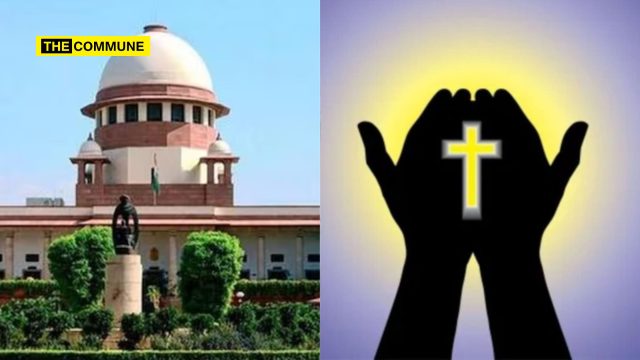
The Supreme Court on 22 September 2025 stayed a Madras High Court order that upheld the disqualification of a woman Chairman of a Panchayat for holding a post reserved for Scheduled Caste (General) category, citing her conversion to Christianity. A bench comprising Justices Vikram Nath and Prashant Kumar Mishra passed the order while issuing notice on a petition challenging the High Court decision.
The case pertains to the petitioner, elected to the Theroor Town Panchayat in Kanyakumari, whose status as a Scheduled Caste was challenged on the ground that she had embraced Christianity. The respondent argued that the petitioner, born in the SC category, lost her eligibility for reservation upon professing Christianity.
Opposing the plea, the petitioner contended that she had not abandoned her original faith, continued to be a Hindu, and was not professing Christianity. She denied misusing her community certificate as alleged.
The Single Bench of the Madras High Court examined the marriage register, which showed that the bans, a procedure for marriages among baptized Christians. were published three times. The Bench noted that the petitioner was baptized and admitted to the church at the time of marriage. It held that “even if the petitioner was never baptized, she could be considered only as a Christian.”
The High Court described the case as a “shameful field reality” highlighting how election officers were allegedly reduced to “sheer pawns by the ruling party during local body elections,” thereby undermining the vision of Panchayat Raj. It further observed that conferring SC status on a Christian was “nothing but fraud on the Constitution.” The bench stated that “when a person voluntarily submits himself/herself for conducting marriage under the Indian Christian Marriage Act, they would be considered Christian thereafter and their native religion is renounced automatically.” Consequently, it allowed the respondent’s plea, declaring the petitioner disqualified from her post, and upheld this decision in appeal.
The Supreme Court Division Bench, while staying the order, noted: “It is open to the appellant to embrace Christianity and profess the said religion. Article 25 of the Constitution guarantees such a fundamental right. But problem arises when post-baptism, the individual hides the new identity and for the purpose of enjoying the rights conferred by the Constitution pretends as if the erstwhile status continues.”
The court also observed, “The stand of the appellant is not that she reconverted to Hinduism. Her specific case is that she never embraced Christianity. Her claim stands belied by the production of baptism certificate by the learned Additional Advocate General in the open court.”
(With inputs from LawBeat)
Subscribe to our channels on Telegram, WhatsApp, and Instagram and get the best stories of the day delivered to you personally.