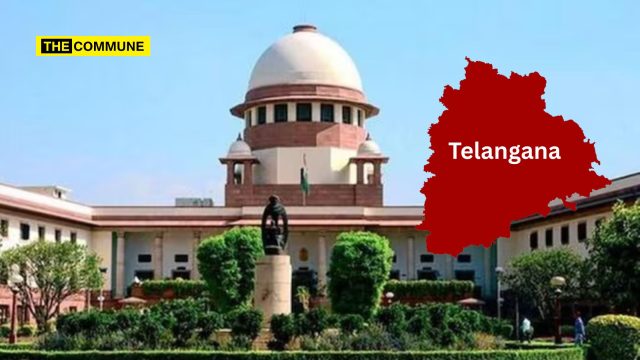
The Supreme Court on Thursday, 16 October 2025, dismissed the plea filed by the State of Telangana challenging the Telangana High Court’s interim order that stayed the implementation of 42% reservation for Backward Classes in local body elections. A bench comprising Justices Vikram Nath and Sandeep Mehta clarified that the High Court should decide the main matter on merits without being influenced by the dismissal of the State’s Special Leave Petition.
At the outset, Justice Nath asked Senior Advocate Dr. Abhishek Manu Singhvi why the reservation was not brought in before the elections were notified. Singhvi responded that the Governor had kept the Bill pending without granting assent. “The Bill became a law based on ‘deemed assent’ in terms of the Supreme Court’s judgment in the Tamil Nadu Governor case. Without making any challenge to the law, a stay has been secured,” he added.
Justice Nath then asked, “How do you challenge a Bill?” Singhvi replied, “The Bill has become an Act now, and has been acted upon on the basis of deemed assent.”
Senior Advocate Gopal Sankaranarayanan, representing the respondents, said the challenge was made to the Government Order that resulted in the reservation exceeding the 50% ceiling. “As per the K. Krishna Murthy (Dr.) & Ors. v. Union of India and Vikas Kishanrao Gawali judgments, triple tests have to be fulfilled before giving reservations in local self-government institutions. Earlier, it was 15%, 10% and 25% respectively for SC, ST and OBCs within the 50% limit,” he added. He pointed out that the Supreme Court has previously held in Maharashtra and Madhya Pradesh that reservation should not cross 50% for local body elections.
Another counsel for the respondents submitted that the State cannot unilaterally act on the basis of “deemed assent” for the Bill, as the Tamil Nadu Governor judgment held that the State must seek a writ of mandamus from the Court if there is a delay on the part of the Governor in granting assent to the Bill.
In response, Singhvi argued that the 50% limit was not an “inflexible rule” and claimed that the State satisfied the triple tests to enhance the reservation. “Door-to-door household socio-economic surveys were done ‘painstakingly’ for one year,” he added.
Justice Nath remarked, “Based on these exercises, you have come up with the Ordinance and a Bill. That is yet to take a final shape.” Singhvi asserted that the law was in operation. Justice Mehta pointed out that the Gawali judgment did not allow crossing the 50% limit. Singhvi replied that Gawali held 50% could be crossed if there was empirical data and highlighted that Telangana was the only State to have conducted such a survey.
The bench was not persuaded by these arguments and dismissed the petition. “You may continue with your elections [without reservations]… dismissed,” Justice Nath said.
(Source: LiveLaw)
Subscribe to our channels on Telegram, WhatsApp, and Instagram and get the best stories of the day delivered to you personally.