On 7 August 2025, the Supreme Court dismissed the writ petition filed by Allahabad High Court Judge Justice Yashwant Varma, who contested the in-house inquiry report implicating him in the ‘case-at-home’ controversy. The petition also challenged the recommendation by then Chief Justice of India Sanjiv Khanna to the President and Prime Minister for Justice Varma’s removal.
A bench consisting of Justices Dipankar Datta and AG Masih, which had reserved judgment on 30 July, delivered its verdict today.
The court immediately ruled that the writ petition was not maintainable due to Justice Varma’s conduct specifically, his initial cooperation with the inquiry followed by his later questioning of the in-house panel’s authority to investigate him.
Despite dismissing the petition’s maintainability, the bench addressed five key constitutional questions raised by the case:
- Does the inquiry have a legal basis?
- Is the inquiry and resulting report an unauthorized parallel mechanism outside the Constitution?
- Does Paragraph 5B of the in-house procedure violate constitutional provisions or infringe on a High Court judge’s fundamental rights?
- Did the Chief Justice of India (CJI) or the committee overseeing the inquiry follow or deviate from the prescribed procedure?
- Is Paragraph 7(2), which requires the CJI to forward the inquiry report to the President and Prime Minister, unconstitutional?
Justice Datta clarified that the inquiry is legally sanctioned and not an extra-constitutional process. He rejected claims that Paragraph 5B violates constitutional rights, affirming it does not infringe on a judge’s fundamental rights. The bench found that the CJI and his committee adhered strictly to the inquiry procedures, except for uploading videos and photographs related to the fire-fighting operation on the Supreme Court website a step deemed unnecessary by the procedure and irrelevant since it was not challenged in a timely manner.
Regarding the requirement to forward the report to the President and Prime Minister, the court upheld its constitutionality. The bench also dismissed arguments that Justice Varma was denied a hearing before the report’s transmission, stating that the procedure did not mandate such an opportunity. The fact that another judge might have been granted a hearing in a different case does not create a universal right for this petitioner.
The court reserved Justice Varma’s right to raise his defense if impeachment proceedings are initiated.
Additionally, the Supreme Court dismissed a separate petition by advocate Mathews J Nedumpara seeking an FIR against Justice Varma for “abuse of court process” and “false submissions.”
Senior Advocates Kapil Sibal and Mukul Rohatgi represented Justice Varma, who had filed the petition anonymously as ‘XXX.’
Sibal argued that under Article 124(4), a judge can only be removed for “proved misbehavior” or incapacity, and that the in-house procedure allowing the CJI to recommend impeachment initiation is unconstitutional. Justice Datta countered that the in-house inquiry is a preliminary, ad-hoc step, and its report is not treated as evidence, thus no grievance arises at this stage.
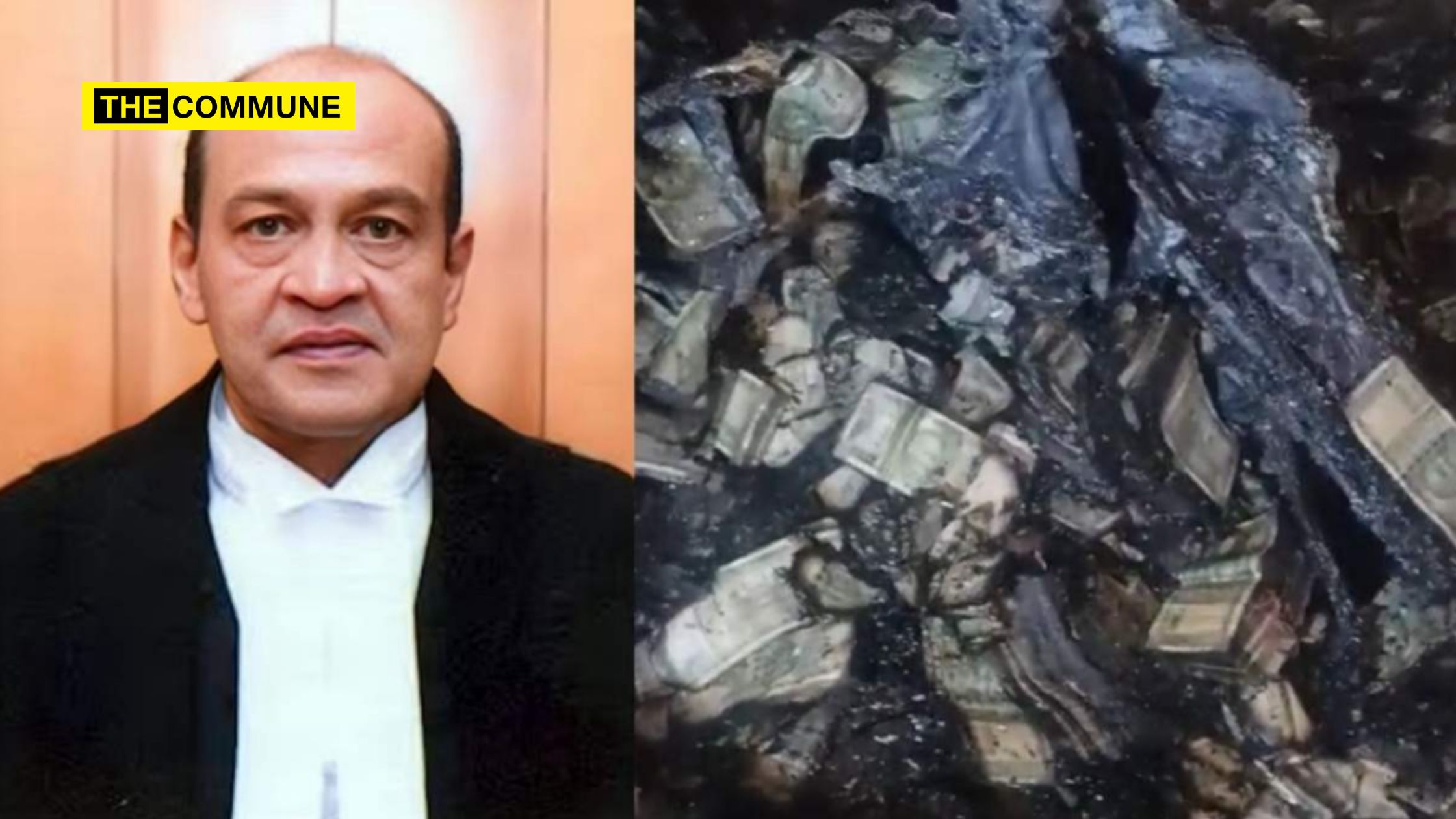
The controversy began with the accidental discovery of a large amount of cash in an outhouse at Justice Varma’s official residence during a firefighting operation on March 14. This sparked a public outcry.
Subsequently, then CJI Sanjiv Khanna set up a three-judge inquiry committee comprising Justices Sheel Nagu, GS Sandhawalia, and Anu Sivaraman. Justice Varma was reassigned to the Allahabad High Court, and his judicial duties were suspended during the investigation.
After examining 55 witnesses including Justice Varma and his daughter and reviewing video and photographic evidence from the fire brigade, the committee concluded that the cash was found in a storeroom under Justice Varma’s control. The judge failed to provide a satisfactory explanation for the money, instead denying the allegations or alleging conspiracy. On this basis, the committee recommended action against him. Recently, impeachment notices with the required signatures have been circulated in both Houses of Parliament.
(With inputs from Live Law)
Subscribe to our channels on Telegram, WhatsApp, and Instagram and get the best stories of the day delivered to you personally.