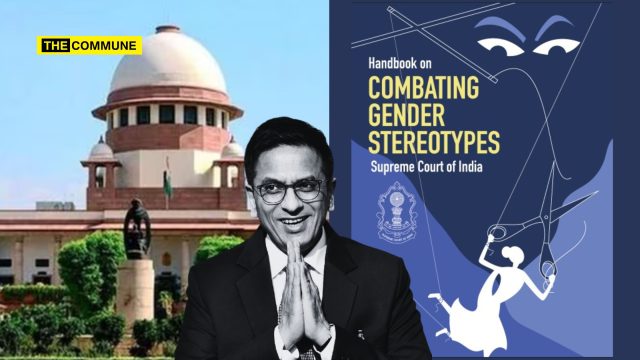
The Supreme Court of India has ordered a comprehensive relook at the controversial “Handbook on Combating Gender Stereotypes” introduced in 2023 under former Chief Justice D Y Chandrachud. It has ordered the drafting of fresh judicial sensitivity guidelines after several sitting judges expressed deep discomfort – both with the process through which the handbook was adopted and with portions of its content that they believe reinforce, rather than remove, prejudice.
As reported in The Indian Express, the move, formalised through a February 10 order by a three-judge bench of Chief Justice Surya Kant, Justice Joymalya Bagchi, and Justice N V Anjaria, asks former Supreme Court judge Justice Aniruddha Bose, now Director of the National Judicial Academy in Bhopal, to constitute a committee of domain experts drawn from practitioners, academicians, and social workers to prepare a comprehensive report and draft new guidelines. The committee has been given three months to submit its findings.
What Triggered the Order
As reported in OpIndia, the immediate occasion was a suo motu case the Supreme Court had initiated against an Allahabad High Court ruling in a POCSO matter, where the High Court drew a distinction between “preparation” and “attempt” to commit rape and consequently diluted the charges against the accused. The Supreme Court disagreed sharply. It held that the accused had clearly moved beyond preparation into active execution of intent, restored the original charges, and set aside the High Court’s judgment.
In that context, concerns raised by counsel about the persistence of judicial insensitivity in sexual offence cases, particularly those involving minors and vulnerable victims, found a receptive bench. CJI Kant acknowledged that empathy and compassion must accompany legal reasoning in such cases. The broader order that followed was, however, about something more systemic.
The Handbook That Divided the Court
The 2023 handbook, produced under CJI Chandrachud’s initiative and described in its foreword as having been “conceptualised during the COVID-19 pandemic” as part of the e-Committee of the Supreme Court, was framed as a tool to help judges and legal professionals identify and avoid gender stereotypes. Its glossary offered alternative language to replace what it termed “gender-unjust” terms in pleadings, orders, and judgments.
But behind the scenes, the handbook had been quietly generating friction within the institution. Highly placed sources told The Indian Express that judges were unhappy on two counts – process and substance.
On process, the grievance was direct: a document intended to guide the judiciary’s conduct in courtrooms was adopted without being placed before the full court. “It was necessary to take all judges into confidence before deciding to publish the handbook, which they were supposed to follow… It should ideally have been placed before the full court for a broader discussion, but this was not done,” sources said.
On substance, judges took specific exception to a section listing stereotypes commonly applied to men and women in the context of sexual violence. One entry in the handbook states that a prevailing stereotype holds that “dominant caste men do not want to engage in sexual relations with women from oppressed castes” and therefore any allegation of sexual assault by an oppressed caste woman against a dominant caste man is presumptively false. The handbook then offers its counter-narrative: that rape and sexual violence have historically been “used as a tool of social control” and that “dominant caste men have historically used sexual violence as a tool to reinforce and maintain caste hierarchies.”
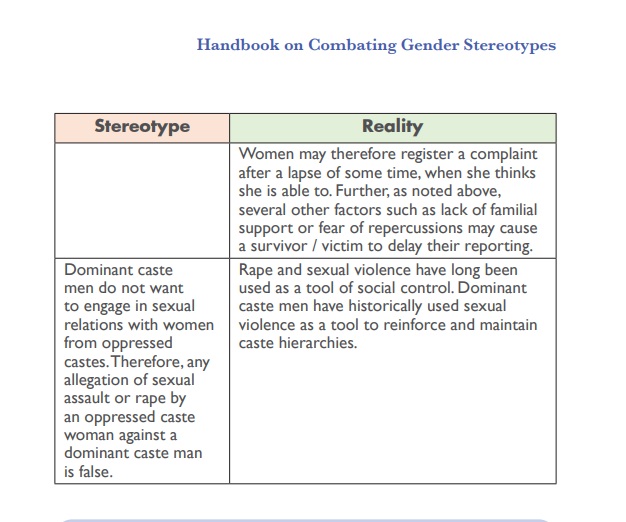
For a section of the judiciary, this was not sensitivity training – it was institutional overreach. Sources told the Indian Express that judges felt “the Supreme Court should not be making such generalised and sweeping statements, which have the effect of painting targets on entire communities.” That an official Supreme Court publication was making categorical sociological assertions about entire caste groups, rather than adjudicating specific disputes between individuals, was seen as a category error that carried serious institutional risk.
“Too Harvard Oriented”
The February 10 bench was also unsparing about the handbook’s language. CJI Kant pointedly described it as “too Harvard oriented” – academic, inaccessible, and remote from the lived reality of the litigants it was nominally designed to serve. The court’s order mandated that any new guidelines must be written in “simple language comprehensible to laypersons” and must not be “loaded with heavy, complicated expressions borne from foreign languages and jurisdictions.”
In a pointed formulation, the bench stated that the guidelines “must be contextualised in the real and lived experience of the stakeholders in the Indian judicial process, with direct reference to the ethos, values, and social fabric of our country.” The committee has also been specifically asked to identify offensive and insensitive expressions used across regional contexts so that victims from diverse linguistic backgrounds can better articulate their experiences before courts.
The order also acknowledged frankly that “the efforts thus far have not borne the fruit that was expected” – a measured but unmistakable institutional admission that Chandrachud’s handbook had failed its stated purpose.
A Pattern Worth Noting
This is not the first time that an institutional document addressing sensitive social questions has generated a sharp backlash for making sweeping generalisations. The UGC’s Promotion of Equity in Higher Education Institutions Regulations, 2026, stayed by the Supreme Court itself in late January, ran into similar turbulence for structurally presuming that General Category students and faculty are perpetrators in matters of caste discrimination. The court has now, in effect, flagged the same problem with a document it had itself published.
When contacted by The Indian Express, ex-CJI Chandrachud declined to comment.
What Comes Next
The new committee will study all previous attempts, including the 2023 handbook, before proposing fresh draft guidelines. Crucially, sources confirmed that the final guidelines will be placed before the full court for discussion and adoption – the consultative step that was conspicuously skipped the last time around.
What the February 10 order signals is an institution quietly pressing the reset button. The judiciary understands that sensitivity toward victims of sexual violence is not optional, it is a constitutional imperative. But the court has also signalled, without ambiguity, that the instruments used to build that sensitivity must themselves be constitutionally sound: carefully deliberated, linguistically accessible, institutionally credible, and free of the kind of sweeping sociological generalisations that convert judicial guidance into political controversy.
Chandrachud’s handbook arrived with considerable fanfare. It is leaving through the back door.
Subscribe to our channels on WhatsApp, Telegram, Instagram and YouTube to get the best stories of the day delivered to you personally.