


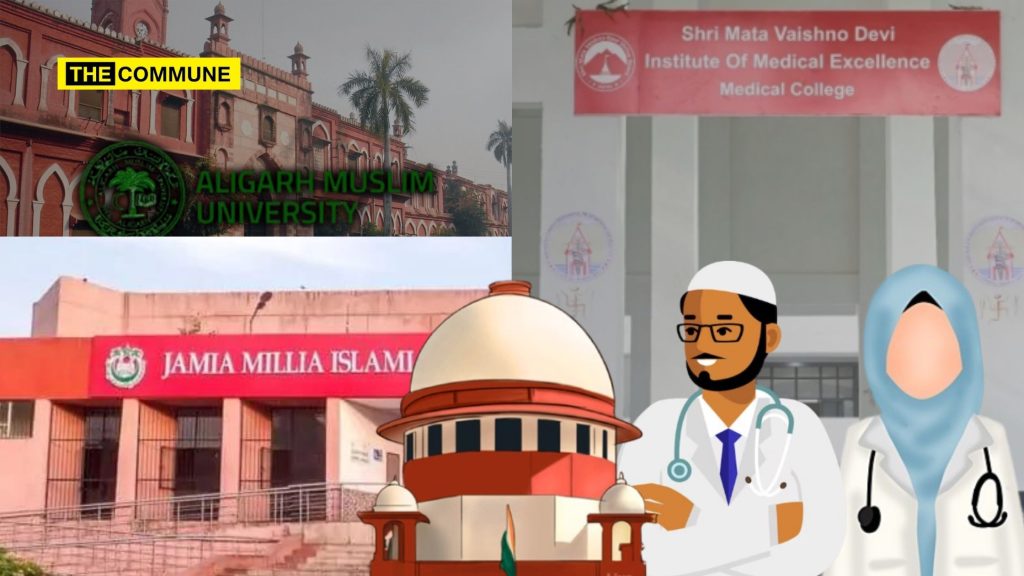
The first MBBS batch of a medical college built entirely from offerings made by Hindu pilgrims at the Shri Mata Vaishno Devi shrine has admitted 45 Muslim students and only three Hindus in its very first batch, igniting outrage among the Hindu community. Ironically, this comes at the very moment the Supreme Court has forcefully defended the constitutional privileges enjoyed by minority educational institutions under Article 30.
The parallel developments have thrown into sharp relief a long-ignored inconsistency: minority institutions enjoy ironclad legal safeguards, while Hindu-run institutions, even in Hindu-minority Union Territories, have none.
Hindu Shrine-Funded Medical College Admits 45 Muslim Students
The medical college at Katra, run by the Shri Mata Vaishno Devi Shrine Board and funded entirely through offerings made by Hindu pilgrims, admitted its first MBBS batch for the 2025–26 academic year with 50 seats. Initial admission lists showed 42 Muslim students, seven Hindu students, and one Sikh student. Subsequent updates from the medical fraternity in Jammu indicated that the final distribution had shifted to 45 Muslim students and only three Hindu students.
Five Hindu girls from Jammu who were allotted seats reportedly chose not to join. A doctor from Jammu told Swarajya that parents were uncomfortable sending their daughters to an institute “when the admitted batch is overwhelmingly Muslim for an institute built on the guiding principles of the Hindu faith and Shri Mata Vaishno Devi.”
The institute is located in Kakryal, Katra, an area that forms a crucial part of the Vaishno Devi pilgrimage ecosystem and is governed culturally by the shrine’s traditions, including strict vegetarian norms.
While authorities maintain that admissions were conducted strictly on the basis of NEET merit and the approved domicile structure, 85% for Jammu and Kashmir candidates and 15 per cent open quota, Hindu organisations, local residents, and political representatives have questioned whether a shrine-funded institution can be treated as ideologically neutral.
Bajrang Dal’s J&K president Rakesh Bajrangi argued that admissions should have been routed through an All India NEET pool or structured to protect Hindu representation, stating that pilgrims across India had contributed to building the institution. BJP legislators echoed this view in representations to Lieutenant Governor Manoj Sinha, arguing that the absence of government funding strengthens, rather than weakens, the case for community-linked safeguards.
Demands For Minority Status And Legal Clarity
Four core demands have emerged from the controversy: cancellation of the current admission list; granting the college Hindu minority-institution status; a review of alleged procedural irregularities in admissions; and amendments to the Shri Mata Vaishno Devi Shrine Act to explicitly define the religious and welfare objectives of institutions funded by shrine offerings.
Medical professionals in Jammu have questioned how admissions were announced when the college’s name reportedly did not feature prominently on National Medical Commission or JKBOPEE listings, and why the process was carried out in what they described as undue haste.
Legal experts point out that the Constitution already provides a pathway. Article 30 guarantees minorities the right to establish and administer educational institutions, and Supreme Court jurisprudence has consistently held that “minority” is State-specific. Hindus, while a national majority, are a minority in Jammu and Kashmir, where Muslims constitute over 68% of the population.
Jammu already hosts minority-run institutions operating within NEET norms, including ASCOMS, which reserves 25% seats for Hindu students as a Hindu minority institution, and a Sikh minority engineering college reserving 50 per cent seats for Sikh students.
The Hypocrisy Of Judiciary
Against this backdrop, the Supreme Court on Friday, 12 December 2025, issued a sharp warning to those seeking to roll back minority protections in education. A Bench of Justice BV Nagarathna and Justice R Mahadevan came down heavily on a writ petition filed by United Voice for Education Forum challenging the exemption granted to minority institutions from the RTE Act.
“You cannot do this to Supreme Court. We are enraged. This is against the entire system of judiciary in this country if you start filing such cases,” Justice Nagarathna remarked. The Court said it was “restraining” itself to imposing a ₹1 lakh cost, adding, “Don’t bring down the judiciary in this country by filing such cases.”
Calling the plea a “grossest abuse,” the Bench questioned how advocates could advise filing a petition under Article 32 to challenge the Supreme Court’s own judgment. “What is happening here? Advocates are giving such kind of advice? We will have to penalise the advocates,” the Court said, while stopping short of initiating contempt proceedings.
The petition had sought to overturn the Constitution Bench ruling in Pramati Educational and Cultural Trust v. Union of India, which upheld the exemption of minority institutions from RTE obligations, including the requirement to reserve 25% seats for economically weaker sections.
“Let this be a message to others. You want to crumble the judiciary of this country,” the Court warned while imposing costs.
How Muslim Minority Institutions Enjoy Extensive Legal And Judicial Protection
This expansive protection is not theoretical; it is visible in practice through institutions like Aligarh Muslim University (AMU) and Jamia Millia Islamia, both of which enjoy minority status and the attendant constitutional safeguards despite receiving substantial public funding. AMU’s minority character, repeatedly litigated, has remained a central legal and political question precisely because of the privileges it confers in admissions and administration. Similarly, Jamia Millia Islamia operates under minority protections that exempt it from RTE obligations and allow autonomy over institutional character. Beyond these central universities, hundreds of Muslim-run medical, engineering, and professional colleges across states function as minority institutions with reserved seats, preferential admissions, and protection from regulatory intrusion. Together, these examples illustrate how Muslim minority institutions benefit from a well-entrenched legal framework that actively preserves their identity—protections that Hindu-run institutions, even in Hindu-minority regions and even when funded exclusively by religious offerings, are categorically denied.
The Contrast Could Not Be More Stark
For Hindus, the juxtaposition can’t get starker. While the Supreme Court, playing the role of ‘protector’, has vehemently defended (non-Hindu) minority institutions’ right to remain insulated from RTE mandates in order to preserve their cultural and religious character, Hindu-run institutions, even in Hindu-minority regions, continue to operate without any constitutional recognition or protection.
Officials in Jammu point out that admissions were drawn from across the Union Territory, where cultural and religious practices vary sharply from those of the shrine town of Katra. They warn that if current trends continue, the institute could face persistent friction over dietary norms, religious practices, and campus culture, issues that are inseparable from a shrine-linked environment.
Are Hindus Second-Class Citizens?
The episode exposes an uncomfortable constitutional imbalance that the Supreme Court has consistently refused to confront. By zealously insulating minority institutions from scrutiny and even penalising those who question this privilege, the Court has effectively frozen a one-sided interpretation of equality in education. While minority rights are guarded with near-absolute rigidity, Hindu-run institutions—even those funded entirely by religious offerings and operating in Hindu-minority regions—are left without any legal mechanism to preserve their character or ensure fair representation. This selective constitutional sensitivity risks transforming Article 30 from a protective provision into a permanent shield against accountability, deepening perceptions that the judiciary is unwilling to even acknowledge, let alone correct, an evident asymmetry in how religious communities are treated under the law.
Source: Swarajya & Bar and Bench
Subscribe to our channels on WhatsApp, Telegram, Instagram and YouTube to get the best stories of the day delivered to you personally.