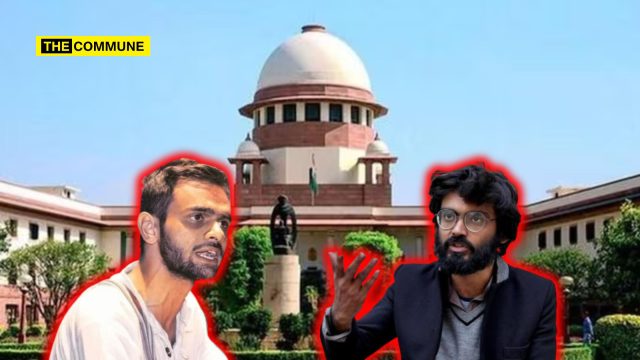
The Supreme Court on Monday (5 January 2026) denied bail to Umar Khalid and Sharjeel Imam in the Delhi riots “larger conspiracy” case, holding that the prosecution material disclosed a prima facie case against them under the Unlawful Activities (Prevention) Act, 1967 (UAPA).
At the same time, the Court granted bail to five other accused – Gulfisha Fatima, Meeran Haider, Shifa Ur Rehman, Mohd. Saleem Khan, and Shadab Ahmed, subject to stringent bail conditions.
A Bench comprising Justice Aravind Kumar and Justice NV Anjaria pronounced the judgment, clarifying that Umar Khalid and Sharjeel Imam would be at liberty to renew their bail applications after the examination of protected witnesses or after one year from the date of the order.
Court Finds Prima Facie Case Against Khalid, Imam
The Court observed that the prosecution material, at this stage, prima facie disclosed “a central and formative role” and “involvement in the level of planning, mobilisation and strategic direction extending beyond episodic and localised acts” in relation to Khalid and Imam.
It held that the statutory bar under Section 43D(5) of the UAPA was attracted in their case, observing, “Threshold under Section 43D(5) stands attracted…continued detention has not crossed constitutional impermissibility to override the statutory embargo as against them.”
Accused-Specific Assessment, No Collective Approach
The Bench emphasised that it had not adopted a collective approach and had independently assessed the role attributed to each accused. It noted that treating all accused identically would risk unjustified pretrial detention.
The Court held that Umar Khalid and Sharjeel Imam stood on a “qualitatively different footing” compared to the other accused who were granted bail.
Trial Delay Not a “Trump Card”
Pronouncing the judgment, Justice Aravind Kumar observed that in prosecutions under the UAPA, delay in trial does not automatically entitle an accused to bail.
“Delay in trial does not operate as a ‘trump card’ which automatically displaces statutory safeguards,” the Court held.
At the same time, the Bench clarified that Section 43D(5) does not completely bar judicial scrutiny. The Court said the enquiry at the bail stage must be “accused-specific” and limited to examining whether the prosecution material, if accepted as true, discloses a prima facie case.
The judgment further held that defence arguments are not to be examined at the bail stage and that the court must undertake a structured enquiry confined to statutory parameters.
Scope of “Terrorist Act” Under UAPA
The Court also ruled that Section 15 of the UAPA, which defines terrorist acts, cannot be narrowly interpreted to cover only overt acts of violence.
It observed that the provision also encompasses acts that disrupt essential services and threaten the economy, apart from causing death or destruction.
Bail Conditions and Trial Directions
For the five accused granted bail, the Court imposed twelve conditions, warning that any misuse of liberty would result in cancellation of bail. The Bench also directed the trial court to expedite the proceedings.
Background of the Case
The Special Leave Petitions were filed against a 2 September 2025 judgment of the Delhi High Court, which had denied bail to several accused in the case. The Supreme Court had reserved judgment after hearing the matter on 10 December 2025.
The accused have been in custody for over five years in connection with cases registered under the UAPA and the Indian Penal Code, arising out of the communal riots that took place in Delhi in February 2020.
Legal Representation
Senior Advocate Kapil Sibal appeared for Umar Khalid, Siddharth Dave for Sharjeel Imam, Abhishek Manu Singhvi for Gulfisha Fatima, Salman Khurshid for Shifa Ur Rehman, Siddharth Agarwal for Meeran Haider, Siddharth Luthra for Shadab Ahmed, and Advocate Gautam Kazhanchi for Mohd. Saleem Khan.
The Delhi Police was represented by Solicitor General Tushar Mehta and Additional Solicitor General SV Raju.
Case Context
The petitioners, many of whom were student activists involved in protests against the Citizenship (Amendment) Act during 2019–2020, are accused of being part of the alleged “larger conspiracy” behind the February 2020 Delhi riots.
Other accused in the case include Tahir Hussain, Khalid Saifi, Ishrat Jahan, Devangana Kalita, Natasha Narwal, and Safoora Zargar, some of whom have already been granted bail either on merits or on humanitarian grounds.
Source: Live Law
Subscribe to our channels on WhatsApp, Telegram, Instagram and YouTube to get the best stories of the day delivered to you personally.