


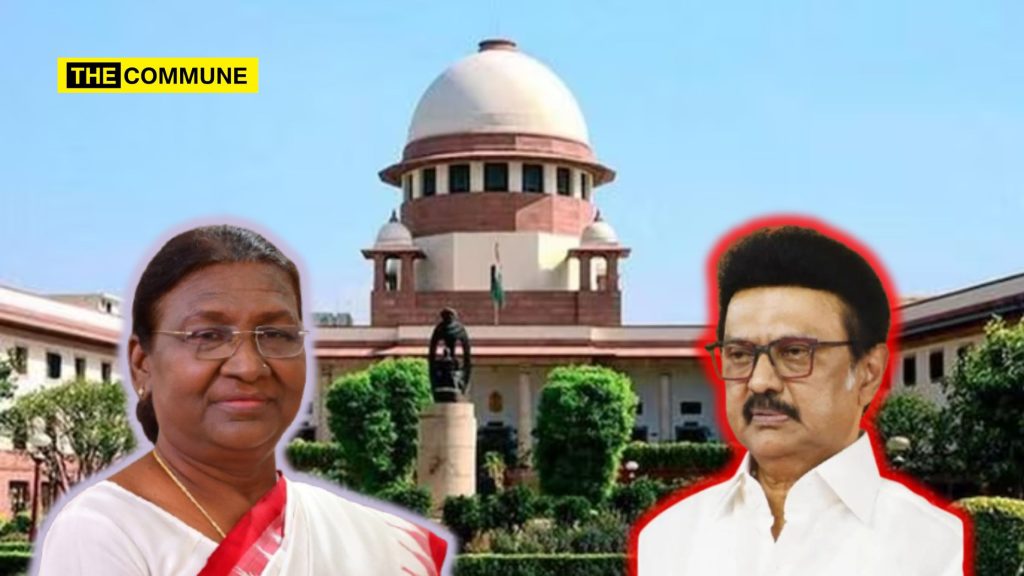
The Supreme Court on Friday, 17 October 2025, deferred the hearing of the writ petition filed by the Government of Tamil Nadu challenging the Governor’s decision to reserve two state Bills — the Kalaignar University Bill, 2025, and the Sports University Bill — for the consideration of the President of India.
The bench comprising Chief Justice of India B. R. Gavai and Justice K. Vinod Chandran suggested that the State government wait for the outcome of the Presidential Reference currently pending before a Constitution Bench. The reference concerns the timelines for granting assent to Bills by the President and Governors under Articles 200 and 201 of the Constitution.
CJI Gavai observed, “You have to wait hardly for 4 weeks, the reference has to be decided before 21st (November),” while addressing Senior Advocate Dr. A. M. Singhvi, who was appearing for Tamil Nadu. The Chief Justice is scheduled to retire on 23 November 2025.
State Challenges Governor’s Action
The Tamil Nadu government filed the writ petition questioning the Governor’s decision to withhold assent to two state Bills and refer them to the President of India.
The first, the Kalaignar University Bill, 2025, seeks to establish a university that would designate Chief Minister MK Stalin as its first Vice-Chancellor. The second, the Sports University Bill, proposes to amend the Tamil Nadu Physical Education and Sports University Act, empowering the state government to appoint or remove vice-chancellors.
Senior Advocates Dr. A. M. Singhvi and Mukul Rohatgi appeared on behalf of Tamil Nadu, with AOR Misha Rohatgi assisting in filing the plea.
“Governor Cannot Act Like a Judge”
Arguing for the State, Dr. Singhvi contended that the Governor had no authority to assess the contents of a Bill as if adjudicating it judicially. He submitted, “He (the Governor) cannot refer to the President, the issue of repugnancy.”
Supporting this, Rohatgi remarked, “The question today is, can the Governor examine every clause like a judge and say — it’s repugnant?”
Centre Defends Governor’s Authority
Solicitor General Tushar Mehta, appearing for the Union Government, defended the Governor’s role, asserting that the act of examining Bills and referring them to the President formed part of the Governor’s constitutional duty.
He pointed out that between 2015 and 2025, Governors across India had made 381 references to the President of India. He cautioned that if every such reference were to be challenged, it would overwhelm the judiciary.
“If this is to be justiciable, my lords will have two separate benches permanently for deciding,” he submitted.
Responding to the State’s arguments, Mehta said, “The Governor (position) is doing it since independence; that is his job.”
Linked to Pending Constitutional Clarification
The present case is closely tied to the pending Presidential Reference before a five-judge Constitution Bench led by the Chief Justice of India. The reference seeks the Court’s opinion on the scope of Articles 200 and 201, following a two-judge bench’s judgment in the Tamil Nadu Governor case, which had set timelines for constitutional authorities to act on Bills.
That opinion was reserved on 11 September 2025, and the Supreme Court indicated that it expects a decision by 21 November 2025, before the Chief Justice’s retirement.
Until then, the Tamil Nadu government’s plea will remain pending, as the Court signaled that the outcome of the Presidential Reference will directly affect the present petition.
(Source: LiveLaw)
Subscribe to our channels on Telegram, WhatsApp, and Instagram and get the best stories of the day delivered to you personally.