


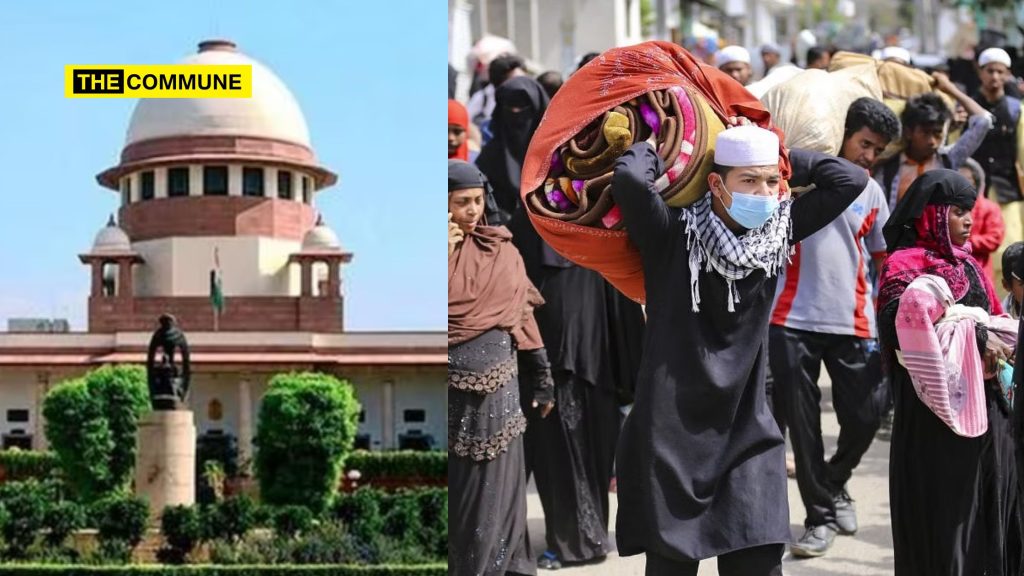
The Supreme Court was informed on Thursday, 8 May 2025, that several Rohingya refugees, including women and children possessing United Nations High Commission for Refugees (UNHCR) cards, were allegedly detained late Wednesday night and deported to Myanmar—just hours before their case was due to be heard.
Senior Advocates Colin Gonsalves and Prashant Bhushan, appearing for the petitioners, raised the issue based on media reports, claiming the deportations occurred under the pretext of “paper verification” from the detention centres where the refugees were held. They contended that this act constituted a grave violation of court proceedings and existing protections.
A three-judge bench comprising Justices Surya Kant, Dipankar Datta, and N. Kotiswar Singh expressed concern but refrained from issuing a stay on deportations. The matter has been listed for final hearing on 31 July 2025.
Justice Kant emphasized that the Court would resolve the matter conclusively: “If they have a right to stay here, that should be acknowledged; and if they don’t, then the procedure for deportation must be followed as per law.”
Solicitor General Tushar Mehta, representing the Union government, referred to a Supreme Court order dated 8 April 2021, which permitted deportation of Rohingyas in accordance with legal procedure. He reiterated that India is not a signatory to the 1951 Refugee Convention and is therefore not bound by its provisions.
Bhushan, countering this, cited India’s obligations under the Genocide Convention—ratified by the country—and argued that the interim protections extended to Rohingya refugees should remain until a final verdict is delivered.
The Court, however, appeared divided on the scope of protection. Justice Datta pointed out that Rohingyas, being foreign nationals, fall under the ambit of the Foreigners Act, and cannot claim the right to reside or settle under Article 19(1)(e) of the Constitution. “The rights under Articles 14 and 21 are available to all persons, but the right not to be deported is ancillary to the right to reside, which is reserved for citizens,” he observed.
He also referenced a 2018 case involving the deportation of Rohingyas from Assam, noting that the Court had dismissed the plea, suggesting precedence for the government’s current position.
Gonsalves disagreed, stating the previous case involved migrants, not recognized refugees. He also invoked the NHRC v. State of Arunachal Pradesh judgment to stress the constitutional protection of life under Article 21, but the bench noted that decision was not binding on the current three-judge bench.
Concerns about deaths in detention centres were also raised during the hearing. However, the bench ultimately decided to rely on the 2021 order and hear the matter in full in July.
In related proceedings, the Court recently disposed of a petition seeking school admission for Rohingya refugee children in Delhi, directing that eligible children should first apply to local government schools and approach the High Court only if denied admission. Another similar petition seeking educational benefits was disposed of earlier in February, with the Court emphasizing that children’s right to education must not be denied, but only after determining the family’s legal residence status.
(With inputs from Live Law)
Subscribe to our channels on Telegram, WhatsApp, and Instagram and get the best stories of the day delivered to you personally.