


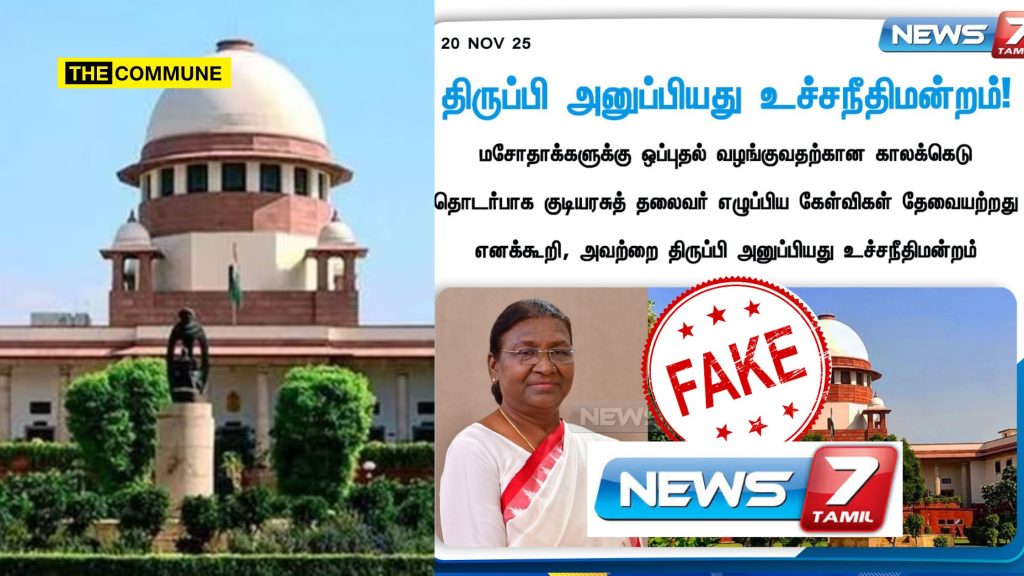
In a landmark Presidential Reference opinion, a five-judge Constitution Bench of the Supreme Court has unanimously held that it cannot impose fixed timelines on Governors or the President for granting assent to Bills under Articles 200 and 201. The Court also issued a categorical rejection of the concept of “deemed assent,” calling it a judicial takeover of executive functions and “antithetical to the spirit of the Constitution.”
The opinion, delivered by Chief Justice BR Gavai and Justices Surya Kant, Vikram Nath, PS Narasimha and AS Chandurkar, answered 14 constitutional questions raised by President Droupadi Murmu under Article 143.
However, even as the ruling became public, News7 Tamil published a completely false interpretation of the verdict, claiming the Supreme Court had “returned” the questions and dismissed the reference – the precise opposite of what the Bench actually held.
In a news card still present on its X handle at the time of publishing this report, Dravidianist media News7 Tamil claimed: “Returned by Supreme Court”
“The Supreme Court sent it back! The Supreme Court has dismissed the questions raised by the President regarding the deadline for assent to bills, saying they are unnecessary,” said the news card.
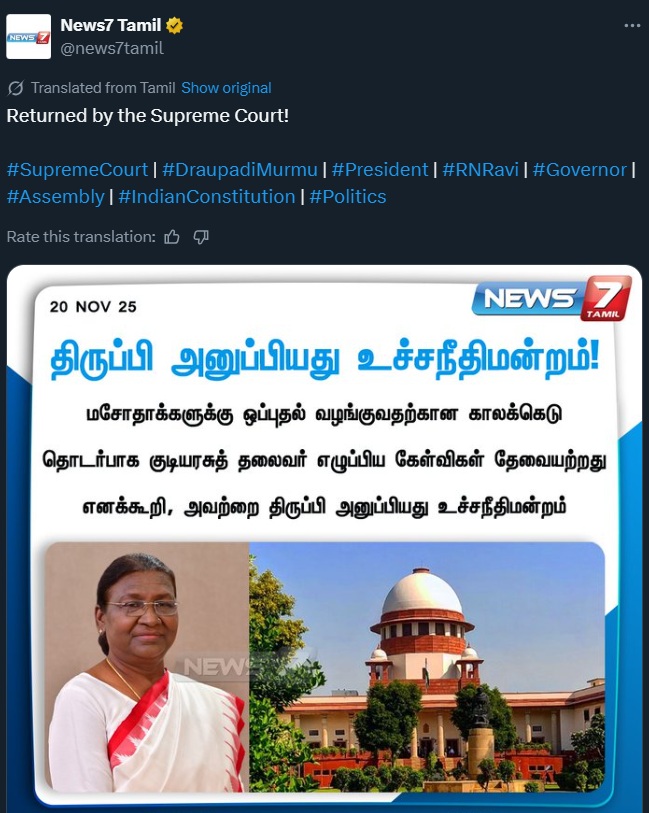

This statement is factually incorrect. The Supreme Court did not return the reference, did not dismiss the questions, and did not say they were unnecessary. Instead, the Court answered every one of the 14 questions, clarified the constitutional scheme in detail, and laid down binding principles.
What the Supreme Court Actually Held
1. No Fixed Timelines for Governors or President
The Court ruled that the Constitution deliberately uses elastic language and courts cannot fix strict deadlines.
2. No “Deemed Assent” Under Any Circumstance
The Court said using Article 142 to force assent or treat inaction as assent would be “a takeover” of executive functions and is impermissible.
3. “Limited Mandamus” Allowed in Cases of Prolonged Inaction
If a Governor’s unexplained delay frustrates the legislative process, courts may direct the Governor to make a decision — but cannot comment on the merits.
4. Governor’s Options Clarified
Assent, withhold + return, or reserve for President.
Withholding assent without returning the Bill is unconstitutional.
5. Actions of Governors Not Generally Justiciable
Courts cannot review the merits of the decision, only the delay.
6. Article 361 Immunity Does Not Shield the Office
Governors cannot be sued personally, but their offices are subject to judicial direction.
7. President’s Decisions Non-Justiciable
The Court cannot impose timelines on the President either.
8. No Scenario Where a Bill Becomes Law Without Governor’s Assent
The Court explicitly ruled that deemed assent is unconstitutional.
News7 Tamil’s Claim Is the Exact Opposite of the Verdict
News7 Tamil’s assertion that the Supreme Court “sent back” the reference and “dismissed the questions” is completely contradicted by the ruling itself. The Court accepted the reference, answered all 14 questions in detail, gave authoritative constitutional interpretation.
The Court did not return anything to the President.
News7 Tamil’s claim that the Court said the questions were “unnecessary” is demonstrably false. The Court in fact said the questions raised important constitutional issues requiring clarification.
Background: Why the Reference Was Made
The reference was issued in May 2025 after a previous Supreme Court bench attempted to set timelines for Governors in the Tamil Nadu Bills case. The Union Government opposed timelines; several states favoured them.
The Constitution Bench has now settled the issue, balancing the executive’s discretion with limited judicial supervision to prevent abuse.
Subscribe to our channels on WhatsApp, Telegram, Instagram and YouTube to get the best stories of the day delivered to you personally.