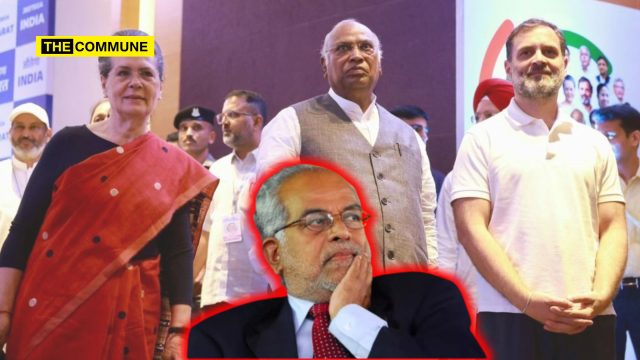
The Opposition I.N.D.I. bloc has nominated former Supreme Court judge, Justice Sudershan Reddy, for the Vice Presidency. It is noteworthy that the NDA has nominated CP Radhakrishnan who is presently serving as Governor of Maharashtra.
This is being hailed by its leaders as a masterstroke. They present him as a “progressive jurist” and a “champion of the Constitution.”
Who Is Justice Sudershan Reddy?
Born on 8 July 1946, into a farmer’s family in Akula Mylaram village (then in Rangareddy district, now Telangana). He obtained his law degree from Osmania University, Hyderabad, in 1971. In his early law days, he enrolled as an advocate with the Andhra Pradesh Bar Council, handled writ and civil cases in the Andhra Pradesh High Court and served as a Government Pleader (1988-90). He then worked as Additional Standing Counsel for the Central Government (1990). He acted as the legal adviser and standing counsel for Osmania University.
At 79 years old, Justice Reddy is among the oldest candidates for the Vice Presidency.
Justice Reddy was appointed Chief Justice of the Guwahati High Court on 5 December 2005 and served there for a relatively short period before being elevated to the Supreme Court of India on 12 January 2007, during the UPA-1 regime under PM Manmohan Singh. He was in office for 4.5 years until his retirement in July 2011.
A closer examination of his ‘landmark’ judgments and statements reveal a troubling pattern of judicial overreach and decisions that, critics argue, have actively undermined national security and denied justice to victims of one of the world’s worst industrial disasters.
Politically Aligned To Congress?
As soon as the news of his candidature was made public, Justice Sudershan Reddy told Times of India, “What is wrong in accepting it? INDIA bloc represents 60% of the country’s population and talks of ideals of the Constitution.”
Well, for someone who has been a judge for all these years, Justice Reddy seems to be unaware that this is not how governments are formed. He did not focus on the number of MPs in Parliament, reflecting a perspective where, in a first-past-the-post electoral system, the key factor is the number of seats a party or organization wins, as this determines the formation and fall of governments. Justice Reddy described the contest as a battle of ideologies, revealing that his own ideology, possibly the same even during his tenure as a Supreme Court judge, aligns with a party that is against nationalistic ideas, against nationalist forces, those questioning the army’s bravery, those supporting Pakistan, or those attempting to create anarchy. By entering politics under this banner, he chose to become the candidate of this ideological faction.
The Salwa Judum Verdict: A Judicial Blow to National Security
Justice Reddy’s most infamous contribution is authoring the 2011 verdict in the Nandini Sundar vs. State of Chhattisgarh case, which effectively hamstrung the state’s efforts to combat a violent Maoist insurgency.
In this ruling, Justice Reddy declared the state’s policy of creating Special Police Officers (SPOs) from local tribal youth, a critical component of the anti-Naxal strategy. as “unconstitutional“. He ordered the immediate disarming of these forces, labeling them a threat to the “rule of law”, he also disbanded the Salwa Judum.
During the Salwa Judum movement, many civilians who worked as SPOs later joined the District Reserve Guard (DRG), which became a crucial counter-insurgency force. Police and security officials maintain that these local recruits brought invaluable knowledge of the terrain and communities, enabling more effective operations against Maoists. By ordering the disbandment of these forces, Justice Reddy’s ruling arguably prioritized legal principles over the immediate safety and well-being of vulnerable tribal populations, leaving them exposed to violent attacks. Several thousand Adivasis were murdered by Naxalites following this judgement.
The Catastrophic Consequences of the Salwa Judum Judgement
Demoralized Security Apparatus: The verdict instantly invalidated a key tactical framework. The District Reserve Guard (DRG), now hailed for its success in eliminating top Maoist leaders like Basavaraju, is built on the very foundation of local knowledge that the SPO program pioneered. Justice Reddy’s judgment sought to dismantle this model at its peak. It is the same DRG comprised of tribal youth SPOs who have been helping India completely eradicate naxalism.
Endangered Lives: By ordering the state to “disarm” these local fighters, the judgment left thousands of former SPOs and their families exposed and vulnerable to brutal retaliation by Maoist forces they had been fighting.
Ignored Ground Reality: From the comfort of the Supreme Court, Justice Reddy philosophized about “constitutional morality” while dismissing the life-and-death reality on the ground. The state of Chhattisgarh was grappling with an existential threat from an ideology that seeks to overthrow the Indian state through violence. His judgment prioritized a theoretical purity of law over the practical security of millions of citizens living under the shadow of Naxal terror.
This verdict was seen as a dangerous and ivory-tower decision that cost lives and prolonged a bloody conflict.
Refusal To Reopen Bhopal Gas Tragedy Case
If the Salwa Judum verdict showed a disconnect from ground realities, his role in the 2012 Bhopal gas tragedy curative petition revealed a shocking indifference to justice for the common Indian.
Justice Reddy was part of the five-judge Constitution Bench that unanimously dismissed the CBI’s curative petition seeking harsher punishment for the accused in the 1984 disaster that killed over 15,000 people.
The technicality used? A “lapse of 14 years.” This, despite the Attorney General arguing the petition was filed based on facts “which shook our conscience” and was necessary for justice to prevail in the public interest.
By hiding behind procedural delay, the bench, including Justice Reddy, let the convicted officials of Union Carbide India, including Chairman Keshub Mahindra, escape with a mere two-year sentence for a crime of such monstrous negligence. For the over victims and their families, this decision was a final, judicial betrayal. It signaled that the lives of thousands of ordinary Indians were not worth revisiting a procedural timeline for. Critics argue that the handling of this petition failed to ensure strict accountability for one of the world’s worst industrial disasters, in which over 15,000 lives were lost and thousands maimed. His involvement in upholding diluted sentences for the accused has been interpreted by some as favoring corporate interests over victims’ rights.
Urged Defence Ministry to Halt Arms Exports to Israel
In 2024, a group of prominent citizens, including former Supreme Court judge Sudarshan Reddy, urged India’s Defence Ministry to cancel all existing licenses and stop future military exports to Israel amid the Gaza conflict. Citing International Court of Justice rulings declaring Israel in violation of the Genocide Convention, the letter argued that supplying arms would breach India’s obligations under international law and Article 21 of the Constitution. Signatories also included Justice Ruma Pal, Arundhati Roy, Prashant Bhushan, and social activists. The letter called for transparency in licenses and an immediate halt to all military shipments.
An Ideologue, Not a Neutral Arbiter
His own speech, such as the 2020 K.G. Kannabiran Memorial Lecture, reveal a deeply ideological mindset. He lambasts “neo-liberalism” and mourns the “death of democratic institutions,” framing complex economic and security challenges through a rigid, activist lens.
The Vice President’s role is that of a neutral, non-partisan constitutional authority who chairs the Rajya Sabha and must uphold the dignity of the House above political fray. Justice Reddy’s record shows a man given to strong, divisive ideological pronouncements, making him ill-suited for a role that demands impartiality and restraint.
Single Party Rule Not Good For Democracy
In 2018, Justice Reddy criticized single-party dominance as harmful to democracy. Speaking at a seminar on Indian democracy and the judiciary, organized by the Chandra Rajeswara Rao Foundation on the late Communist leader CR’s 104th birth anniversary, he emphasized that the Central government should not interfere in Supreme Court judgments. Justice Reddy urged political leaders to respect court verdicts and avoid actions that could undermine the judiciary.
Administrative Shortcomings – Goa Lokayukta Resignation
Justice Reddy became the first Lokayukta of Goa in 2013, but resigned after only six months, citing personal reasons. While such reasons are private, the brevity of his tenure raises questions about his ability to sustain leadership roles in politically sensitive positions – will he do something similar if (a big if) he becomes the Vice President, who chairs the Rajya Sabha and navigates complex political negotiations?
He also has a stamp of approval from the left-leaning community with keywords ticked off – social justice, civil liberty and what not.
Justice Sudershen Reddy is the ultimate champion of civil liberties, institutional integrity & social justice.
I can personally vouch for it, having worked very closely with him as the Convenor of the Expert Group for Telangana Caste Census, of which he was the Chairman. https://t.co/8LDbmVklSN pic.twitter.com/xn6OaGPHq4
— Praveen Chakravarty (@pravchak) August 19, 2025
It is no surprise that Justice Reddy is the chosen candidate for the post of Vice President for the I.N.D.I bloc.
Reddy Was Part Of Andhra HC Bench That Struck Down Muslim Reservation Order
Justice B. Sudarshan Reddy, heading a five-judge Andhra Pradesh High Court bench, declared the state government’s July 12 order granting 5% reservation to Muslims in education and employment as ultra vires. He held that Section 11(2) of the Andhra Pradesh Commission for Backward Classes Act, 1993, mandating consultation with the Commission before revising the Backward Classes list, was violated. Justice Reddy emphasized the need to identify the “creamy layer” and directed the government to reconstitute the Commission within three months, seek its opinion, and follow an objective, criterion-based process for determining backwardness and reservations.
Justice B. Sudershan Reddy’s controversial verdicts, especially in the Salwa Judum case, tilted the balance away from on-the-ground necessities to an idealistic interpretation that left many citizens more vulnerable than before. Recent years have shown the risks of excessive reliance on judicial activism at the cost of pragmatic governance.
In a democracy battling both violence and institutional decay, India needs a Vice President who is mindful of both constitutional values and practical solutions.
Whether he will win the approval of the Parliament is something we have to wait and watch.
Subscribe to our channels on Telegram, WhatsApp, and Instagram and get the best stories of the day delivered to you personally.