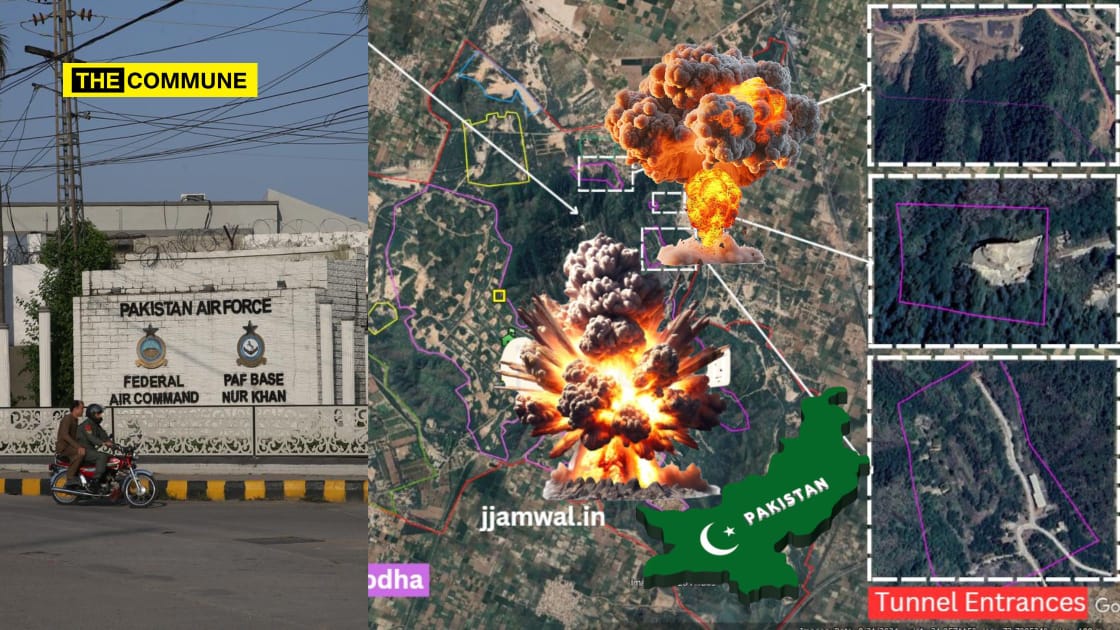
The question of whether a specific Indian strike forced Pakistan to push for a ceasefire following last year’s Operation Sindoor has remained a subject of sustained debate. In an exclusive interaction with NDTV, noted aviation historian and military aviation analyst Tom Cooper has asserted that a decisive strike on Pakistan’s Kirana Hills nuclear-linked facility may have been the tipping point in the conflict.
Speaking to NDTV’s Shiv Aroor, Cooper said he was convinced that the Indian Air Force had struck Kirana Hills, despite India’s official denial, and argued that the development critically altered the strategic balance at the time.
He described Kirana Hills as a site that would be targeted to send a calibrated but unmistakable strategic signal without causing excessive destruction. According to him, such a strike would convey the message that India possessed the capability to hit high-value targets in Pakistan at will and in scale, thereby compelling Islamabad to halt escalation.
Cooper linked the timing of the alleged strike to diplomatic activity that followed. He stated that when cross-checked with developments on the diplomatic front, it coincided with Pakistan reaching out to both Washington and New Delhi to push for a ceasefire, indicating mounting pressure on Islamabad. He clarified that while Pakistan may not have “literally begged” for a ceasefire, the sequence of events made the outcome evident.
Claims of Evidence
When asked about proof, Cooper said his assessment was based on multiple strands of evidence rather than a single source. He cited videos filmed from the Pakistani side that purportedly showed missile contrails descending toward the Kirana Hills area and impact signatures on the hillside.
He also pointed to visuals showing smoke rising from what he identified as radar installations linked to a Pakistani Air Force unit, arguing that this suggested radar suppression strikes preceding the main attack. According to him, the Indian Air Force first targeted radar systems to degrade Pakistan’s defensive response before striking entrances to underground storage infrastructure.
Cooper characterised Kirana Hills as a central node in Pakistan’s nuclear programme, noting its history as a nuclear testing site where numerous non-critical nuclear tests had been conducted.
He further argued that by that stage of the conflict Pakistan’s retaliatory campaign, Operation Bunyan-un-Marsoos, had already failed, having been blunted by Indian air defences and follow-on air strikes.
Basis for “Victory” Assessment
Cooper said the alleged Kirana Hills strike was among the principal reasons he had assessed the conflict as a clear-cut Indian victory. He argued that militaries do not target such sensitive sites without confidence that the adversary lacks the capacity for meaningful retaliation.
In addition to open-source material, he said his conclusions were reinforced by inputs from personal contacts in Pakistan who, according to him, confirmed that the facility had been hit.
Nuclear Link Assertions
Addressing questions about whether Kirana Hills indeed housed nuclear assets, Cooper said references in publications of atomic science bodies in the United States, along with assessments by Indian analysts, had long identified the site as nuclear-linked.
He cited the presence of hardened shelters, maintenance complexes and multiple underground entrances as indicators of strategic storage or testing infrastructure. While he noted there might not necessarily be an operational reactor at the site, he maintained that this did not preclude the storage of nuclear weapons or related assets.
Cooper also pointed to the proximity of Sargodha, a major Pakistan Air Force base, and questioned why aircraft such as F-16s were trained for nuclear delivery roles there if no nearby storage infrastructure existed. In his assessment, Kirana Hills’ tunnel networks and fortified depots made it a logical storage location.
Escalation Dynamics
On escalation risks, Cooper said the broader operational context was critical. He claimed that Pakistan had launched missiles, drones and aerial strikes during the conflict, most of which were intercepted by India’s air defence systems. He also alleged that several Pakistani aircraft were downed during the exchanges.
He said India subsequently carried out large-scale retaliatory strikes on multiple Pakistani air bases before the alleged Kirana Hills operation, reinforcing deterrence signalling.
Weapons and Operational Integration
Discussing the strike package, Cooper said specialised platforms were not strictly necessary. He stated that India possessed sufficient stand-off strike capability through combinations of aircraft and missile systems, including Su-30s, Jaguars and Rafales deploying long-range precision munitions.
He praised India’s integrated air defence architecture, arguing that it had played a decisive role both defensively, by neutralising incoming threats, and offensively, by enabling coordinated large-scale strike operations.
According to him, India’s system effectively integrates indigenous and foreign platforms sourced from partners such as France, Russia and Israel, achieving interoperability that many countries struggle to build.
Stealth Fighter Debate
On whether India’s lack of stealth fighters posed a vulnerability, particularly vis-à-vis China, Cooper said India’s layered radar and air defence network reduced the decisive advantage of stealth platforms. He argued that system redundancy and multi-sensor detection capability could still identify stealth aircraft under operational conditions.
However, he added that the true test of the system would only emerge in a potential confrontation with China, which also fields advanced integrated air defence capabilities.
Questions Over Official Denial
Cooper also expressed puzzlement over India’s continued denial of striking Kirana Hills, stating that in his assessment the evidence was sufficiently clear.
The Indian Air Force has not publicly confirmed any strike on Kirana Hills, and official positions on specific target sets during Operation Sindoor remain limited. Pakistan, too, has not acknowledged any damage to nuclear-linked infrastructure.
#OperationSindoor World Exclusive | “Clear proof to show Kirana Hills hit”: Aviation Historian Tom Cooper to @shivaroor pic.twitter.com/V9C1VEAObr
— NDTV (@ndtv) February 17, 2026
Source: NDTV
Subscribe to our channels on WhatsApp, Telegram, Instagram and YouTube to get the best stories of the day delivered to you personally.