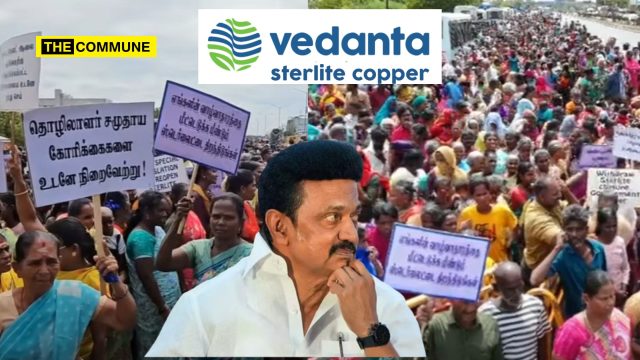
Remember the vehement Sterlite protest back in the day? Today, it seems the Sterlite copper plant continues to haunt the DMK, as public anger resurfaces in Thoothukudi. In a striking turn of events, hundreds of residents rallied outside the District Collector’s Office, demanding the reopening of the very plant that was once fiercely opposed.
Back when fringe outfits and missionary-backed groups spearheaded a campaign of blind opposition to the Sterlite facility, it was the DMK that seized the moment, turning the agitation into a political weapon to shut down the plant. But today, the tide has clearly shifted the very people of Thoothukudi are now at the forefront, calling for the revival of Sterlite.
Villagers from Pandaram Patti South, Veerapandiapuram, fisherfolk from Threspuram, and women’s self-help groups laid siege to the Collector’s Office, stating that the plant’s closure had stripped them of their jobs and economic stability.
With tensions running high, heavy police presence was stationed at the scene. Authorities allowed only select representatives to meet with the District Collector and submit a petition on behalf of the protestors.
ஸ்டெர்லைட் ஆலையை மீண்டும் திறக்க வலியுறுத்தல்… மீனவ கிராம மக்கள் முற்றுகை போராட்டம்#THoothukudi #SterliteFactory #Fisherman #Protest #TamilNews #NewsTamil #NewsTamil24x7 pic.twitter.com/lFs3iCcd7z
— News Tamil 24×7 (@NewsTamilTV24x7) July 21, 2025
The 2018 closure of the Sterlite Copper plant dealt a significant blow to Tamil Nadu’s economy. Once a key player in India’s copper production, its shutdown plunged Thoothukudi into joblessness and financial distress while Gujarat quickly stepped in to fill the industrial vacuum. What was once projected as an environmental victory has now come full circle, with the DMK being cornered by the consequences of a decision it once celebrated.
Mounting Protests from the Ground
On 16 June 2025, villagers from South Veerapandiapuram, Saminatham, and nearby communities gathered outside the Thoothukudi District Collector’s Office. Their demand was simple: reopen the Sterlite Copper plant and the associated thermal power station. Many of the protesters were former employees, who now struggle to survive as low-paid laborers. According to their statements, over 300 youth from these villages had worked at the plant, and the shutdown pushed them into economic instability.
Surprisingly, the call for reopening the facility has come not just from locals, but also from the Indian National Trade Union Congress (INTUC)—a key ally of the ruling DMK in Tamil Nadu. INTUC national secretary Kathirvelu openly questioned the inconsistency in allowing copper smelters to operate in other states while Sterlite remains shut. He pointed out that if pollution was the concern, it should be addressed with uniform regulations across India.
INTUC maintained that the economic cost of closure has been immense. Thousands of jobs were lost—not only within Sterlite itself but across hundreds of ancillary businesses that depended on the plant’s operations.
Wider Impact Across Industries
The plant’s closure didn’t just affect direct employees. On 6 January 2024, members of the Namakkal Lorry Owners’ and Trailer Owners’ Associations staged protests, claiming the shutdown paralyzed the logistics sector in the region. Over 6,500 trucks were impacted, and more than 600 vehicle owners had to seek alternative sources of income. Daily revenue losses were estimated at around ₹10 crore. Protesters proposed restarting the plant under strict environmental guidelines to balance development and sustainability.
In February 2025, the Thoothukudi Contractors’ Association joined the demand, highlighting job losses for 20,000 workers and severe financial strain on 400 SMEs, with income levels dropping by 40%. They have called for a Government Order to restart operations.
On 13 May, representatives from the Thoothukudi People Livelihood Protection Association met with MP Kanimozhi, urging her to support efforts to revive the copper plant. Their appeal noted that the facility had supported 20,000+ families across 50 villages for over two decades. Around 64 contractors had invested in trucks and machinery solely to serve Sterlite’s logistics operations. When the plant was shut, many were left facing crippling debts, having mortgaged personal property to finance their businesses.
Association president S. Thiyagarajan criticized the misleading narrative that labeled Thoothukudi as the “cancer capital” due to the plant’s presence. He pointed to multiple independent environmental assessments that found no such link, yet the perception persisted, fueling protests and ultimately the closure.
Subscribe to our Telegram, WhatsApp, and Instagram channels and get the best stories of the day delivered to you personally.