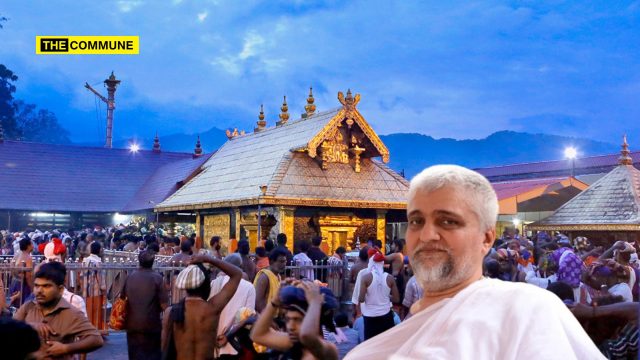
A fresh intervention has been made in the ongoing Sabarimala case, adding a new dimension to the legal and constitutional debate surrounding religious freedom. On 23 March 2026, Gitarth Ganga, a spiritual research institute led by Jainacharya Yugbhushansuriji, filed a review petition before the Supreme Court.
The institute, which has been active for over three decades, has urged the Court to revisit the framework through which religious rights are interpreted. In its petition, it has called for the restoration of religious freedom, recognition of religions and religious groups as legal entities, and a contextual interpretation of Articles 25 and 26 that reflects India’s civilisational ethos.
The development comes ahead of April 7, 2026, when a nine-judge Bench of the Supreme Court is scheduled to hear review petitions challenging the 2018 Sabarimala verdict. In that judgment, the Court had allowed the entry of women of all age groups into the Sabarimala temple, including those between 10 and 50 years.
In its submission, Gitarth Ganga has argued that courts should refrain from determining what constitutes “essential religious practice.” It has maintained that questions of faith and tradition must be decided by the communities that follow them, rather than through judicial scrutiny.
The petition also raises a broader structural concern, pointing out that religions originating in India — including Hinduism, Buddhism, Jainism, and Sikhism — lack formal recognition as legal entities. According to the institute, this absence prevents such religions from holding property in their own name, asserting legal rights, or approaching courts as independent entities.
Describing this as a significant gap in the legal framework, the institute has urged the Court to address the issue by granting clear legal status to religious institutions, thereby strengthening their ability to protect their interests.
The petitioner has further emphasised the need to maintain a clear separation between the domains of the state and religion, arguing that both operate in distinct spheres and should not encroach upon each other’s functions.
Here is a detailed conversation with the petitioner, offering deeper insight into these arguments and the broader implications of the case.
Q: How do you view the Supreme Court’s 2018 verdict, and what is your take on the 50–60 review petitions that have been filed since then?
A: During the review proceedings, the Apex Court chose to step back and frame a set of broader constitutional questions, seven larger issues, instead of limiting itself only to the matter of entry into the Sabarimala temple. Because of this wider scope, many parties have already stepped in and several new stakeholders have also shown interest. There is clearly an ongoing effort to identify and accommodate representative viewpoints so that the final judgment is both balanced and comprehensive. Naturally, a process of this nature takes time, and the Court will need that time to do justice to the issues involved.
When viewed through a civilisational lens, India’s religious traditions call for a more nuanced understanding. India has never been a theocratic state in the past, nor is it one today and there is little reason to believe it will become one in the future. At their core, Indian religions recognise a clear distinction between the domains of religion and the state.
It is neither appropriate for religion to step into the functioning of the state and assume its authority, nor for the state to intrude into the sphere of religion. This balance becomes even more important in a society like India, which is deeply pluralistic and home to multiple faiths rather than a single religious identity. A theocratic model, which elevates one religion above others, simply does not align with this diversity.
Politics, by its very nature, operates within the framework of governance and power. ‘Dharamniti’, or the ethical framework rooted in religion, is inherently wider in scope and is guided by the idea of justice for all. The state’s role is to function as a governing authority and ensure social justice for its citizens, that is its primary responsibility. Religion, on the other hand, is anchored in a more universal vision of justice, one that extends concern to all forms of existence. In that sense, when it comes to justice, the scope of religion is broader than that of the state.
Historically, the institution of the state is relatively recent, whereas religion has existed for thousands of years, long before the modern state took shape. This makes it essential to maintain a clear demarcation between the two. It is our expectation that, in the Sabarimala case, the Apex Court’s eventual verdict will clearly articulate and reaffirm this principle.
Q: If the Court does go ahead and define what constitutes “essential religious practices”, even though, in your view, it ideally should not, how do you see that playing out?
A: Why draw a line between what is “essential” and what is not in the first place? Even practices labelled as non-essential should not become the subject of definition or regulation by the State. If a particular matter does not adversely affect the State, there is no reason for it to step in without clear and sufficient cause. Those who follow a religion are already willing participants in its traditions and practices. Religions have existed and sustained themselves long before the Constitution came into being; they rest on their own foundations. The State has neither granted religion its existence nor its legitimacy. It has, instead, found its place in public life naturally, through its own relevance and acceptance among people.
That being the case, it is not the State’s role to tell religions what they should or should not practice. Questions of rituals, forms of worship and religious observances should remain outside the State’s reach. Why, then, create a framework that separates “essential” from “non-essential” practices as a basis for stepping in?
It is worth noting that Articles 25 and 26 of the Constitution do not explicitly use the term “essential” at all. The expectation, therefore, is that the State should stay away from religious matters, except under the six clearly recognised constitutional grounds: public health, morality, public order, social reform, other fundamental rights, and secular activities associated with religion.
Within these six boundaries, the Constitution does allow the State to regulate or intervene where necessary. However, relying on an “essential versus non-essential” test as a justification for interference goes beyond this mandate and does not stand on firm constitutional ground or is not a legitimate approach.
Q: In a city like Bombay, where migrants, or even those with criminal or hostile intent, may enter and operate, non-interference might seem reasonable in the context of Indian-origin religions. But could it become problematic if the State follows the same approach when it comes to Abrahamic religions as well?
A: The State certainly has the authority to act. Wherever there is a social crime, the State has full power to take necessary action. For instance, if someone commits a murder and then takes refuge inside a temple, it does not mean that the State cannot act against them. Law and order must always prevail.
Just as under the Indian constitutional framework, foreign embassies are treated as sovereign spaces; this principle is well-established in international law and recognized through the Vienna Convention, and there exists a comparable conceptual understanding.
However, in practice, religious institutions or places of worship have not been accorded the status of sovereign spaces within the constitutional framework. We believe that religious institutions should be granted a certain degree of sovereign recognition. At the same time, the State must retain the authority to take action in cases of crimes affecting society at large.
Q: If “Indian Oriental religions” are to be granted such a status while others are not, there has to be a clear and logical basis for that distinction. If the concern is that certain sections promote fundamentalism, then shouldn’t the focus be on addressing fundamentalism itself, rather than targeting any particular religion?
A: The real concern arises when there is an element of fanaticism, an excessive zeal that begins to breed intolerance. If any religion or its followers start displaying an aggressive, hostile, or confrontational attitude towards others, that is clearly a problem.
It is important to draw a clear line between religion and fundamentalism. Religion, in its true essence, is not the same as fanaticism. But when its principles are interpreted through an extreme or rigid lens, they can easily turn into fundamentalism.
Every religion has the right to express and practice its beliefs. That said, responding with intolerance, aggression, or attempts to silence others is neither justified nor sustainable. If such tendencies take hold, society risks sliding into rigidity and conflict, something that goes against the larger ideals of co-existence and mutual respect.
Q: This boundary… between religious wisdom and fanaticism… is a very thin line.
A: It is, without a doubt, a very meaningful and important boundary. It exists within every religion, and when understood properly, it has the potential to expand in a positive way. Within that space, one should be able to express thoughts, beliefs, and perspectives with clarity and openness.
At the same time, there has to be a conscious effort to ensure that such expression does not slip into imposition or fanaticism. The intent should be to share and deepen understanding, not to dominate or enforce. When this balance is maintained, religion continues to remain a source of ज्ञान (wisdom) rather than drifting into जनून (fanaticism).
One should follow, preserve, and practice their own system of faith with sincerity. But that should never translate into conflict, negativity, or intolerance towards others. Just as the State does not permit acts of disloyalty or rebellion against itself, in a similar way, attitudes or actions that foster hostility in the name of religion should have no place in a civilised society. These views are grounded in, and consistent with, our understanding of the scriptures.
Q: In terms of rights, it is often argued in the Sabarimala case that women do not have the right to enter the temple.
A: Women do have that right. However, there is a restriction that applies only during a specific phase of life. India’s religious landscape is incredibly diverse, with a wide range of traditions and places of worship. Not everyone is permitted to enter every religious space. In some places, even men are not allowed. Similarly, access to the sanctum sanctorum is not always open to all; there are often conditions and traditions that determine who may enter. In certain temples, entry is allowed even during the menstrual cycle, while in others, the practices are different.
This variation reflects the richness and diversity within Indian religious traditions. There are multiple systems of faith and ways of practicing them, all of which have been acknowledged and accommodated over time. At the heart of this is a deeply rooted sense of tolerance, which allows different traditions to coexist.
An individual has the freedom to choose. If someone feels aligned with a particular tradition, they are free to follow it; if not, they can choose another path. That freedom is always there. But then, what role does an outsider, someone with no connection to that specific faith, have in interfering? If those within a tradition are at peace with it, external intervention to decide what is right or wrong is like a stranger walking into a home and telling a content family how they should live.
Q: Within the framework of the modern Constitution, what does the term “Hindu” really mean?
A: In the constitutional context, especially under Article 25 – the term “Hindu” has been interpreted in a fairly broad sense. It is not limited to just one community, but is understood to include Jains, Buddhists, and Sikhs as well. In that way, several indigenous or what are often called “oriental” religious traditions are brought under a common umbrella and are governed accordingly.
It is often suggested that there was a certain inclination within the Constituent Assembly to reform these indigenous traditions. Many believe this approach was shaped, at least in part, by exposure to Western frameworks of thought. As a result, there seemed to be a greater openness to engaging with and reforming oriental religions, while showing a degree of hesitation when it came to similarly intervening in other religious traditions.
There were also intense and detailed debates within the Constituent Assembly on whether the right to propagate religion should be recognised as a fundamental right. At the outset, there was some hesitation about including such a provision. Eventually, however, it was incorporated, with the argument that without the right to propagate, the possibility of religious conversion would not meaningfully exist. All of this reflects the complexity of the discussions and the various pressures at play during the framing of the Constitution.
Q: What is the bridge between Article 25, which deals with religious rights, and Article 14, which speaks about individual fundamental rights?
A: Article 14 guarantees equality before the law and equal protection of laws; it is a core fundamental right. These rights are not limited only to the religious sphere; they extend across the broader social domain as well.
At the same time, the State is essentially a temporal, or worldly, authority, not a spiritual one. Its primary role is to govern society and ensure justice within the social framework. Religion, on the other hand, is rooted in personal belief and spiritual practice, and therefore lies largely outside the State’s direct domain, especially within a secular system.
It is also important to understand that equality does not mean treating every situation in exactly the same way. Real equality is about ensuring fairness among equals, not forcing inherently different situations into an artificial sameness.
Even today, there are several laws that, in practice, seem to raise questions about this principle of equality. Take, for instance, divorce cases, alimony is often viewed as the man’s responsibility towards the woman, while there is usually no equivalent expectation from a woman who is earning. If equality is to be applied in its true sense, then in situations where the woman is financially independent, there could be a case for shared responsibility. However, such a balance is often seen as missing. This is just one example; many similar concerns are raised in public discussions, even as debates around “inequality” continue to grow.
Historically, there was also the concept of Streedhan, or a woman’s own wealth. This referred to assets given to a woman over which she had complete and exclusive control. No one in the family had the right to claim even a part of it. Traditionally, it was also understood that parents gave to their children throughout life without expecting anything in return. In that sense, Stridhan played an important role in ensuring a woman’s financial independence. Even today, millions of women hold assets, whether in the form of jewellery or property, as part of their Streedhan, which continues to support their financial independence. At the same time, it is often argued that such traditional systems were gradually weakened during the colonial period. According to some, this has created a disconnect from cultural frameworks that once helped maintain social and economic balance.
There is, therefore, a need to revisit and better understand these cultural foundations, as they may still hold answers to many of today’s challenges. That said, one principle must remain non-negotiable: no individual should face injustice. Any system we uphold must be fair, balanced, and just for everyone.
The larger goal should always be to move towards a just, fair, and peaceful social order. And when we speak of the welfare of society as a whole, ensuring justice for women has to remain central to that vision. The focus should not be on continuing past inequities, but on building a framework that upholds dignity, fairness, and equal respect for all.
Q: In other constitutions, is the relationship between religion and the State any different, or does it lead to similar debates and tensions?
A: In many Western and European constitutional systems, what is described as secularism does not always translate into a complete separation between religion and the State. In practice, it can sometimes resemble what critics call “pseudo-secularism,” where the divide is not as clear-cut as it appears.
Take the United Kingdom, for instance. In its Parliament, Bishops hold reserved seats in the House of Lords and actively take part in discussions and policy-making. When religious figures are given such institutional roles, it naturally raises questions about how strictly secular the system really is. On the surface, it may seem secular, but a closer look at how it functions reveals a far more layered reality.
Historically, the idea of a codified constitution itself developed in the West. Before that, governance was more directly shaped by political authority. Over time, constitutions were formalised, and lawmaking became more structured. But as the number of lawmakers grew and perspectives began to differ, new complexities emerged. This made constitutional frameworks increasingly important as guiding anchors.
At the same time, a written constitution, by its very nature, is an inert document – it does not have a living consciousness of its own. This is where interpretation becomes critical, and debates around interpretation start to carry real weight. In earlier traditions, authority often rested with individuals or institutions seen as “living sources” of wisdom, which influenced decision-making in a very different way.
The United Kingdom again presents an interesting example, as it does not have a single written constitution. Authority flows from Parliament, and the system runs on a mix of conventions, statutes, and judicial principles. At the same time, the British monarch, such as Charles III, also serves as the Supreme Governor of the Church of England. This creates a unique arrangement where elements of religion and state authority remain historically intertwined.
In contrast, many other countries place a stronger emphasis on the “rule of law” and maintain a clearer institutional separation between religion and the State. The global picture, therefore, is far from uniform; each country reflects its own history and has arrived at its own balance between faith and governance.
Q: Some people say this case is an attempt to dismantle or weaken the Constitution.
A: No, that’s not a fair assessment. An issue like this, by itself, cannot fundamentally alter the Constitution. Changes of that scale require far deeper and more foundational questions to be addressed. Platforms like legal conclaves have, in fact, created space for lawyers and judges to engage in open and meaningful dialogue. The Constitution remains the supreme law of the land, and it is meant to rest on sound and enduring principles. Within its framework, interpretation should stay anchored in constitutional values. At the same time, it is often argued that the Constitution also contains a number of provisions related to administration and day-to-day governance, areas that some believe need not have been part of its core structure.
At its heart, a Constitution is meant to lay down the framework of power and governance, the foundational principles that are meant to stand the test of time. Detailed administrative or execution-related matters, according to some viewpoints, could have been kept outside this core framework, even though they eventually found a place within it. That said, whatever is valuable and relevant within the Constitution should be engaged constructively and upheld without bias. If certain principles serve not just the State but also contribute to the larger good of society and even the world, there should be no hesitation in preserving them. In fact, nations can set examples for others by adopting and demonstrating such positive principles in practice.
The emphasis, therefore, should be on nurturing ideas and guidance that can inspire and offer meaningful direction. It is also worth remembering that Dr. B.R. Ambedkar, one of the principal architects of the Constitution, himself acknowledged soon after its framing that there were gaps and scope for improvement.
As early as 1950, even before the first elected Parliament had fully taken shape and after the Constituent Assembly was dissolved, the First Amendment to the Constitution was introduced. It was a significant moment, and its long-term implications, especially in relation to fundamental rights, continue to be discussed and debated even today.
Q: Many people argue that while you call for the State to stay out of religious matters, there are also voices that believe certain religious traditions themselves need reform and change.
A: Our position is quite clear: if interference is justified, then the State does have the authority to step in. But before that happens, there must be a clearly defined policy framework in place.
If a State calls itself secular, it must act with neutrality and restraint. On the other hand, if it is theocratic, it will naturally lean towards protecting and promoting a particular religion. So the first and most fundamental question is this: are we a secular State or a theocratic one?
At the same time, if an existing tradition is found wanting and there is a genuinely better alternative, we are open to change. There is no rigidity in that sense. Reform is acceptable, but only when it is meaningful and constructive. That said, the larger question remains: what direction are we moving in? Are we aiming for a society with only one religion? Are we looking to erase all religions altogether? Is the intention to establish a theocratic order? Should there be coercion or suppression of belief? Should society be pushed towards conflict between communities? These are not small questions. They go to the very heart of how a society is shaped.
India has, for centuries, functioned as a pluralistic society where multiple faiths have coexisted. The real question is whether that pluralism is to be preserved, or whether it will be replaced by a system that privileges one belief over others or suppresses diversity altogether. Any reform or intervention, therefore, must be legitimate, balanced, and well-justified. If it is not, it will naturally face resistance. The guiding principle should be coexistence, fairness, and respect for diversity, not imposition or conflict.
Q: Apart from legal means, what other steps do you plan to take in this matter?
A: Beyond the legal route, there is a lot that can be done. Efforts can be made to build public awareness, shape informed opinion, and present the facts clearly so that people can understand the issue in its true light. Engaging in reasoned dialogue and constructive conversations is an important part of that process.
With a sincere sense of purpose, we are committed to contributing in this direction as well, using methods that are responsible, appropriate, and rooted in ethical engagement.
Q: Has there been any precedent in India where the Court has intervened in religion in a way similar to Sabarimala?
A: Reforms within religions have certainly taken place over time. But when the Court itself steps in to drive such changes, it can raise concerns about overreach. The judiciary operates within a secular framework, and its role is not to create or alter laws, but to interpret them.
The authority to bring about change ultimately rests with the State, through the legislature and the executive. The Court’s role is more limited; it is meant to interpret the law and ensure it stays within constitutional boundaries.
Q: How should this issue be framed – Religion vs. Social, or Orthodox vs. Progressive?
A: The more meaningful way to look at it is through the lens of justice versus injustice. The starting point should always be what is legitimate in terms of law and principles of justice. The goal is not to seek favour, but to seek what is right. If a claim is valid, it deserves to be recognised and upheld. And if there is injustice, it must be identified and corrected; that is ultimately the Court’s responsibility.
Religion, in that sense, does not need to become the central battleground of this discussion. Even in the Sabarimala case, there are multiple dimensions and stakeholders involved beyond just religion. The arguments, therefore, should be framed in the language of justice, not as a demand for favour.
It is also important to clarify that Acharyashri is not putting forward these views from a purely religious standpoint or to promote any one religion. The effort is to engage with what is appropriate and inappropriate within the framework of governance and public policy. The intention is to align with what is just and consistent with India’s political and constitutional ethos.
For example, when Narendra Modi spoke about “Raj Dharma” during elections, he was invoking a concept deeply rooted in Indian thought. Our scriptures have long discussed the duties and ethical boundaries of governance – what a ruler must do, and what must be avoided. When those boundaries are crossed, injustice follows.
In that context, the idea is to remind the State of its own guiding principles– its Raj Dharma. Similarly, the Court is being urged to interpret matters in a way that remains aligned with these principles.
The position, therefore, is clear. This is not about promoting religion; it is about seeking justice and upholding sound governance. References to scriptures are used only to illustrate principles of governance, for instance, texts like the Arthashastra explore what constitutes good statecraft and what does not. The focus remains firmly on justice, not on religious favour.
Q: You have studied the constitutions of many countries. As an Acharya, what drives you to engage with subjects like the Constitution, society, and civilization?
A: In our Guru-Shishya Parampara (lineage of teachers), I was fortunate to learn under revered Gurus who possessed deep and wide-ranging knowledge. It was, in fact, their insistence that I study these subjects. In the Indian tradition, a Dharmaguru is expected to have an understanding that goes beyond just scripture, because our texts emphasise that a spiritual guide should be able to offer well-rounded and meaningful guidance to society.
If someone approaches with a question related to economics or a social issue, a Dharmaguru should be equipped to guide them thoughtfully, with a clear sense of what is beneficial and what is not. Today, however, there is a growing belief that a religious teacher’s role should be confined strictly to religious matters, and that they should neither speak on nor engage with anything beyond that. In my view, that is a limited and incomplete understanding.
Historically, even kings would seek the counsel of spiritual teachers. When they faced political or administrative challenges, they would turn to Dharmgurus for guidance. That itself shows the broader and respected role such figures once held in society.
So, the idea that a Dharmguru should restrict themselves only to religious texts does not fully capture the tradition. Even Mahavira taught that one should not confine oneself to a single scripture. To truly understand Dharma, one must study different traditions, reflect on them comparatively, and then, with an open and neutral mind, accept what appears to be true.
Over time, and through the opportunities I have received, I have also tried to understand what works and what does not in the social sphere. By the grace of my teachers, this knowledge has been cultivated not for personal gain or any commercial purpose, but with a constructive intent, not to create division, but to contribute in a way that is meaningful and beneficial to society.
Background of the Case
The Sabarimala issue traces back to a writ petition filed before the Supreme Court in 2006, which sought directions to permit the entry of women aged between 10 and 50 into the Sabarimala temple. The petition also challenged Rule 3(b) of the Kerala Hindu Places of Public Worship (Authorisation of Entry) Rules, 1965, contending that it violated constitutional guarantees under Articles 14, 15, and 25.
In September 2018, a Constitution Bench of the Supreme Court, by a 4:1 majority, ruled that women of all age groups must be allowed entry into the temple. The judgment struck down the practice restricting women of menstruating age. Justice Indu Malhotra delivered the sole dissent, holding that the longstanding temple tradition deserved judicial deference.
The verdict triggered widespread protests across Kerala and beyond, with strong opposition from Lord Ayyappa devotees, including sections of women, who argued that the ruling interfered with established religious customs.
Following the backlash, multiple review petitions were filed. In November 2019, a five-judge Bench, by a 3:2 majority, noted that the issues raised in the Sabarimala case could have implications for practices in other religions. The Court therefore referred larger constitutional questions concerning religious freedom and the doctrine of essential religious practices to a nine-judge Bench for authoritative consideration.
With inputs from Vayuveg
Subscribe to our channels on WhatsApp, Telegram, Instagram and YouTube to get the best stories of the day delivered to you personally.