


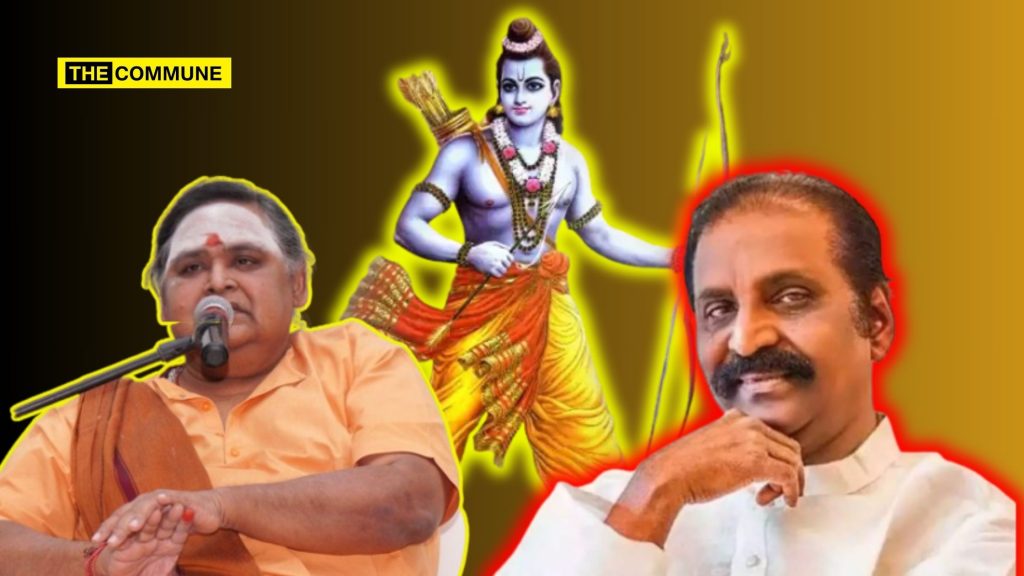
A few days ago, sexual harassment accused Vairamuthu was awarded the Kavi Chakravarthy Kamban Award by DMK MP Jagathrakshakan’s Azhwar Research Centre. Among the dignitaries present on the stage were spiritual speaker Ilangai Jeyaraj.
Ilangai Jeyaraj also referred to by the name Kambaviridhi for his scholarship in Tamil literature and scriptures, mentioned at another event that he was pained to hear the derogatory remarks made about Lord Rama at the preceeding event.
Ilangai Jeyaraj said, “I keep asking myself one question. When we organise a function, gather an audience, and have a speaker address us, is it all only for the purpose of belittling a great character? I do not understand. If a great poet like Kamban has elevated a certain character, and we, using our so-called intelligence and interpretations, try to bring that character down, is that our real objective? If that is the case, then what is the need to even hold such an event? On the very first day of the event, there was one poet I really admire, Vairamuthu. There is no doubt at all that he is a great poet. That day, he spoke very appreciatively about me. But when he spoke about the “Vali Vadham” episode (killing of Vali), he said something that pierced my heart. He said, in the case of Vali Vadham, he wanted to protect Rama from being accused, so he argued that Rama was not guilty because Rama did not have “freedom of intellect” (decision-making independence). In other words, it means that by portraying Rama as a person of unsound mind, we can save him from this moral wrongdoing. For this, he referred to the word “thegaththan thegaththanan” in the text, searched in the dictionary, and concluded that it meant “one of lesser intellect” or “without freedom of thought.” When I heard that, I felt a pain in my heart. We must uplift those who are low, not bring down those who are already great. That is very important. Literature itself is born for that purpose. I could very well stage a scene saying “Rama, are you too a criminal?” and walk away after branding him as guilty. But I ask, would Kamban, who begins his very work calling him “Kaasil Kottrathu Raman Kathaiyaro” (the story of victorious Rama in Kasi), start a poem like that only to accuse Rama later? If Kamban says Rama is guiltless at the start, yet later there seems to be fault, then there must be some deeper meaning. If we fail to think about that, we lose the qualification to truly read an epic. So, whenever we come across any scene where blame is ascribed to Rama, we must approach it with the thought, “There is no justification for him to commit wrong.” That is how I always look at it. When I teach my students Thirukkural, I tell them: “You are all intelligent, and sometimes you may cleverly find a mistake in Parimelazhagar’s commentary.” But I also tell them, “Do not do that casually. It’s not wrong to spot an error, but you must first be certain that it is impossible for Parimelazhagar to have erred. If he has never made mistakes before or after, why would he make one here? If something appears wrong, search for the hidden correctness within.”
That is very important. That is the right way to study. It takes no great intelligence to insult and dismiss a character in an epic. But if a character seems to be lowered in stature, the real intelligence lies in elevating them again. That is what true interpretation is for.”

What Sexual Harassment Accused Vairamuthu Said
Speaking at the Chennai Kamban Kazhagam event during the organisation’s 51st year celebrations, Vairamuthu explained the Tamil poet Kamban’s Kambaramayanam, saying Kamban “saved Rama” by portraying him as having lost mental clarity after being separated from Sita. This, he claimed, was akin to the IPC’s provision that a person of unsound mind cannot be held criminally liable. He says, “The crime committed by a person who has lost his mind is not a crime. The Indian Penal Code Section 84 of the Indian Penal Code says that a person who has lost his mind due to a mental disorder cannot be held guilty of an act committed by him. The message of Section 84 of the Indian Penal Code is that whether Kamban knows this or not, he does not know the law. He knows society, he knows psychology. With this forgiveness, a criminal named Rama is also freed. He forgives Rama and makes Rama a human being. Rama becomes a human being at that place, while Kamban becomes a god. The character is a human being; the creator is God. This is the difference between a character and a poet.”
Subscribe to our channels on Telegram, WhatsApp, and Instagram and get the best stories of the day delivered to you personally.