In the complex arena of international diplomacy and political optics, even offhand remarks can uncover significant undercurrents. A recent clip featuring a discussion between Indian-American scholar Prof. Muqtedar Khan and Pakistani commentator Dr. Qamar Cheema has drawn attention to a lesser-known detail of Congress leader Rahul Gandhi’s 2023 trip to the United States a trip already surrounded by political scrutiny.
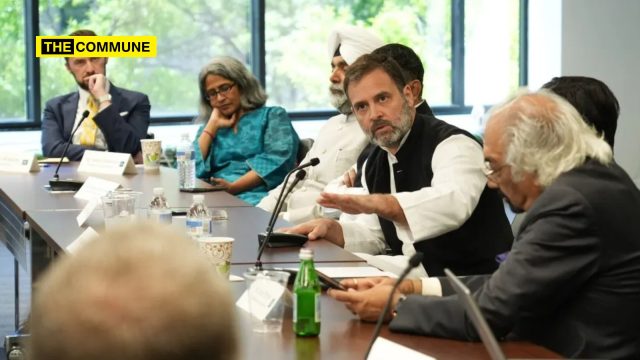
In the conversation, now circulating widely on social media, Professor Khan recounts an unexpected incident during a visit to the Hudson Institute in Washington, D.C. As he arrived at the venue, he discovered it was closed to outsiders due to an ongoing seminar by Rahul Gandhi. While waiting to gain access, Khan says he was joined by a man who was also attempting to enter. That man turned out to be none other than Sheikh Meshaal bin Hamad Al-Thani, the Qatari Ambassador to the U.S. According to Khan, Ambassador Al-Thani informed him that he had personally arranged Gandhi’s event at the think tank.
The claim that Qatar’s ambassador hosted a closed-door event for Rahul Gandhi at a prominent U.S. policy institution has raised questions about foreign influence and political intent. Qatar, while a key U.S. ally, has been accused of backing Islamist movements and hosting groups like Hamas, considered a terrorist organization by several countries. Given this context, the reported involvement of a senior Qatari diplomat in organizing a platform for a leading Indian opposition figure has sparked concern among foreign policy observers.
Remember Rahul Gandhi’s 2023 US trip before PM Modi’s state visit?
He met Soros-funded hindu hater Sunita Viswanath & Muslim Brotherhood linked IAMC at @HudsonInstitute – meeting reportedly arranged by Qatar – a notorious islamist state, not “friendly” to India.
Question why. pic.twitter.com/IurKrJYr39
— Viktor (@desishitposterr) September 18, 2025
Controversial Associations Of Rahul Gandhi With Sunita Viswanath In Hudson Institute
Photos from the Hudson Institute event show Rahul Gandhi seated next to Sunita Viswanath, co-founder of Hindus for Human Rights (HfHR), an organization that has often taken critical positions on Indian policy and Hindu nationalist politics. HfHR has been linked to funding from George Soros’s Open Society Foundations and associations with groups like the Indian American Muslim Council (IAMC), which has been accused of ties to extremist networks.
Viswanath has drawn criticism in the past for controversial comparisons and commentary. In a Janmashtami op-ed published by The Wire, she likened the suffering of Palestinians in Gaza to Hindu epics, even comparing Israel to Kansa a parallel many found offensive. Her group has hosted events equating Hindu identity with “supremacy,” supported the “Dismantling Global Hindutva” conference, and circulated material during Prime Minister Modi’s 2023 visit to the U.S. that critics say was intended to undermine India’s image.
Foreign Funding, Political Messaging, and Echoed Rhetoric
Analysts argue that Gandhi’s appearance alongside figures like Viswanath wasn’t accidental. His messages at these forums particularly at Hudson echoed narratives long pushed by U.S.-based advocacy groups critical of the Indian government. These included sharp critiques of the Citizenship Amendment Act (CAA) and NRC, reinterpretation of “Hindutva” as a threat distinct from “Hinduism,” and portrayals of the BJP as authoritarian.
Critics suggest these positions align with talking points promoted by HfHR, IAMC, and even international media funded by foreign philanthropists with known political agendas, including George Soros. These overlaps have raised concerns over the extent to which foreign narratives are influencing domestic political discourse.
The Unexplained White House Visit
Further adding to the speculation was a report by journalist Seema Sirohi in The Economic Times, revealing a discreet meeting Gandhi had at the White House during the same trip. The visit, notably absent from official Indian briefings, has prompted questions about protocol and transparency. Who Gandhi met, and what was discussed, remains undisclosed.
Prominent voices have also noted the presence of individuals connected to Khalistani, Kashmiri separatist, and Pakistani lobbying circles at various events on Gandhi’s U.S. itinerary. Some members of the Indian diaspora have expressed concern that such associations could impact India’s international image or even interfere in electoral politics.
Patterns of Seeking Foreign Validation?
This isn’t the first time Rahul Gandhi has been accused of inviting international commentary on India’s internal matters. In 2023, he delivered a speech at Cambridge University suggesting that democracy was under threat in India and that Western nations should intervene. In 2021, during a Harvard event, he asked U.S. officials to speak out on Indian issues, a move that drew diplomatic criticism.
Past engagements including undisclosed meetings with Chinese officials during his 2018 visit to Kailash Mansarovar have also fueled speculation about Gandhi’s foreign outreach strategies and their implications for national sovereignty.
A Coordinated Strategy?
Taken together, these developments have led some analysts to propose that Gandhi’s U.S. tour may have been more than a diaspora engagement exercise. With Qatar reportedly facilitating events, Soros-funded organizations shaping the narrative, and Islamist-linked lobbies amplifying his message, a broader strategy may have been at play one aimed at reshaping the global perception of India ahead of critical elections.
The links to controversial entities and figures, the overlap of narratives, and the Qatari ambassador’s alleged involvement raise deeper concerns about foreign influence in Indian politics. If true, this convergence of diplomatic, ideological, and political forces paints a complex picture of modern opposition politics in a globalized world.
What Comes Next?
As the clip featuring Prof. Muqtedar Khan continues to make the rounds online, public and media scrutiny of Rahul Gandhi’s foreign engagements is likely to intensify. Questions of transparency, foreign lobbying, and political alliances both at home and abroad will continue to shape the debate around the role of India’s opposition in the international arena.
Whether this was routine diplomacy or something more orchestrated remains to be seen. But in an era where narratives can shift global perceptions, the need for clarity and accountability from public figures has never been greater.
(With inputs from OpIndia)
Subscribe to our channels on Telegram, WhatsApp, and Instagram and get the best stories of the day delivered to you personally.