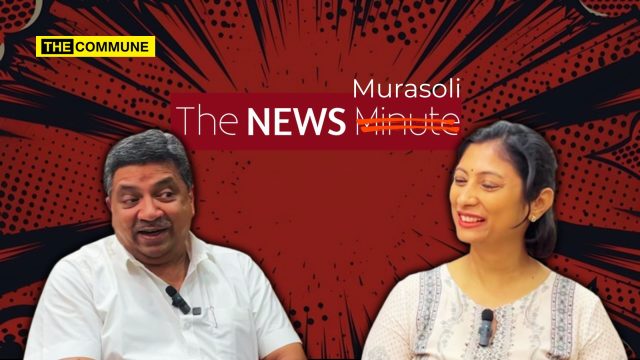
The News Minute’s video “interview” with Palanivel Thiagarajan is a masterclass in how not to do political journalism. It is framed as a probing conversation with a powerful DMK leader, but plays out as an indulgent, almost fawning chat show that lets a senior politician glide through with zero real scrutiny. For viewers who live in Madurai’s garbage‑strewn streets and crumbling civic infrastructure, the contrast between the city’s reality and the interview’s tone is staggering.
Right from the opening, Pooja Prasanna, the interviewer for TNM signals whose side it is on. The first prompt is not about governance, Madurai’s condition, or state finances. Instead, the interviewer flatters him: “I saw a bunch of interviews before I came and I could see that you’re quite bored with repetition of questions. What question now seems like a cliché that you’re just annoyed with?” This is not a journalist interrogating power; it is a host inviting her guest to complain about other journalists. PTR happily bites, ridiculing “northern channels” for their “scripted” questions. TNM’s Pooja lets him posture as the reasonable victim of shallow media, without for a second acknowledging that they are about to do something even worse: ask easier questions than the channels he is mocking.
From there, the pattern is set. PTR launches into long monologues about how crime has fallen “in every dimension,” how the DMK government is going into this election with “relatively such a good track record and relatively low anti‑incumbency.” Any serious interviewer would interrupt here: What crime data? What about specific categories? How does this square with public perception? Where exactly is this supposedly low anti‑incumbency visible, especially in Madurai? Pooja Prasanna does none of that. There is no demand for numbers, no challenge, no local reality check. The claim is allowed to float, glossy and untested.
Instead of anchoring the conversation on hard questions of governance, the interviewer feeds PTR one ideological softball after another. “You have positioned DMK versus BJP this election…” she says, inviting him to expand on his favourite theme of DMK as the noble defender of federalism against a homogenising BJP. He obliges, waxing at length about “Hindi‑Hindutva” politics, “one nation, one X,” and the supposed philosophical purity of regional parties. At no point does TNM press him on DMK’s own centralising instincts, its track record on dissent, or the party’s long history of patronage and corruption. The interviewer’s role is reduced to nods and prompts that tee up his talking points.
The most glaring omission is Madurai itself. PTR is not just any DMK figure; he is the face of the party’s technocratic, reformist image and a key representative from a city that routinely ranks among Tamil Nadu’s dirtiest and most neglected. Yet TNM never asks: Why is Madurai still choking on filth? Why do basic services lag so badly? Why does a minister who boasts of “bringing more change in the way government functions in two years than in any 20 years” have so little to show in his own backyard? Viewers get a sweeping lecture on federalism and identity politics, but not one tough, concrete question on garbage, sewage, public health, or municipal collapse in Madurai.
Instead, Pooja keeps circling back to topics on which PTR is perfectly comfortable: electoral “technicals,” alliance arithmetic, and the supposed contradictions of the BJP and Congress. She asks, for instance, whether the DMK’s positioning “suits the narrative,” handing him an easy chance to sound strategic and reflective, rather than pinning him down on failures. Later, when discussing a celebrity‑turned‑politician, the question is framed again in flattering, abstract terms: is his entry “a good thing for democracy,” can he “channelize the angst and expectations of the youth?” These are seminar‑room prompts, not the questions a hard‑nosed reporter asks a sitting minister accountable for grim urban realities.
Even when there is an opening to bring in accountability, TNM retreats into comfortable territory. PTR boasts about how, as minister, he was given charge of “finance and pensions,” “personnel and administrative reforms,” “planning and development economics and statistics,” and claims he delivered sweeping changes in “revenue management,” “audit,” and “litigation management.” A serious interviewer would push: If all this reform is real, why does it not show up on the ground? Why do ordinary citizens still see potholes, piling garbage, and broken services? Instead, TNM lets him brag about his degrees, his work experience in the US or his family background. TNM basically functions as a PR amplifier.
The style of questioning is revealing. This is an interview filled with agreeing noises and soft, open‑ended cues designed to keep PTR talking, not corner him. When he asserts that northern media follow a “script,” TNM never turns the mirror around and asks whether DMK leaders themselves repeat scripted talking points about federalism and identity to dodge uncomfortable material questions. When he paints BJP as uniquely dangerous on identity politics, there is no follow‑up about DMK’s own history of using identity and language politics for mobilisation. The ideological echo chamber is complete: TNM and PTR speak the same language, share the same villains, and never disturb each other’s comfort.
For a platform that likes to brand itself as independent and fearless, this video is damning. It is not just that TNM fails to ask about Madurai’s condition. It is that the outlet is visibly more interested in showcasing PTR’s eloquence and ideological line than in extracting answers that matter to citizens. The entire exercise smells of access journalism, where the price of getting a powerful guest on camera is surrendering adversarial intent. The result is a friendly, meandering conversation that flatters PTR’s self‑image while ignoring the lived reality of the people he represents.
In the end, this is the core problem with TNM’s interview: it treats a senior minister, from one of Tamil Nadu’s most visibly mismanaged cities, as a pundit rather than as a public servant. It lets him lecture on the evils of Delhi, the dangers of homogenisation, and the virtues of regional parties, while Madurai’s trash heaps and broken drains never once enter the frame. That is a soft‑focus promo reel for power masquerading as accountability and viewers deserve much better.
Subscribe to our channels on WhatsApp, Telegram, Instagram and YouTube to get the best stories of the day delivered to you personally.