


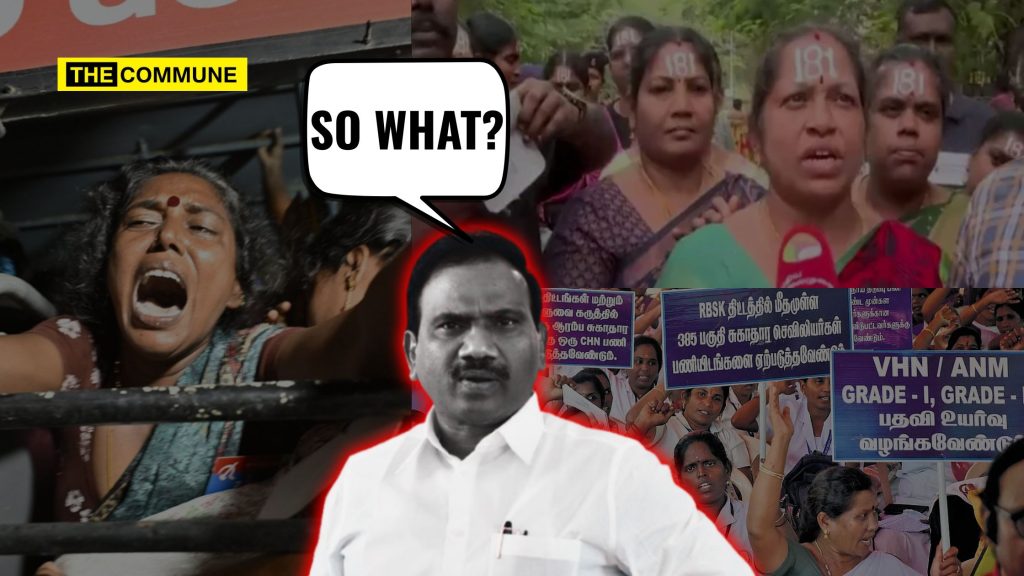
At an interactive meeting with youth in Tamil Nadu, DMK Member of Parliament A Raja was confronted with pointed questions over what participants described as the party’s “selective social justice” approach in handling protests by different sections of society.
During the interaction, a young man narrated what he described as an “imaginary story” to question the DMK government’s contrasting responses to protests by government employees and sanitation workers. Drawing a parallel with a landlord hosting a feast ahead of an election, he said that while government employees who protested were swiftly appeased with the restoration of the old pension scheme and an allocation of ₹13,000 crore, sanitation workers faced police action, arrests, and lathi charge when they protested.
Referring to the death of a sanitation worker during protests near the Cooum river, the questioner said that despite the loss of life, the government cited a “resource crunch” and did not address their demands. He pointed out that sanitation workers, largely Dalits and women, lacked strong unions or political backing, unlike government employees. Framing his question, he asked whether extending different approaches to different groups could truly be called social justice, or whether it amounted to “selective social justice”.
Responding to the criticism, A Raja said, “There has been a 20-year-long struggle by government employees to restore the pension that was earlier given to them.” He added that sanitation workers’ issues existed across sectors and could not be described as a single nationwide movement, while maintaining that he was not denying their problems.
“Work is being done for them; talks are ongoing. Good news can come at any time. Before that good news arrives, there is no need to label this as ‘selective social justice’,” Raja said. Emphasising the timeline, he stated, “After 20 years, we have solved this [pension] issue. For 20 years, even Jayalalithaa could not solve it, Edappadi Palaniswami could not solve it, even when Kalaignar was in power, it could not be solved.”
Addressing the sanitation workers’ protests, Raja said, “As you said, it has been only six months [since the sanitation workers’ protest]. After six months – tomorrow morning – see the newspaper, maybe you will see good news.” He added that even he did not believe the pension scheme would materialise until it finally did, arguing that patience was required.
Raja also attributed the state’s financial constraints to what he described as pressure from the Union government. “The financial crisis we are facing is one that no other government has been subjected to – the Union government and its ‘friendly’ governments have imposed this crisis on us,” he said, claiming that funds due to Tamil Nadu were being withheld.
When the host intervened, she reframed the audience’s question by pointing out that the DMK had promised in its 2021 election manifesto to resolve the pension issue, asking what happened to that commitment and whether actions taken now were linked to upcoming elections.
In reply, Raja said, “There is nothing wrong if a political party makes moves towards an election. The question is only whether we did what we promised or not.” Acknowledging delays, he said, “We could not do it; we could not. Now we have found a solution.” Explaining the contributory pension model, he admitted that it faced criticism but insisted a solution had finally been reached.
Responding to why the issue could not be resolved earlier, Raja said, “We admit it. So what? We did not have money in hand. So what? We had no money. Now money has come, so we have done it.” He likened the criticism to questioning why someone eats today and not yesterday.
When asked how the DMK would respond if similar questions were raised during the next election campaign, Raja concluded with the remark, “Only the child who cries gets the milk. There is nothing wrong in demanding any right and getting it by asking.”

Subscribe to our channels on Telegram, WhatsApp, and Instagram and get the best stories of the day delivered to you personally.