


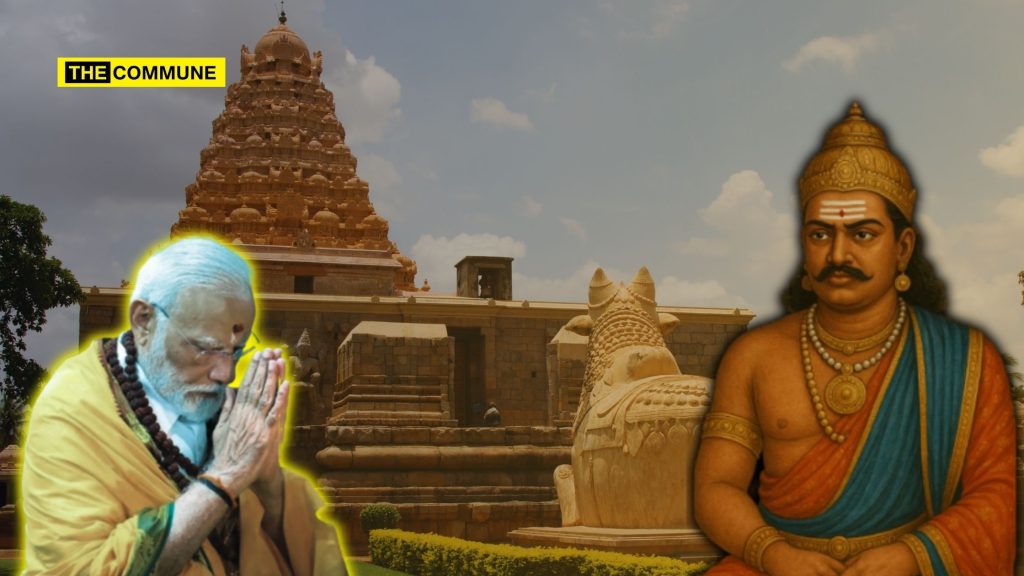
The recent visit of Prime Minister Narendra Modi to Gangai Konda Cholapuram, commemorating both the birth anniversary of Rajendra Chola and the thousand-year milestone of his maritime expedition, seems to have unsettled certain ideological quarters.
In response, there have been attempts to downplay the Chola legacy and portray them in a negative light. A recent article in a newspaper is one such example, riddled with factual inaccuracies, misleading interpretations, and anachronistic judgments about Rajendra Chola’s Gangetic expedition and his reign.
Brilliant from @tallstories, as always. On what the Cholas really were and what they are now being fit into by Modi. pic.twitter.com/cpcigCmnjB
— Sushant Singh (@SushantSin) August 6, 2025
It is no surprise that a book by Kanisetti is quoted frequently in the article, a work that contains more fiction than verified history about the Cholas.
Let us be clear. No one claims that ancient India was devoid of warfare. The epic battle of Kurukshetra itself is a testament to this. Many dynasties ruled various parts of the subcontinent, and conflicts among them were not uncommon. In Tamil Nadu, the Cheras, Cholas, and Pandyas were engaged in frequent battles since the Sangam era. However, these conflicts were typically confined to the battlefield. Yes, there were occasional excesses, as is common in the course of wars, but they remained exceptions.
A verse from the Sangam classic Purananuru captures the ethics of war. The Pandya king Palyagasalai Muthukudumi Peruvazhuthi, known for his fierce campaigns, declared through his army, “Cows, Brahmins devoted to natural duties, women, the sick, and those without heirs, please move away as our arrows will be unleashed soon.” This was the war dharma practiced by our kings.
The author of the article does not seem to be aware of what actually happened at Gangai Konda Cholapuram just a week ago, let alone have the authority to write about events from a thousand years ago. The article begins by claiming that the Prime Minister carried “a traditional kodam or jug of water from the Ganga to pour into a tank.” In reality, the Gangajal was used for performing abhishekam to the presiding deity, Gangai Konda Choleeswarar, not poured into a tank. This is clearly visible in the visuals from the event.
The article further states that “the BJP adopted the Tamil god Murugan,” indicating its ideological slant. Gods do not belong to any one language or region. Murugan, also known as Kartikeya or Skanda, is revered across India. Inscriptions refer to a Murugan temple in Abbottabad, Pakistan. The Yaudheyas worshipped Skanda as their guardian deity and minted coins bearing his image. The Guptas built several temples for Skanda. Thus, the label of “Tamil God” is both misleading and divisive.
The article makes another fundamental error by stating that Rajendra Chola conquered the Cheras and Pallavas. The Pallavas had ceased to exist as a ruling power long before Rajendra’s time. Aditya Chola had defeated the last Pallava king, Aparajitha, in 897 CE, marking the end of the Pallava dynasty. There was nothing left for Rajendra to conquer on that front.
It goes on to claim that Rajendra was seeking ritual confirmation of his status as emperor. This demonstrates a complete ignorance of Chola records. The Thiruvalangadu copper plates clearly state that the purpose of Rajendra’s northern expedition was to bring the sacred waters of the Ganga to sanctify his newly established capital and temple at Gangai Konda Cholapuram.
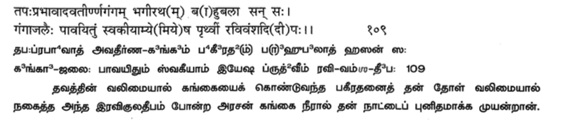

It was customary to consecrate a new capital or temple with sacred water. Rajendra undertook a Digvijaya, a ceremonial conquest, to bring the Ganga water. Along the way, he faced resistance, particularly from the Western Chalukyas who had allied with northern kings such as Indraratha. Rajendra, in turn, had alliances with King Bhoja of the Paramaras and Gangeya of the Kalachuris. A strong army was dispatched to ensure safe passage. The military engagements were incidental to the main objective of sanctification, as reiterated in the Karandai and Esalam copper plates, which also compare Rajendra with Bhagiratha who brought Ganga to earth as per our Puranas.
The article then cites Kanisetti’s book to claim that Rajendra’s army “killed, raped, and plundered” its way to the north. This is an unsubstantiated and baseless claim. None of Rajendra’s inscriptions or Meikeerthi mention such acts. They only document victories over kingdoms. The accusation that Rajendra’s army sacked temples and stole idols is equally baseless. Rajendra was a devoted Shaivite, calling himself “Shiva Charana Sekhara.” Why would such a ruler desecrate temples? For instance, a temple at Mahendragiri in Odisha contains a Tamil inscription by Rajendra, and the temple stands intact even today. In fact, Chola kings often made donations to temples in conquered regions, a fact that completely contradicts the article’s narrative.
The article also mocks the practice of bringing idols from other regions, quoting Kanisetti’s speculative statement that it is “difficult to believe that these idols were obtained without extreme violence.” This is mere conjecture. Chola records mention that some idols were given as gifts. At Gangai Konda Cholapuram, Rajendra built a separate shrine for the Mahishasuramardini idol brought from Chalukya territory, where she was revered as a war goddess.

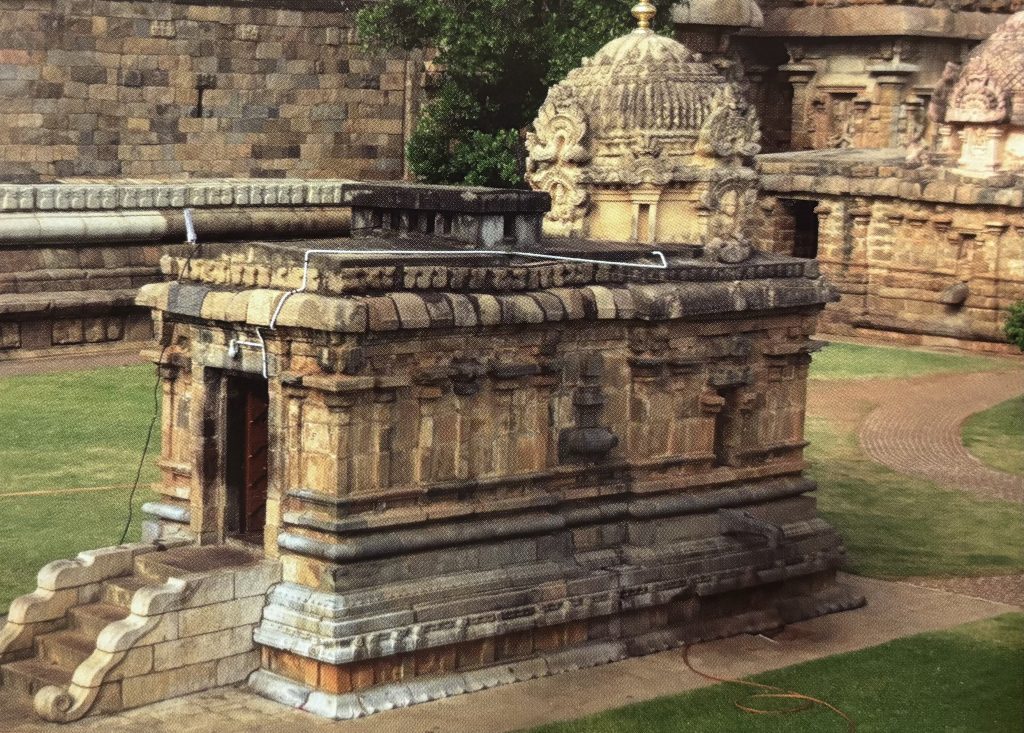
A Ganesha idol from Bengal is still worshipped as “Gangaikonda Ganapathi” in a Kumbakonam temple. These idols were housed in temples and treated with reverence. Calling temples “less respectable places” only reveals the bias of those unfamiliar with temple traditions.
The article makes another glaring factual error in stating that “in 1025, Rajaraja stormed Kedah in Sumatra,” when in fact, Rajaraja had passed away in 1014. Kedah is in the Malay Peninsula, not in Sumatra. Moreover, the Srivijaya Empire was not thrown into chaos for a century. In fact, post-expedition, the Cholas maintained cordial relations with Srivijaya. Inscriptions record that Vira Rajendra mediated a succession dispute within Srivijaya, and Kulottunga I even spent time in the region and built temples there.
It is also worth noting that the celebration of Adi Thiruvathirai at Gangai Konda Cholapuram was initiated by local history enthusiasts, not by Dravidian ideologues. Ironically, the same ideologues have in the past accused the Cholas of favouring Brahmins, a baseless allegation with no historical support.
The article includes a veiled comparison, implying that Rajendra’s expedition was akin to the later Islamic invasions. This is not only historically inaccurate but deeply offensive. The invasions led by the Delhi Sultanate and the Mughals were marked by temple destruction and massacres. Ulugh Khan, also known as Muhammad bin Tughlaq, is recorded to have killed 12,000 devotees. According to Amir Khusrau, Malik Kafur destroyed the Chidambaram temple and slaughtered Brahmins who defended it. There is no comparable evidence of such violence during Rajendra’s campaign. Moreover, the Cholas never annexed northern territories, as that was never their objective.
To conclude, at a time when the country is rediscovering its civilisational legacy through events like the Gangai Konda Cholapuram celebrations, attempts to distort history and equate dharmic kings with foreign invaders are deeply disingenuous. The facts of history do not support the narrative that Hindu kings were looters or temple destroyers. These are speculative imaginations of individuals who pose as historians without offering credible evidence.
TS Krishnan is a Tamil scholar, historian and author of the book The Cholas.
Subscribe to our channels on Telegram, WhatsApp, and Instagram and get the best stories of the day delivered to you personally.